
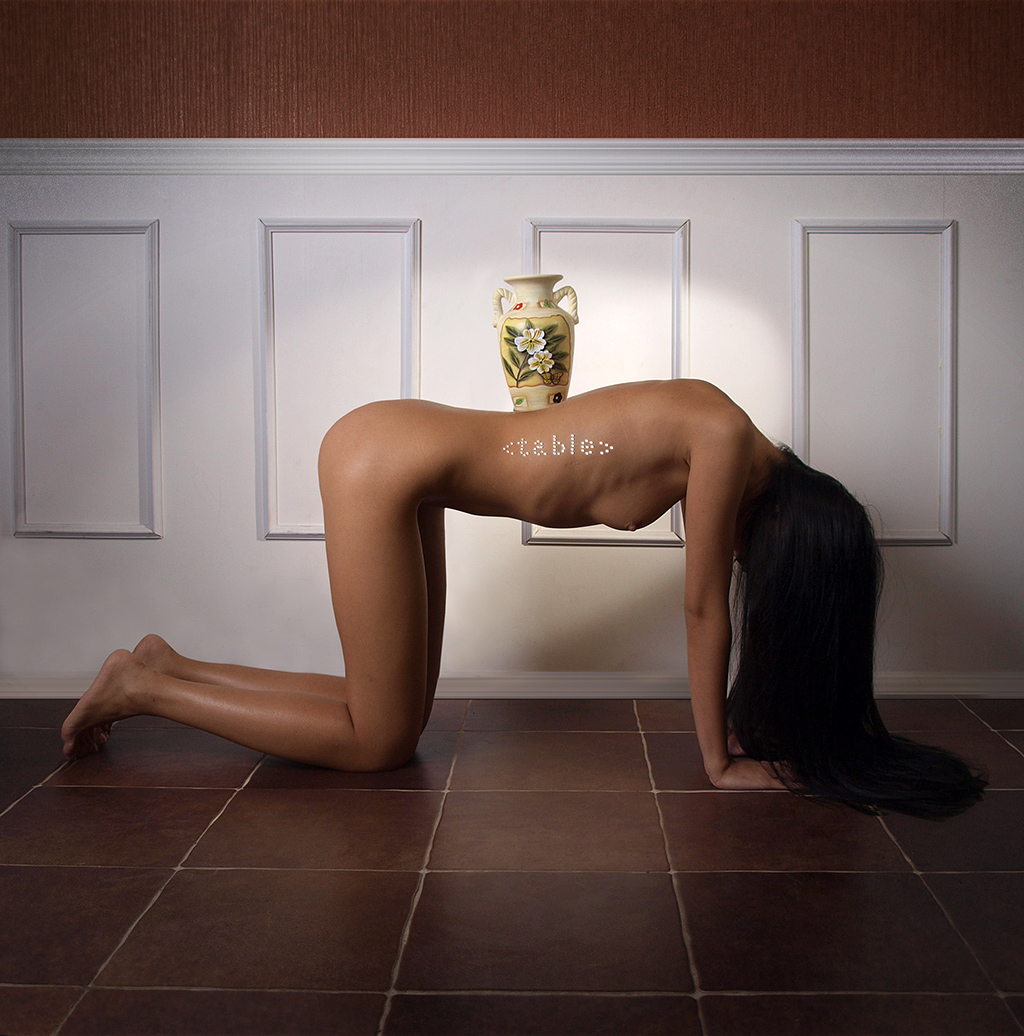
Human furniture turns a person’s body into a tray, a footstool, a chair, a table, or a cabinet. The paraphilia is called forniphilia, not “furniphilia.” It shows up in fine art and in bondage at the same time. It did not start as an art-world invention and then trickle down. In 1969 the British pop artist Allen Jones made three sculptures, Hatstand, Table, and Chair, casting semi-naked white women as furniture. When the works were auctioned at Sotheby’s in 2012, feminists protested the use of women’s bodies as functional décor. The Norwegian artist Bjarne Melgaard later made a sculpture of the same shape, titled Chair, depicting a Black woman. In 2014 Dasha Zhukova, partner of the Russian billionaire Roman Abramovich, was photographed sitting on Melgaard’s chair. The picture collided with race and power. Zhukova apologized and said she utterly abhors racism. The Japanese fetish artist Namio Harukawa turned the gallery habit around: voluptuous women dominate, and men are the furniture.
Jeff Gord, time limits, and what to watch
Bondage artist Jeff Gord coined the word forniphilia. He ran the site House of Gord and documented elaborate builds that made people into tables, lamps, and other fixtures. As a BDSM practice this is not a still photograph. The person is tied tight and expected to stay immobile for a long stretch. Gord said a session generally should not run past two hours, and that only experienced people should do it. The maximum depends on the tie. Gags show up often here. A forniphilic gag is built for sexual objectification and erotic humiliation. Making the person quiet is secondary. Check breathing, circulation, and joint strain often. If breathing or circulation goes wrong, stop. If the same scene also includes suspension or breath play, those need a way to call a halt and someone experienced in the room. The long hold is already a physical risk. Adults negotiate it. It is not a decorating project.
Film, television, and the power in the pose
The image is older than fetish websites. In the 1971 film A Clockwork Orange, a room is furnished with tables shaped like nude women, an early mainstream picture many viewers still attach to the trope. Episode 7 of the 2021 Netflix series Squid Game puts anonymous VIPs, watching the blood sport, among living furniture in elaborate body paint. The still bodies are there to show elite decadence.
For adult BDSM players the point is power, not interior design. Who gets to sit. Who has to hold still. How long that hold can last. Whether the scene is an art photo, private play, or both. The body doing the job of a chair is still a person who has to breathe.

![[Art Video] 1931 Forbidden White Lily Ward Enema Angel Butches Aya Iijima, Nana Okamoto](https://bdsmwild.com/wp-content/uploads/2026/08/Art-Video-1931.jpg)