
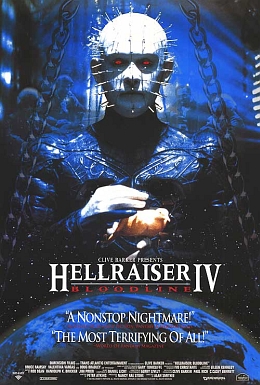
Hellraiser: Bloodline (also Hellraiser IV: Bloodline) is a 1996 American science-fiction horror film—the fourth Hellraiser installment, functioning as both prequel and sequel. Directed by Kevin Yagher and Joe Chappelle, it stars Doug Bradley as Pinhead (sole remaining original cast linchpin), with Bruce Ramsay, Valentina Vargas, Kim Myers, and Adam Scott in an early major role. It was the last Hellraiser film released theatrically and the last with major official Clive Barker involvement until the 2022 reboot. Across 1796, 1996, and 2127, a toymaker’s bloodline builds the Lament Configuration and later a space-station trap meant to destroy Cenobites. Themes include time, toys and games, adultery, and slavery. After Yagher finished a cut, Miramax demanded new scenes; Chappelle completed reshoots that changed relationships, forced an earlier Pinhead entrance, added a happy ending, and cut about 25 minutes. Yagher took the Alan Smithee pseudonym. Released 8 March 1996 without critic screenings, it grossed about $9 million and drew negative reviews. For kink-horror readers, Bloodline is the franchise’s bondage cosmology epic: Angelique as temptation-era Hell versus Pinhead’s ascetic pain cult, with the LeMarchand line enslaved to the box they built.
Plot: 1796, 1996, 2127
2127: Engineer Dr. Paul Merchant seals himself aboard the Minos space station he designed and has a robot solve the Lament Configuration (destroying the robot). Guards seize him; he explains to leader Rimmer via flashback.
1796 Paris: Toymaker Phillip LeMarchand builds the Configuration for libertine Duc de L’Isle. L’Isle and assistant Jacques sacrifice a peasant girl and use her flayed skin to summon demon Angelique through the box. LeMarchand flees and designs a neutralizing second box. Returning, he finds Jacques has killed L’Isle and bound Angelique as slave so long as Hell’s wishes are not impeded. They kill LeMarchand; Jacques curses his bloodline for opening Hell’s portal.
1996: Descendant John Merchant builds a Manhattan skyscraper resembling the Lament Configuration. Angelique, refused a U.S. trip by Jacques, kills him as Merchant threatens Hell, fails to seduce Merchant, and tricks a guard into solving the box in the foundation—summoning Pinhead. They clash: she favors corruption by temptation; he is fanatically devoted to pain and suffering. Uneasy allies, they target Merchant before he finishes the Elysium Configuration—an anti-box of perpetual light to seal Hell’s gateways. Pinhead tires of seduction and threatens Merchant’s wife and child. Angelique, used to Earth decadence, wants Merchant to fire Elysium and free her from Hell’s new austerity; his flawed prototype fails. Pinhead kills Merchant; Bobbi Merchant opens the box and sends both back to Hell.
2127 again: Rimmer locks Paul away. Pinhead’s followers—now including enslaved Angelique—are already free. They slaughter the crew; Paul and Rimmer escape. The Minos is the perfected Elysium Configuration. Paul distracts Pinhead with a hologram, flees with Rimmer, and activates lasers and mirrors that fold the station into a massive box of perpetual light, killing Pinhead and company—this time, permanently (within the film’s claim).
Bloodline’s SM map is hierarchical slavery: Angelique owned by aristocrats then Pinhead; LeMarchands owned by the puzzle; Pinhead owned by Hell’s will yet more independent than she. Game-playing and seduction are weapons; light is the only hard safeword that works.
Cast
- Doug Bradley as Pinhead
- Bruce Ramsay as Philippe LeMarchand / John Merchant / Dr. Paul Merchant
- Valentina Vargas as Angelique / Peasant Girl
- Kim Myers as Bobbi Merchant
- Adam Scott as Jacques
- Christine Harnos as Rimmer
- Charlotte Chatton as Genevieve LeMarchand
- Mickey Cottrell as Duc de L’Isle
- Jody St. Michael as Chatterer Beast
- Courtland Mead as Jack Merchant
- Mark and Michael Polish as Siamese Twin Cenobites
Ramsay described Philippe as ambitious and seducible, John more self-aware, Paul weathered. Vargas nearly refused after Pinhead nightmares, then leaned into seductive evil. Angelique’s origin shifted in rewrites from independent black-magic summon to box-dependent. Jacques and de L’Isle (modeled on Sade and Gilles de Rais) swapped screen time as her origin changed. Bobbi mirrors Larry from the first film—spouse who suspects betrayal. Rimmer was rewritten female after other women were cut, including a Kirsty Cotton descendant as Paul’s love interest.
Production: Barker’s Three Eras, Smithee Ending
Barker wanted a fresh turn after two sequels. The shape-changing trap structure grew from Hellraiser III’s Lament-shaped building. Barker proposed three time periods; Peter Atkins (Hellbound, co-Hellraiser III) added LeMarchand back to the novella. Miramax greenlit without an outline. Paul Kane later called the screenplay ambitious and among the best sequels—linear timeline, bigger effects, violent Pinhead–Angelique war—until budget forced scale-back. Stuart Gordon left over artistic clashes; effects technician Kevin Yagher directed after Tales from the Crypt work, impressed by Barker’s vision.
Bradley joined first; lesser-known actors filled major roles. Gary J. Tunnicliffe (Image Animation) handled effects—Angelique as nun-habit-as-flayed-skin (Morticia Addams meets Sister Act); Pinhead makeup reverted toward the original look. Yagher contributed the Chatter Beast. Filming began Los Angeles August 1994 (I. Magnin Building, abandoned factory as station). Bradley called it “the shoot from hell”: cinematographer replaced by Gerry Lively, AD emergencies, illness, art and camera crews dismissed in week one—yet finished on time and budget.
Initial 110-minute cut (early 1995) displeased Miramax, who demanded earlier, larger Pinhead. Yagher declined reshoots and left. Joe Chappelle shot new material April–May 1995 (Atkins and Rand Ravich). Theatrical cut: 85 minutes, altered Angelique–Pinhead hostility into sexual tension, happy ending, Paul as narrator of ancestors’ tale. Yagher used Alan Smithee.
Themes, Score, Release, Reception
Kane maps time (non-linear bloodline knowledge), toys/games (box, computer Elysium, shoot-’em-up station, Pinhead’s “I am forever”), sex/death/adultery (Angelique’s temptation of Merchants), slavery/bondage across almost every relationship, and mirror imagery (twins, literal mirrors, Paul mirroring Pinhead to win). Daniel Licht’s score (released 19 March 1996) blends unconventional instrumentation and chorus.
No critic screenings. U.S./Canada: $4.5 million opening weekend (fifth place), $9.3 million total—last theatrical Hellraiser (D-to-V in UK). Inferno followed October 2000 on video. Home media: Dimension VHS/DVD 1996–2001; Echo Bridge Blu-ray 2011.
Rotten Tomatoes: 24% of 17 reviews (average 4.1/10). Metacritic: 21/100. Contemporary pans: “pointless mess,” gross but not frightening effects, incoherent and wretchedly acted except Bradley. Retrospectives are kinder: Dread Central 2.5/5 half-baked compromise; Entertainment Weekly B for interesting chaos; religion scholar Douglas E. Cowan called it his favorite for expanded mythology; Katie Rife (A.V. Club) “entertaining mess” fans passionately defend.
Bloodline still matters as the film that tried to make the puzzle-box universe a multi-century SM theology—temptation versus pain, light versus hooks—before studio panic sanded it into a shorter, happier, Pinhead-forward product.
Slavery, Seduction, and the Broken Theatrical Cut
In Kane’s thematic map, almost every major relationship is bondage by another name. Angelique is slave first to de L’Isle’s black-magic summoning, then to Jacques’s control, then—after rebelling against Hell’s new pain-ascetic regime—to Pinhead’s Order. The LeMarchand bloodline is cursed and chained to the box their ancestor built; Phillip’s ambition and John’s skyscraper obsession both read as erotic thrall to Angelique and to the Configuration itself. Pinhead declares “I am forever” even as the Elysium Configuration’s perpetual light folds him into a killing box—immortality as branding, light as the one force that ends the scene without negotiation.
The theatrical cut blunted the Angelique–Pinhead war that Atkins and Yagher had written as ideological: old Hell of long temptation versus new Hell of efficient suffering. Reshoots pushed sexual tension into the gap and forced Pinhead onscreen earlier so marketing would not wait. What remains is still the series’ most ambitious cosmology for kink-literate viewers—three centuries of toymakers, slaves, and engineers trying to close a door their bloodline opened—plus the bitter production irony that the only Hellraiser film to reach space still ended with an Alan Smithee credit and a happy ending the original director refused to own.
What Survives for Franchise Readers
Keep the facts: 1796 LeMarchand and L’Isle; 1996 John Merchant’s Configuration tower; 2127 Paul Merchant’s Minos as perfected Elysium; Angelique versus Pinhead; Bobbi sending both back with the box; lasers, mirrors, and a station that becomes a giant puzzle. Keep the box-office and release: March 1996, about $9.3 million U.S., last theatrical Hellraiser before the direct-to-video era. Keep Tunnicliffe’s effects fingerprints—he would later write Revelations and write/direct Judgment. For adult audiences, Bloodline is the entry where Hellraiser stops being only a haunted house and becomes a hereditary SM contract written in toys, light, and chains.