
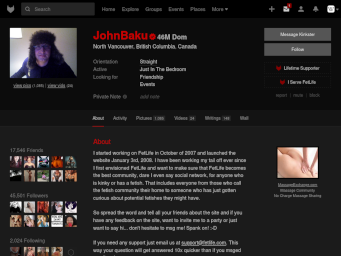
FetLife sells itself as a social network for people into BDSM, fetish, and kink, not as a swipe-only dating app. From the late 2000s it became the largest and most argued public square in that world. Profiles, groups, events, blogs, photos, and relationship lists are the core. Private messages are one piece of that. Adult players who want community infrastructure, rather than only a matching machine, get more surface to stand on. Fantasy and role-play there belong to adult members. They are not a manual for harming minors or for committing real crimes.
From FriendsWithFetishes to a separate site
The site went live on 3 January 2008. John Kopanas, username John Baku, a software engineer in Montreal, Quebec, built it. He had trouble finding partners who shared his sexual interests, and he had already made FriendsWithFetishes. While working on that project he decided the new version should be its own site, and he named it FetLife. James Golick was chief technology officer. In 2009 Kopanas received the Community Choice (Man) Award at the Pantheon of Leather Awards. Leather and kink circles were already treating the platform as community memory, past the point of startup chatter.
Profiles, groups, and a search that will not fish
A profile can show one or more sexual orientations, D/s roles, and fetishes from the official list. It can also list relationships with other members, so poly households and people in a dynamic can be visible. Members open or join groups that work like forums, send direct messages, post events, and publish blogs, photos, and videos either in public or to friends only. Unlike mainstream dating apps, search is deliberately narrow. You cannot easily hunt people by tight combinations of age, gender, and similar filters. Blogs can be searched only through tags the poster chose. The aim is less predatory trawling and more of a social graph built around interest groups. Critics still argue over whether that limited search reduces harm or only hides it. Either way, it is part of how FetLife describes itself.
Payment rails, accusation bans, and racism
In January 2017, under pressure from a payment processor, FetLife deleted hundreds of groups whose names included words such as blood, needles, rape, and incest, and it temporarily shut off the creation of new groups. The Electronic Frontier Foundation called that censorship: payment rails deciding what kink communities may discuss, including fantasy and consensual non-consent role-play. Adult platforms get policed through payment processors as well as through criminal law.
In 2012 the site was already in a fight over a rule that members must not make criminal accusations against another member in a public forum. Survivors objected that deleting posts which name alleged predators stops people from warning each other. The site’s answer was that a public accusation, if false or impossible to prove, can be libel. Community self-defense and due process hit each other here. How you judge the rule depends on whether you want open warning boards or allegations pushed into private channels and the legal system.
The terms of service ban promoting racism. Members still say the site has not dealt with racist content well enough. During the George Floyd protests, people reported more “white power” symbols, Nazi imagery, and white-supremacist discussion. Race play on the official fetish list splits the membership. Some defend it as consensual exploration of historical trauma and power. Others call it racism and fetishization wearing kink clothes. The argument is not unique to FetLife. The size of the site makes it loud.
A murder headline, and the square that stayed
In April 2017 Brendt Christensen, who killed Yingying Zhang, used FetLife to look through discussion forums on abduction and kidnapping. After that, the site removed several hundred fetish tags. The fight sharpened over whether extreme fantasy labels help real-world harm. Kink educators already know that argument. It returns with every media panic about consensual non-consent, knives, or abduction role-play.
Purges, scandals, and smaller niche apps have not removed FetLife as the large public square of online BDSM. Organizers still post munch notices. Members still argue house rules. Photographers still tease portfolios and send traffic to paid sites. Scale is the advantage and the problem: more eyes, more community memory, more room for educators and for people who mean harm. Limited search will not stop a determined harasser. A ban on public accusations does not replace a court or a private warning network. Payment processors and news headlines can still rewrite the fetish list in a short time. The site remains infrastructure people actually use.
![[Fuji Kikaku] AS-01 Essence of Bondage 1 Abducted Yuri Yuri Haruhara (Essence of Tight Binding 1) fuji-0066 [Exclusive]](https://bdsmwild.com/wp-content/uploads/2026/08/AS-01-fuji-0066-Exclusive.jpg)
![Legend of Shima 125 Legend of Shima 125 Electric Current Piercing Single Whip -Shikou Shima- [Shima Planning]](https://bdsmwild.com/wp-content/uploads/2026/09/Legend-of-Shima-125.jpg)