
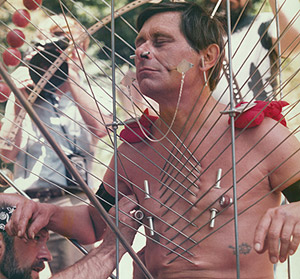
Roland Loomis, better known as Fakir Musafar (August 10, 1930 – August 1, 2018), is counted among the founders of the modern primitives movement. The American performance artist spent his working life on body modification, ritualized pain, photography, teaching, and publishing. That mix shaped piercing culture, suspension, and a visual language of extreme body play that many BDSM and fetish communities still use. In leather archives, piercing history, and modern primitives writing, he sits at the center for treating consensual bodily ordeal as art and as spiritual practice.
He said that from the age of four he often dreamed of past lives. Those dreams, together with anthropology he studied later, fed his fixation on changing the body. He served in the army during the Korean War. In the 1960s he had a short first marriage, and in 1966 or 1967 he tried flesh-hook suspension for the first time, working from anthropological sources. In 1977 he took the name Fakir Musafar.
The suspensions and hook pieces were not straight copies of older cultures. He rebuilt the rites from his own reading, and the performances carried real physical risk. The 1985 documentary Dances Sacred and Profane records the practice: many small skewers pressed into his upper body, then chest hooks holding him from a tree. He also had a cameo as the “man in the hotel room” in Die Jungfrauen Maschine (The Virgin Machine, 1988), and played a character named Fakir in My Father Is Coming (1991).
The 1989 book Modern Primitives gave a lot of space to Musafar’s work and helped record, spread, and define modern body-modification subculture. In 1990 he married Cléo Dubois, and that relationship ran through the work that followed. From 1992 to 1999 he published Body Play and Modern Primitives Quarterly, covering human branding, suspension, contortion, binding, and modern piercing. At the same time he led Fakir Intensives in San Francisco, passing technique and ideas on in person to modifiers and ritual players. In 2004 Arena Editions published the large-format book Fakir Musafar: Spirit + Flesh, photographs and the spiritual side of the work, ISBN 1-892041-57-X.
In May 2018 Loomis announced on his own website that he had terminal lung cancer. He died on the morning of August 1 that year. His wife, Cléo Dubois, first announced the death in a public Facebook post. Artforum later confirmed it with an obituary. In 1993 the National Leather Association International gave him the Steve Maidhof Award for national or international work. In 2019 he was inducted into the Leather Hall of Fame. He is also an inductee of the Society of Janus Hall of Fame. UC Berkeley’s Bancroft Library and the Association of Professional Piercers hold large collections of his photographs, writings, workshop material, and Body Play. The memorial bench at Byxbee Park in Palo Alto is cut with the line “Body is the door to Spirit,” the sentence he used to frame ordeal, modification, and sacred play for modern primitives and for the kink body cultures next to them.
His path was not straight dungeon SM. Leather and kink communities claimed him because he treated intense sensation, restriction, piercing, branding, and suspension as spiritual and erotic techniques a person chooses, not as illness. Through Modern Primitives, Body Play, and the Intensives, he made technical talk about hooks, brands, and binding something people could say clearly, at a time when many players only had underground rumor. Film appearances and photographs turned the modified body into art you could look at. Honors from the National Leather Association, the Leather Hall of Fame, and the Society of Janus put him in leather institutional memory beside activists and educators who fought for the legitimacy of consensual kink. For readers who already know dominance and submission, risk-aware consensual kink, sadomasochism, safe sane and consensual (SSC), and sexual fetishism, the archive is a primary source for how Western body-modification subcultures, leather honor systems, and the ethics of extreme play borrowed from each other.