
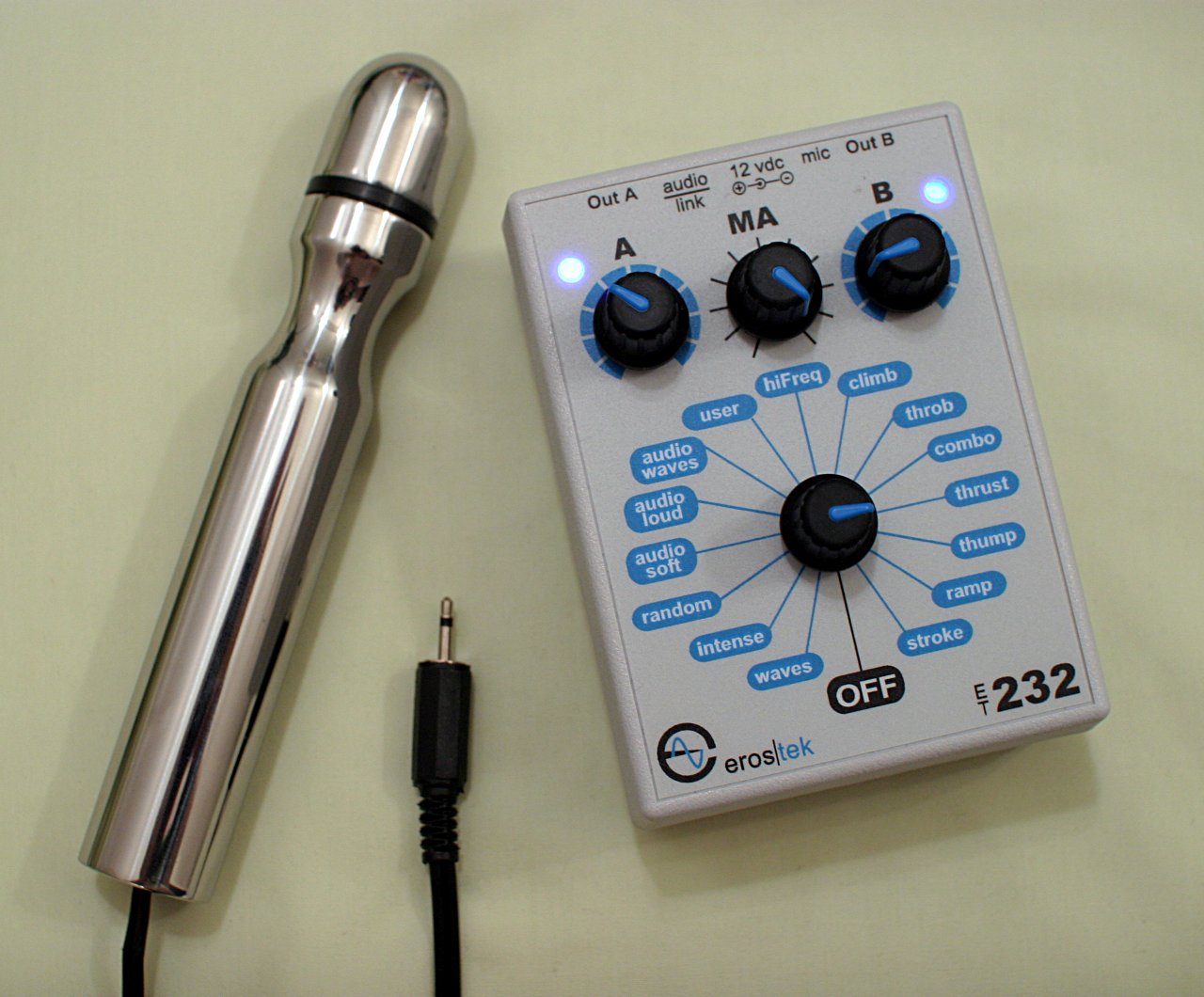
Erotic electrostimulation, also called erotic e-stim or electrosex, is sexual play that puts controlled current on nerves, especially around the genitals. It grew out of BDSM sensation play. The power source might be a TENS unit, an EMS unit, a violet wand, or a box built for this kind of scene. The toys are pads, conductive rubber, urethral probes, cock rings, prostate tools, and nipple electrodes. Done between consenting adults, with purpose-built gear and the current actually under control, the feeling can run from a tingling tease to a hard muscle contraction, and it can push someone toward orgasm without ordinary friction. Done wrong, it burns, throws off heart rhythm, or kills.
From entertainment shocks to fetish boxes
Electricity as entertainment goes back at least to the 1740s. In the 1830s, insertable electrode attachments were sold for small magnetos. Later in the nineteenth century, electric belts, some with a “suspensory sack,” were marketed as a cure for impotence. In the 1920s the American Medical Association looked at devices of that kind and judged them close to mechanical masturbation. Modern e-stim reached a wider public with the Relax-A-Cizor in the 1950s, sold as “passive exercise” that contracted muscles with current. Its medical descendants are today’s EMS units, electrical muscle stimulation. Users soon found that contacts on erotic body parts could be sexual. By the 1970s, medical TENS units, transcutaneous electrical nerve stimulation, were in kink use too. The 1980s brought boxes made for erotic play, including the Titillator and the Pleasure Box, later called the PES Power Box. Early machines used simple pulsed sine waves. Later boxes could take ambient sound or prerecorded music and build a structured e-stim journey, with soft passages, peaks, rewards, and punishments. Sites now sell audio files made for that.
Boxes, hacked gear, and violet wands
Consumer body toners and electromassage units are a cheap way in. They offer fewer options than a dedicated box, and they are the safer introduction only when the electrodes and the current path are chosen carefully. Purpose-built erotic boxes were analog in the mid-1980s and digital by the late 1990s: adjustable frequency and intensity, preset programs, computer control, and sometimes a remote. Homemade stimulators, and HiFi or DVD gear never designed for human tissue, sit in the high-risk column. Too much power and poor isolation can put mains-level voltage on the output if a transformer fails. Patent literature also describes spinal-cord electrodes, external pacers aimed at penile erection, and four-electrode interferential setups. Those are medical or experimental. Bedroom play still centers on TENS and EMS boxes, and on violet wands.
A violet wand started as an electrical tester. There are mechanical versions, built around a Tesla coil, and solid-state versions. It puts low current, high voltage, usually about 35 to 65 kilovolts, and high-frequency electricity on the body. The sensation is sharp, cutting, or piercing, not a deep muscle grab. The usual shell holds the coil or driver, a power cable, and a collet. Glass or metal probes seat in that collet. The collet is 7/16 inch in the United States and 11 mm in Europe. The wand has its own look: neon, sparks, a theatrical sting. It sits next to low-voltage TENS play. It is not the same thing.
Where the electrodes go
Electrodes deliver the stimulus. Genital designs include vaginal plugs, butt plugs, prostate probes, testicle rings, CBT boards, cock rings, and urethral probes. TENS pads are widely reused for sex. Conductive materials include gold, silver, aluminum, stainless steel, conductive silicone, and flexible conductive rubber. Rubber is popular because it is cheap and can take many shapes. Current stimulates nerves between and under the contact areas. It can feel like vibration, an ache, a pulse, or a deep muscle being grabbed. Nipple electrodes need extra care about where the other contact sits, because a bad placement can send current across the chest.
Burns, the heart, and what not to plug in
Misused current can damage tissue or kill. The most common injury is a burn from too little contact between electrode and skin. Even at modest voltage and current, electricity can interfere with the heart, including cardiac arrest. People with pacemakers, other implants, or a known heart condition are at higher risk. Forensic reports of deaths in autoerotic electrostimulation usually involve homemade gear on mains power, with current run across the chest on purpose, often at the nipples, or with a hand touching a live part. In York, Pennsylvania, a widely reported criminal case ended with a man sentenced to 20 to 40 years after he killed his wife by stimulating her nipples directly from a power strip on mains power. That is a record of what happened. It is not a method.
The practical limits are plain. Keep the path off the chest and off the head. Stay below the waist, or on regions that are separated from each other, and think about medical-grade isolation. Contacts should be wide and well wetted. Do not use mains power, and do not use audio gear that is not isolated. If the pain is a burn rather than a sting, stop. A cardiac history is a hard limit, not a maybe. Feeding a sound signal into the body, or making a temporary electrode out of stray metal, is improvised risk, not a technique to copy. With isolated hardware and a path that stays off the heart, e-stim can be ramped, patterned, run from a remote, and tied to sound in a way hands and vibrators are not.


![[Art Video] 1966 Beautiful Breast 18-Year-Old Girl Coming Wildly Lusty Beauty Masochist Club Sayaka Fujino Yu Hayakawa](https://bdsmwild.com/wp-content/uploads/2026/08/Art-Video-1966.jpg)