
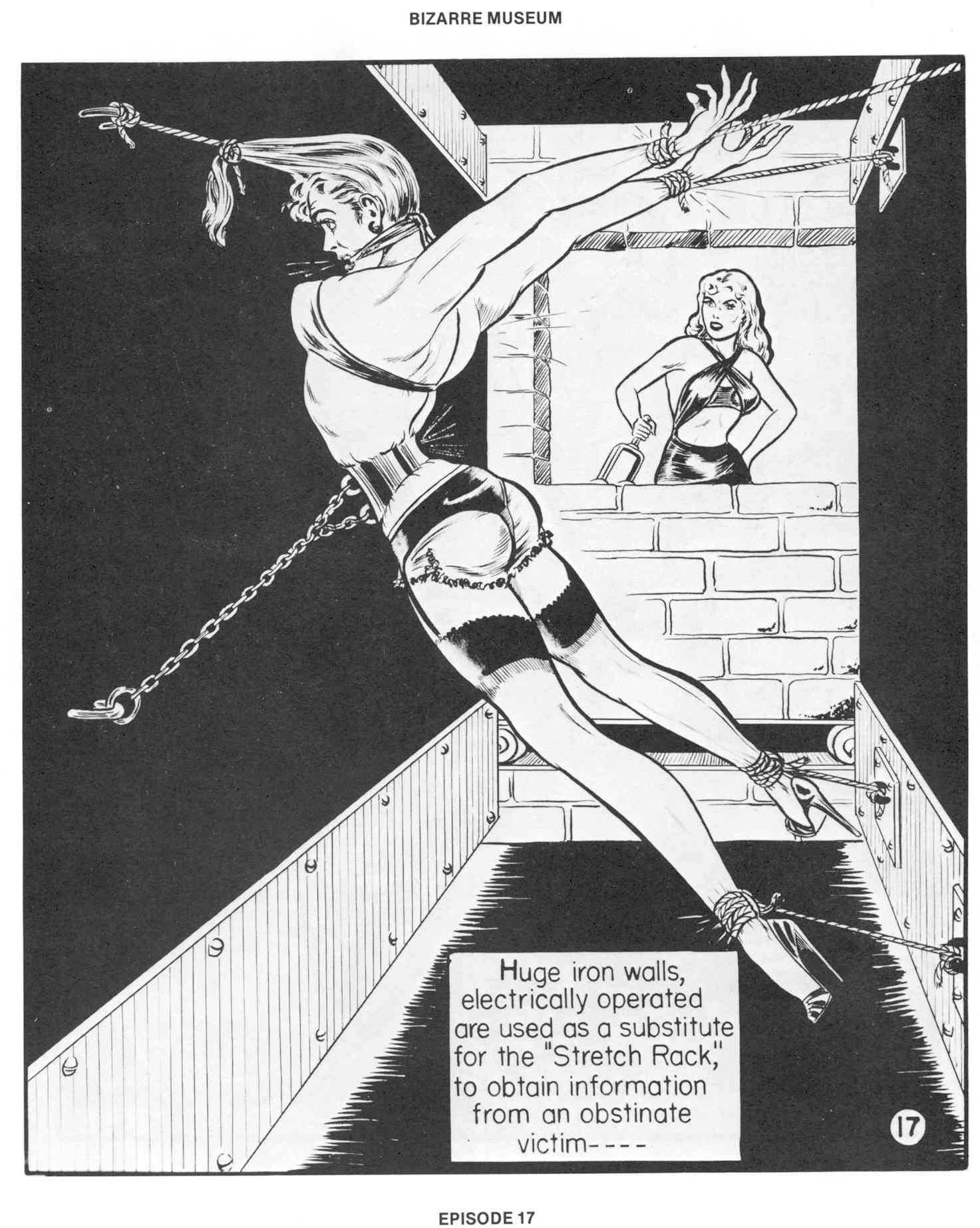
Eric Stanton, born Ernest Stanzoni Jr., was a key figure in American underground comics and an early fetish artist. He lived from September 30, 1926, to March 17, 1999. He first became known for bondage-fantasy chapter serials commissioned by Irving Klaw. Most of his later career went into gender-role reversal and female-dominance scenarios with a proto-feminist edge: women in charge, men humiliated, and Amazons, past the older damsel-in-distress rope scenes. One signature invention is the princk, an oversized female penis, which the women in that world use to dominate men.
The fetish career starts in the late 1940s. Klaw, who also sold pin-ups and movie stills from 212 E. 14th Street, commissioned the bondage chapter serials that made Stanton famous underground. Stanton later worked for Leonard Burtman, on the magazines Exotique and Selbee, for Times Square publisher Edward Mishkin, for paperback publisher Stanley Malkin, and for the later magazine publisher George W. Mavety. He grew up in Brooklyn, with an Italian father and a Russian mother. During World War II he served in the U.S. Navy. A head injury left him partially color-blind. After the war he assisted Boody Rogers on Sparky Watts or Babe, painting backgrounds and offering plot ideas. His own taste ran toward lady wrestling and fighting-women comics. Klaw’s bondage commissions set the early published style anyway. In the early 1950s he attended the Cartoonists and Illustrators School under Jerry Robinson and others. Classmates included Steve Ditko, later a co-creator on Spider-Man and Dr. Strange, and Gene Bilbrew. Stanton introduced Bilbrew to Klaw.
The studio with Steve Ditko
From 1958 to 1968 Stanton shared a studio with Ditko at 43rd Street and Eighth Avenue in Manhattan. That decade is a crossroads of mainstream superhero craft and Times Square fetish comics. They worked on fetish comics together for years. Stanton said they dabbled in each other’s art, mainly spot-inking. An introduction to one collection claims Stanton drew in India ink and Ditko hand-colored the pages. Biographer Blake Bell has written that Ditko at one time denied ever touching Stanton’s work. In a 1988 interview Stanton called his own contribution to Spider-Man “almost nil,” while saying they had worked on storyboards together and that he had added a few ideas, including, he thought, webs coming from the hands. Richard Pérez Seves and other researchers have suggested Stanton may have played that role down to protect the friendship with Ditko. There is also an argument for uncredited Stanton input on Dr. Strange.
Stanton Archives and Stantoons
After the soft-core 1960s, the art got more transgressive. From the late 1960s he supported himself by selling directly to subscribers and patrons, a near-underground network. In the 1970s the mail-order business was the Stanton Archives. From 1982 he issued staple-bound offset fan books called Stantoons, more than a hundred of them by the time he died. He also contributed to underground titles and, later, to the adult magazines Leg Show and Leg World. His only lifetime art exhibit was at New York’s Danceteria in 1984. Banksy, Allen Jones, and Madonna are among those said to have drawn on the work.
The best-known transgressive ideas are concentrated in Stantoons. Blunder Broad, made in the 1970s with writer Andrew J. Offutt, also known as Turk Winter, is a Wonder Woman parody: an inept superheroine who fails her missions and is tortured by her enemies. Those enemies include the lesbian supervillainess Leopard Lady, also called Pussycat Galore or Cheetah, and her male sidekick Count Dastardly. In that setup her super strength can be stripped away by cunnilingus. Princkazons, developed with “Lady Princker,” Shaltis, Alan Throne, and Winter, imagines women worldwide growing oversized female penises, the princks, becoming taller and stronger than men, and dominating them in public with facesitting, urophagia, coprophagia, and oral and anal rape. Even by underground standards the series is extreme. It shows how far Stanton pushed femdom fantasy past the bondage serials of the 1950s. These are adult fantasy comics.
Reprints and the books about him
From the mid-1970s, Bélier Press in New York reprinted many of the serials in its 24-volume Bizarre Comix series. Titles from the 1950s include Dianna’s Ordeal, Perils of Dianna, Priscilla: Queen of Escapes, Poor Pamela, Bound in Leather, Duchess of the Bastille, Bizarre Museum, Pleasure Bound, Rita’s School of Discipline, Mrs. Tyrant’s Finishing School, Fifi Chastises Her Maids, A Hazardous Journey, Helga’s Search for Slaves, Madame Discipline, and Girls’ Figure Training Academy. The schools and finishing schools in those titles are the frame of adult fetish comics. The people drawn in them are adults, not minors. Book-length collections have been translated into French, Italian, German, Spanish, and Dutch. In the 1990s Fantagraphics’ Eros Comix reprinted The Kinky Hook (1991), Sweeter Gwen (1992), Confidential TV (1994), and Tops and Bottoms issues 1 through 4 (1997), subtitled Bound Beauty, Lady in Charge, Broken Engagement, and Broken Engagement 2. Secondary reading includes Richard Pérez Seves’s Eric Stanton & the History of the Bizarre Underground (Schiffer, 2018) and his FetHistory work on Charles Guyette. Stanton’s daughter, Amber Stanton, has written about the tangle of his possible Spider-Man contributions.