
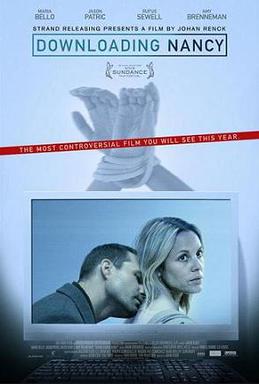
Downloading Nancy is a 2008 drama directed by Johan Renck and starring Maria Bello and Jason Patric. It premiered at the Sundance Film Festival and was nominated for a Grand Jury Prize. The story is loosely drawn from the death of Sharon Lopatka, who looked for a partner to torture her to death. On screen, an unhappily married woman leaves her husband to meet a stranger for a last SM arrangement that ends in death. For readers who know BDSM, this is a hard art film about suicidal masochism and a destruction the characters have agreed to. It is not a how-to, and it is not a compliment to the life.
Nancy, played by Maria Bello, is dead to ordinary pleasure and stuck in a silent, bleak marriage. Therapy, medication, and the comfort of daily life do not fill the hole. She trusts violence. She leaves her husband Albert, played by Rufus Sewell, to meet Louis, played by Jason Patric. Louis is broken too, and he can give her the pain she treats as her last way of coping. The two of them move along the edge of pain and control. For Nancy, the solace is finished only in death. For Louis, the solace exists only in Nancy. Albert stays in the empty house, remembering her loneliness, and finally sees how bleak her days were.
The cast, and the walkouts
The casting is about nerve, not glossy erotic charm. With Bello, Patric, and Sewell, the film also has Michael Nyqvist as Stan and Amy Brenneman as Carol, Nancy’s psychotherapist. Together they make a world of stripped nerves. The film wants that exposed feeling. It is not a tour of bedroom props. That choice did not split the Sundance audience into fans and foes. People kept walking out, and the reviews were mostly hostile. Sewell remembered the door opening and closing through the screening. He still said he was proud to be in it, whether anyone called the film a success or a failure.
What the critics wrote
Rotten Tomatoes sat at about 18 percent from 33 reviews, with an average around 3.8 out of 10. The consensus called the film unseemly, unsettling, and bleak all the way down. Metacritic scored it 19 out of 100 from 11 critics, a pile of dislike. Variety called it a forbidding, morbid piece of psycho-sadomasochism, and praised Bello’s “swimming-in-the-deep-end” work as the definition of fearless. The same review said the performances were cranked to a neurotic red line, and that the production design built an artificially bleak world almost nobody would want to sit in for a whole feature. Salon’s Sundance coverage predicted few people would buy the film, then asked whether Bello’s skin-peeling, deeply depressed, physically and emotionally naked performance could still leave the movie “insulting garbage.” The answer, after sitting through it, was yes. Kirk Honeycutt in The Hollywood Reporter said it was the ugliest film the cinematographer Christopher Doyle had ever shot. Manohla Dargis in The New York Times described it as a nasty exploitation picture dressed up with art-house actors and psychobabble.
What it is not
This is not SM education that the scene would hand to a newcomer. Real BDSM ethics are ongoing consent, limits that include the risks, and the right to stop. Those are the SSC and RACK lines. Nancy is buying her own death. The film is about pathology and despair, not a well-run scene. For viewers trained by the media to think SM is only the prelude to murder, Downloading Nancy is the opposite problem from Fifty Shades. There is no soft light and no negotiation. There is only the bleakness. Sharon Lopatka is the shadow of a real crime, not a report from a dungeon that knows what it is doing. If you watch it, you are watching a cold film about loneliness and an extreme masochistic fantasy. The lead performance was widely praised. The movie itself was so oppressive that audiences left.
![SDDO-039 Destroyed Anal ~SOD Exclusive Graduation Commemorative Work~ Kokoro Amano [Exclusive]](https://bdsmwild.com/wp-content/uploads/2026/09/SDDO-039-Exclusive.jpg)