
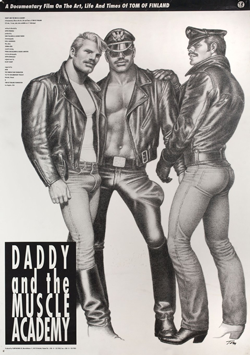
Daddy and the Muscle Academy is a 1991 Finnish documentary written and directed by Ilppo Pohjola. It is about the gay erotic artist Touko Laaksonen, who signed the drawings Tom of Finland. The shoot happened in the years before Laaksonen died. He speaks on camera, and the film looks back through the hyper-masculine male erotica he drew, and through the people those pictures reached. Daddy in the title is not a child. The men in the drawings are adults: cops, sailors, men in leather, bodies built for muscle worship. The pictures are of adults. They do not use minors as sexual objects.
Laaksonen’s exaggerated male bodies, drawn around the middle of the twentieth century, are the visual center of the film. They predate mainstream gay media catching up, and they fed leather style, muscle worship, and a proud erotic masculinity. Interviews with people shaped by the work, notably Etienne, Nayland Blake, Durk Dehner, and Bob Mizer, show how the pictures traveled. It moved through physique magazines and leather clubs, and into the people who later built the look of contemporary gay SM.
Kari Paljakka and Alvaro Pardo produced. Kjell Lagerroos shot it. Jorma Höri edited. The production companies were Filmitakomo and Yleisradio, the Finnish public broadcaster. Kristallisilmä distributed it. Elliott Sharp wrote the score with electronically processed guitar instead of the usual documentary piano. Sharp has said Pohjola gave him only a few vague directions and left the rest open. The sound sits with the film’s blunt, secular pictures.
The documentary premiered in 1991 at the Helsinki International Film Festival and has been rebroadcast on Finnish television more than once. A 2019 airing on Yle Teema & Fem still cut about three minutes. The 2017 restoration, released by Kino Lorber on Blu-ray, put the interview segments back in uncut form. Those two versions show how the room for gay erotic material changed.
Critic B. L. Panther, writing in The Spool, places the film in New Queer Cinema: provocative secular-sexual imagery, a non-linear structure, and a celebration of queer culture that has a real history. He stresses how clearly the film shows gay men using, mailing, lending, and sharing magazines in order to see male erotica, and how that circuit made men feel seen. The crew received a Special Award at the 1992 Jussi Awards. Dehner’s appearance ties the film to the later institutional work of the Tom of Finland Foundation. Mizer’s appearance points back to the older physique-photo underground.
Boots, caps, leather jackets, and those exaggerated bodies are still the default look in leather bars, on pride parades, and across a lot of gay SM porn. Related reading includes Martti Lahti’s essay “Politics of the Flesh: Ilppo Pohjola’s Films and Images of the Body.”