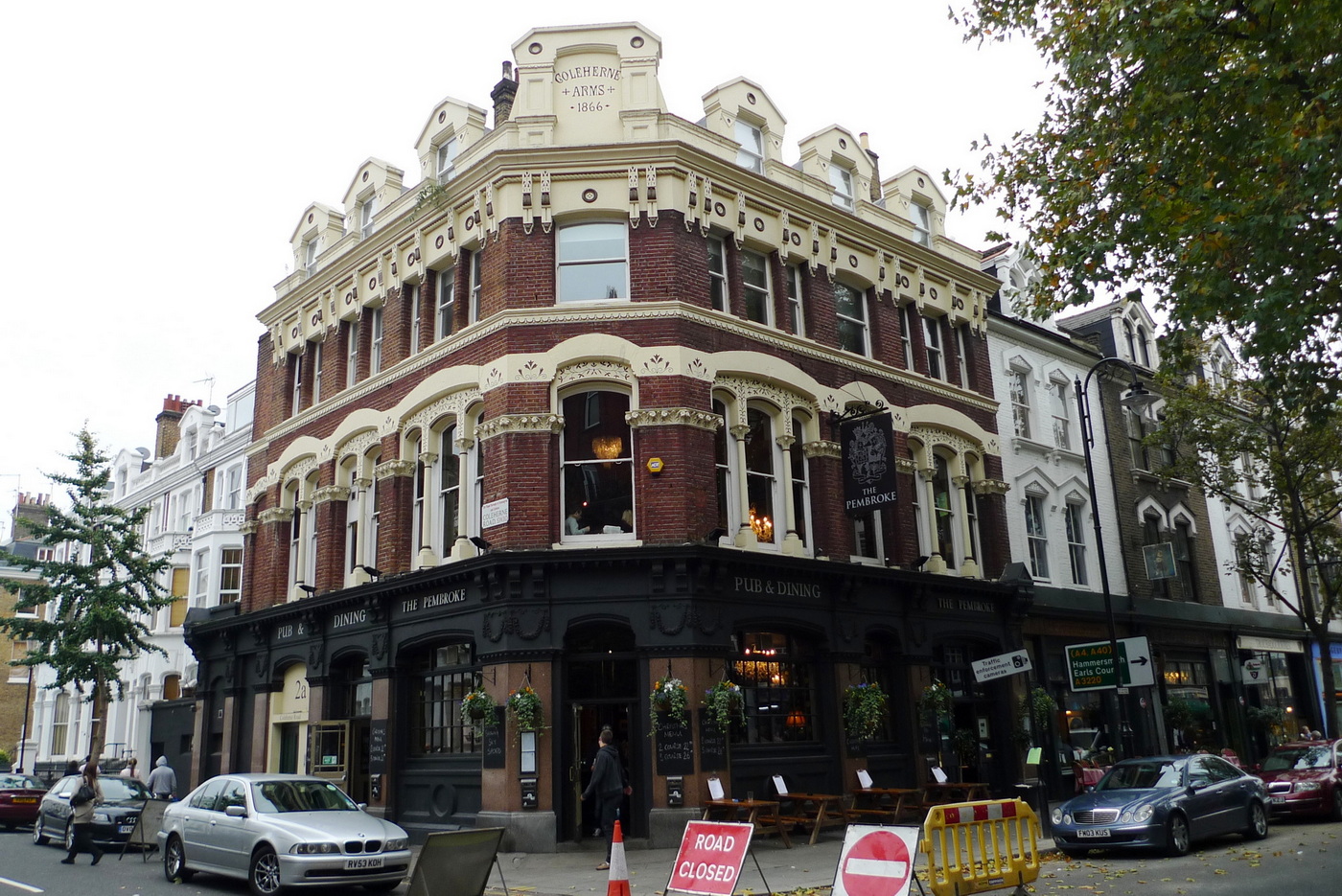
At 261 Old Brompton Road, Earl’s Court, west London, the Coleherne Arms was a BDSM and fetish landmark with more than one life. It started as a bohemian music pub, became a gay refuge, and ended as an internationally known leather bar. In 2008 it was renamed The Pembroke and turned into a gastropub. The blacked-out windows and the sweat are gone. The address is still a coordinate on London leather maps.
Sunday music, then steel pans
The pub opened in 1866, named for the Coleherne family. Before it was a gay bar it drew a bohemian crowd. Jennifer Ware, who lived nearby, remembered drag entertainers after Sunday lunch in the 1930s. For more than thirty years the Coleherne was known for music at Sunday lunch. The mix of race, class, age, and sexual orientation was rare in London at the time. In the mid-1950s traditional jazz gave way to modern jazz. In 1962 pianist Russell Henderson arrived with two young Trinidadian students and a calypso-flavoured Latin jazz. He formed a regular trio with Stirling Betancourt on timbales and a rotating cast of double-bassists, and the room became one of London’s favourite jam sessions, with a Caribbean atmosphere. On weekend evenings Henderson played solo piano. For the next thirty-five years musicians treated the place as a magnet: local players such as Eric Allandale and Malcolm Griffiths, international names such as Johnny Griffin and Philly Joe Jones, and folk guitarist Davey Graham as a regular in the 1970s. Eric Burdon and Mick Jagger showed up in the audience. In 1966 Henderson, Betancourt, and Max Cherrie were brought over from the Coleherne to play steel drums for a children’s event organised by social worker Rhaune Laslett. That event grew into the first Notting Hill Carnival. On 3 February 1973, BBC Two’s Full House aired a documentary directed by Horace Ové on those Sunday sessions.
Leather, the Cloneherne, and The Pembroke
In the mid-1950s the Coleherne became a gay pub. Homosexual acts were still illegal. At first the house ran two bars, one for straight customers and one for the gay crowd. By the 1970s it was a landmark leather bar. The windows were blacked out. Freddie Mercury, Ian McKellen, Derek Jarman, and a heavy international tourist trade came through. Men in leather, key chains, and colour-coded handkerchiefs filled the room, which picked up the nickname The Cloneherne. By 1965 it was already known internationally as a leather bar. Earl’s Court was busy with locals and visitors together. A mid-1990s refit tried to brighten the image and widen the clientele, and did not stop the decline. In September 2008 Realpubs bought the building, refurbished it, and reopened it as the gastropub The Pembroke. Until then the Coleherne had a reputation as London’s oldest gay pub. That title moved to the King Edward VI in Islington, which closed in 2011, and then to the Queen’s Head in Chelsea, which closed in 2016.
GLF, police, and three killers
The same address had a violent public life. In 1972 some of the pub’s drinkers, angry that the Gay Liberation Front was politicising gay sex and gay life, threw bottles at Pride marchers going past. For years police made mass arrests outside at closing time: obstruction, soliciting, importuning, and the heavier charge of conspiracy to corrupt public morals. Men talking in the street were enough. Similar crowds outside non-gay pubs nearby were left alone. Street disturbances and demonstrations in the 1970s and 1980s answered that harassment. From the 1970s into the 1990s the Coleherne was also a stalking ground for three serial killers: Dennis Nilsen, Michael Lupo, and Colin Ireland. Ireland killed five men in 1993. He had decided at New Year to become a serial killer. He later claimed to be straight. At the Coleherne he picked up men whose handkerchief colours signalled interest in sadomasochism and a passive role, went home with them, and killed them. The leather legend cuts both ways. The hanky code was how the room talked to itself. In a handful of catastrophic cases it was also a map a predator could read.
Maupin and The Stranglers
Armistead Maupin put the pub into Babycakes, in the Tales of the City cycle. A character leaves as a clock strikes ten, walks past high-windowed brick buildings, and arrives at the Coleherne: leather boys, a gin and tonic, a bulletin board with notices for Gay Tory meetings, and a young man across the horseshoe bar. The Stranglers’ song Hanging Around, on the debut album Rattus Norvegicus, names the room: moving in the Coleherne, leather all around, the sweat getting steamy, eyes on the ground, hanging around.
For BDSM and fetish readers the Coleherne is London leather geography at one address. Sunday Caribbean jazz that fed the Notting Hill Carnival, a gay back bar while the law was still hostile, a 1970s international clone-and-leather palace, police hostility, a street fight with the GLF, and the shadow of serial killers. After 2008 a gastropub occupied the building. What the blacked-out windows had meant — chaps, hankies, keys, and a pilgrimage stop in Earl’s Court for men who wanted SM-coded leather company before apps replaced the bar door — is the history the address still carries.