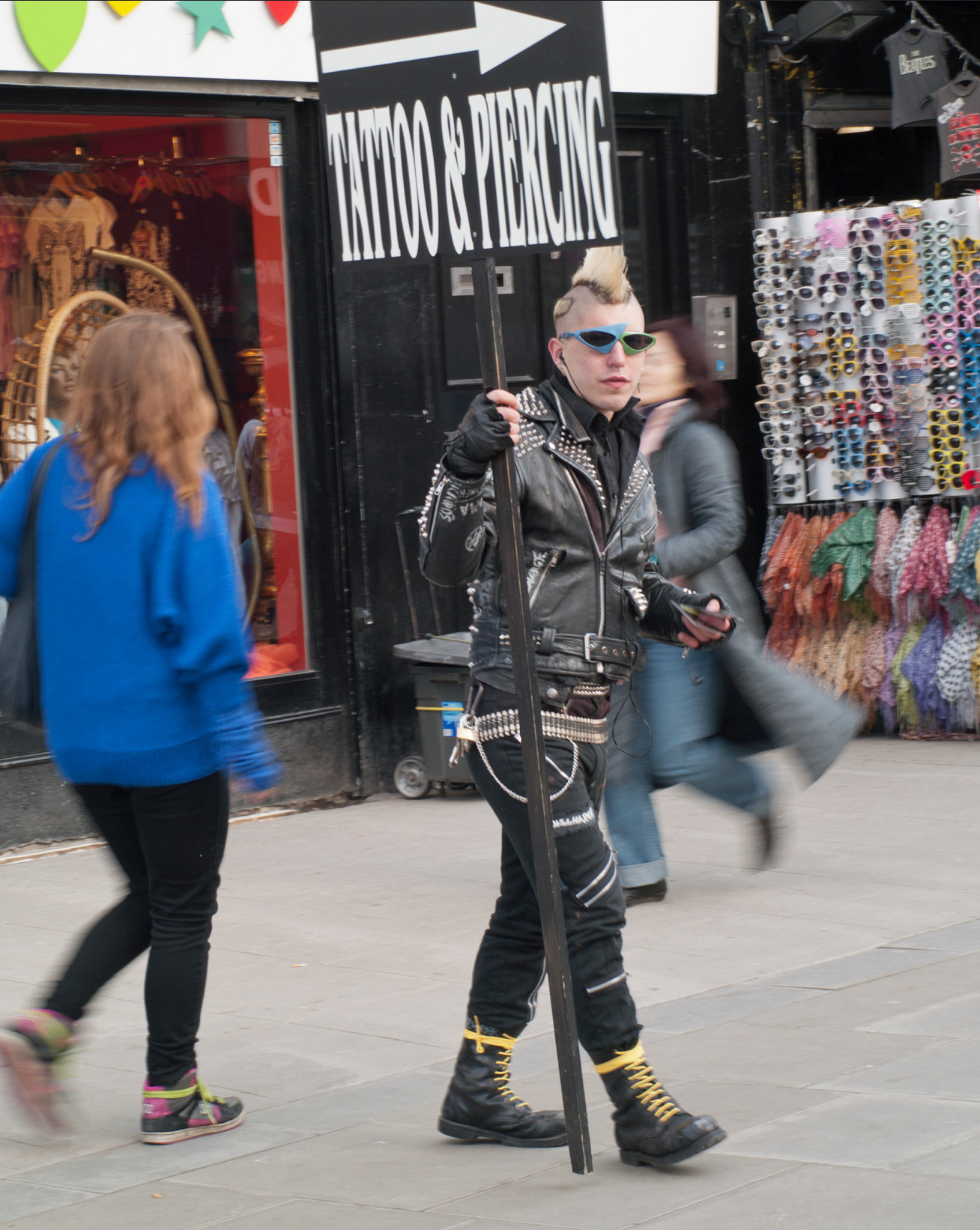
Bondage pants—also called bondage trousers—are trousers loaded with zippers, straps, chains, rings, and buckles so the silhouette reads as BDSM hardware even when nobody is tied. Fetish and alternative-fashion wearers use them as public hardware: D-rings and mock handcuffs advertising restraint without a dungeon. Colors and patterns vary; tartan is one of the most common looks.
Westwood, McLaren, SEX, and the drainpipe
British designers Vivienne Westwood and Malcolm McLaren developed the trousers in the 1970s punk subculture. At first you could only get them from their Chelsea shop SEX—later Seditionaries—in World’s End, London. The Sex Pistols, Jordan, and Adam Ant made them visible. The original drainpipe cut was an anti-fashion strike against the flares of the period. Men’s versions tend toward baggier legs, larger pockets, and more metal: chains, skulls, mock handcuffs, D-rings. Women’s styles are usually more tailored, with less steel and sometimes lace, ribbon, or tartan so the same bondage language reads more feminine. That split—same straps and rings, different steel-to-fabric ratio—still shapes a lot of fetish-adjacent streetwear.
Tripp NYC, mall goth, and the Y2K return
In the late 1990s and early-to-mid 2000s, Tripp NYC’s design—bondage straps and chains on phat-pants-style baggy legs with bright linings—blew up among U.S. teenagers. College students in their early twenties wore them too, and some nu-metal, industrial rock, and darkwave bands put them on stage. The same years put phat-pants-inspired bondage pants on goths, metal kids, gamers, and ravers. Hot Topic and Spencer’s Gifts sold them hard. At electronic and hard-rock clubs and at anime conventions the look went from easy to spot to nearly ubiquitous, then faded from the late 2000s through the early 2010s.
Hardware that barely moved
In the early 2020s retro fashion and the Y2K revival brought them back. Whether the cut is black drainpipe with white topstitching, tartan, hot pink, or a baggy Tripp with a bright lining, the hardware list has barely changed since SEX and Seditionaries: zippers, straps, chains, rings, buckles, mock handcuffs, D-rings. Writers who have tracked the same intersection of retro shops, punk, and queer style include Christina Goulding and Tavia Nyong’o. For readers here, bondage pants are the mass-market cousin of actual restraint gear. Punk, goth, raver, and otaku crowds all rented the same BDSM silhouette for the street: even with nothing bound but a pair of legs walking into a club, the outline still says straps, rings, and control.