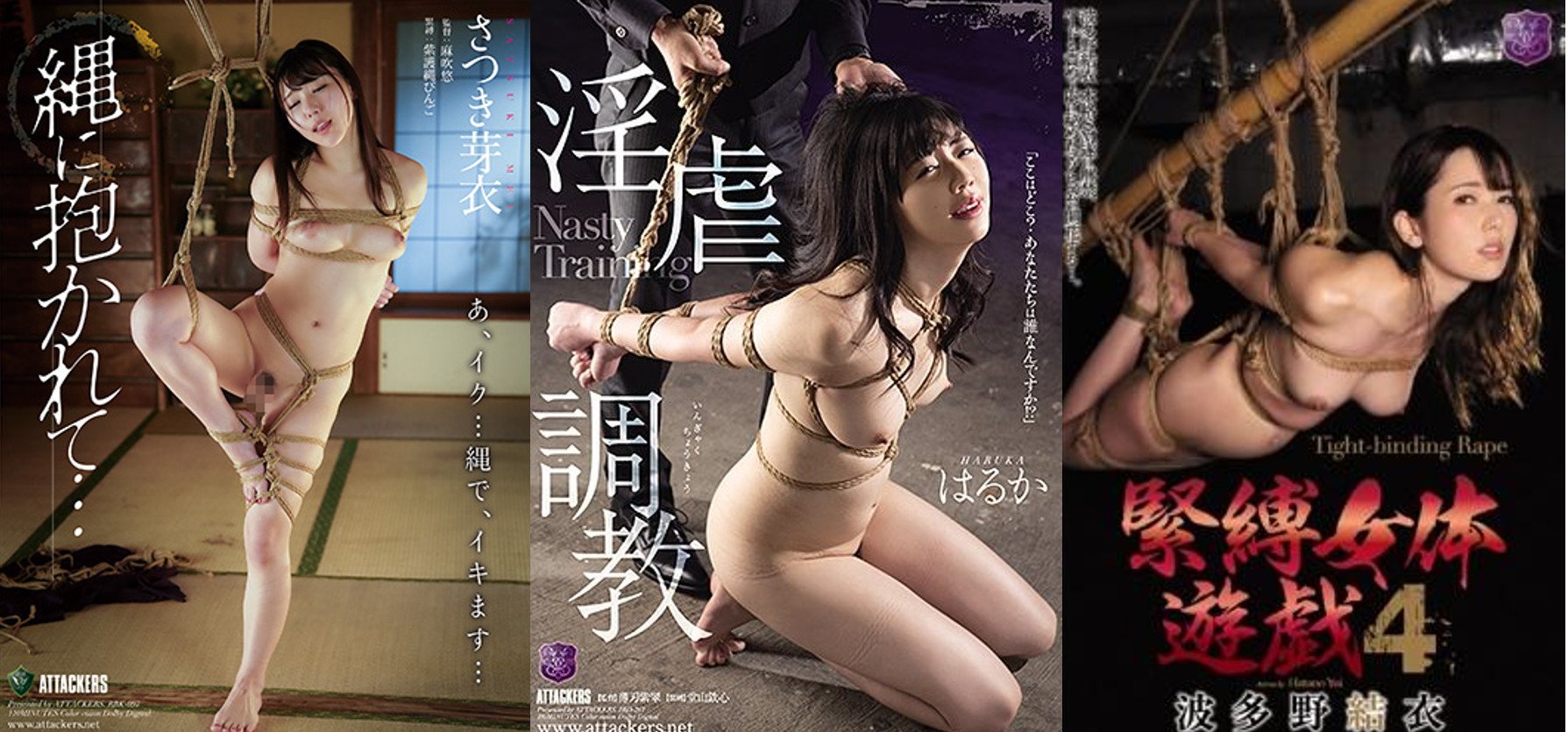
Attackers (アタッカーズ) is the Tokyo AV house that turned ryōjoku — rape-fantasy, confinement, and dead-night-evil drama — into a mainstream sell-through brand. It opened in 1996. In February 1997 it dumped four first titles onto the market under the Shiyaaku imprint (死夜悪, “Dead Night Evil”), all of them sexual-assault stories, sold as an independent direct-to-consumer line rather than a rental-wholesaler product. The company later sat under the Content Soft Cooperative (メディ倫) so tapes and discs could move through ordinary adult channels. Hokuto Corporation bought the label in 2001. From that point the catalog has lived on Hokuto’s DMM storefront, now FANZA. The house never pretended to be a generalist. Its job is hard kichiku AV: gang rape, slave camps, NTR in front of a husband, rope, and the long psychological slide of a woman who cannot leave the room.
From indie Shiyaaku to a Hokuto brand
The late-1990s sell-through boom is where Attackers made its name. Shiyaaku’s hit line Kichiku Rinkan (“Brutal Gang Rape”) should have been too ugly for the open market — group rape, internal ejaculation, no soft landing — but the studio put known faces on the box. Yuka Mihara and Yuri Komuro headlined early volumes. Packaging was retail-grade, not brown-bag fetish mailer, and extra booklets traveled with the tapes. Adult writer Rio Yasuda later said the point was to smash the idea that indie makers only served a basement niche: famous actresses plus a jacket you could put on a shop wall made rape-fantasy AV look like a product a casual buyer might pick up. For a stretch Attackers had more commercial heat than the older SM houses CineMagic and Art Video. It became the first name people said when they wanted ryōjoku with a plot.
The 2001 Hokuto deal locked that position. Attackers kept its own imprint identity inside the group, borrowed Moodyz and other Outvision exclusive talent for guest work, and used the parent’s warehouse and web store instead of fighting wholesalers alone. Release day settled into a collector habit: new discs on the first Tuesday of each month. By September 2011 DMM already listed more than 1,500 Attackers titles. Output in later years has sat around ten to fifteen items a month if you count original features and “Best of” compilations together. The volume is industrial. The theme is not.
Shiyaaku, Jabaku, Ryūbaku, Inma
Shiyaaku stayed the dark-drama spine. Around it Attackers built a set of imprints that split the same cruelty into different temperatures. Jabaku (蛇縛, “Snake Bondage”) arrived in December 1997 for the hardest SM: torture, corporal punishment, name actresses in rope they would not have done at a glamour house. For a while Jabaku’s intensity sat beside CineMagic and Art Video on the same shop shelves and sometimes outsold them. Ryūbaku (龍縛, “Dragon Bondage”) opened in April 2000 as the slightly softer twin — still SM, still restraint, but with more role-play that reads as negotiated or broken-in rather than a snatch-and-dungeon. The two labels became the studio’s bondage pillars, each with its own collectors.
Inma, also styled Inmad, launched in November 2003 for rape content that cares less about rope and more about whether the sex is faked. Anal, real internal ejaculation, no condom if the sleeve says creampie. Chihiro Hara’s Anal Slave Report is the usual example: the production line is that she signed to do the acts as advertised, not as camera cheats. Inma is the house’s “nothing is simulated” corner. ATTACK ZONE, from January 2005, sits at the opposite end — non-explicit gravure and image video with idols who are often not AV performers at all. It is a side door, not the brand.
Idea Pocket is the other split. From December 1998 Attackers used that name for a friendlier, more general line so the parent brand would not have to carry cosplay and pink schoolgirl series next to Shiyaaku. ANGEL and HIGH SCHOOL PINK were the early long-runners. In 2001 Idea Pocket peeled off as its own Hokuto company. The two still share talent and have even collaborated, but Idea Pocket is no longer a sub-label hiding inside Attackers.
Slave Island, the husband in the room, and the other long series
Catalog lists at Attackers run for pages. A few series are the ones fans actually mean when they say the studio’s name. Kichiku Rinkan is the origin myth. Slave Island (奴隷島), on Ryūbaku from 2005 to 2008, is the closed-world epic: recruiters who are not recruiters, a remote island, young women broken into sex slaves. Twelve original features plus compilation discs. The opener, Slave Island: Ryubaku Special (RBD-045), starred Shuri Himesaki and Kyōko Kazama under Kenzo Nagira and took the Attackers Award at the 2005 Moodyz Awards. That is as close as this catalog gets to a festival prize.
While Her Husband Watches (夫の目の前で犯されて) is the later flagship. Married women raped in front of the husband — NTR with a long camera on faces, not just on the act. Nagira again. The films are built as melancholy dramas that happen to be assault pictures, which is why Idea Pocket has crossed over on the concept and why other makers have copied the setup. Female Panther (女豹) and Anata, Yurushite… (あなた、許して…, “Honey, please forgive me…”) work the domestic version: affairs, home invasion, the husband who is too late or too weak. Series titles across the line telegraph the same weather — Slave-Colored Stage, “Female ○○,” “○○ Training Journal,” “Despair ○○.” You know the genre before you read the actress name.
Stars who will do the ugly part
Attackers’ commercial trick, from the first Shiyaaku tapes, was to put famous women in material other major labels treated as a side project. Sally Yoshino, Kyōko Kazama, and Yuri Komuro were the late-90s bait. Komuro especially, then a superstar, made the brand look like a real studio rather than a mania mailer. The Kichiku Rinkan tandem-actress volumes with Mihara and Komuro are how the house escaped the “only weirdos buy this” shelf.
It is not, as a rule, an exclusive-contract factory the way S1 or Moodyz is. Two early exceptions: Ruka Uehara, sold in 2004 as an “imprisoned exclusive,” and Sara Tsukigami in 2005. Most headliners are on loan from other Outvision/Hokuto stables, or they arrive after an exclusive contract elsewhere has expired. Attackers is often the next job inside the group, not the debut. The in-house line is that story only works if the woman can act. Faces matter here more than in gonzo SM: terror, then collapse, then the ugly flicker of arousal the script needs. Shuri Himesaki, Noa, Kaoru Kuroki, Anna Miyashita, Aki Uehara, Ayumi Shinoda, Yu Kawakami, and Eriru Kaname (also billed as Erika / Ozawa Yuka) filled the 2000s. Later posters have carried Nene Yoshitaka, Yuu Shinoda, and Hikari Ninomiya. The type ranges from mature seduction to tight dramatic work. The job is the same: play a victim who is still a person on camera while a room full of men ruin her.
The shoots are not decorative. Industry talk has always been that some performers walked away from AV after an Attackers schedule — too many bodies, too many hours, too much rope and bukkake for the paycheck. That reputation is part of the brand, not a bug the marketing department hides.
Nagira, Hasegawa, Koike, and the rest of the bench
Kenzo Nagira is the name attached to the house style: rape as a story with a temperature, not a string of insertions. While Her Husband Watches is his exhibit. Katsuyuki Hasegawa takes the lavish, sometimes period torture jobs. Female Ninja Torture Rape 3 (2008) was Attackers’ AV Grand Prix entry and the one critics actually mentioned. Shin’ichi Kawamura and Ran Tamai are the other long-serving hands on assault set-pieces. English credits also turn up [Jo]Style and Eitaro Haga. The roster is a director’s studio, not a single-auteur imprint.
The odd one out is Yui Koike, a former actress who directed all five Les Noir films on Inmad between 2005 and 2007. Lesbian sadomasochism and bondage; Sakura Sakurada as the woman who forces younger girls under. A female director on a female-on-female line gave those discs a different cruelty than the standard male-gang Shiyaaku feature. Attackers was willing to park a niche like that under a named creator instead of flattening everything into one rape template.
What the directors share is a refusal to shoot the genre as pure gonzo. Faces, posture, the pause before the next act, a structure that still looks like a film. The sex is extreme. The cut is theatrical. That is the whole pitch.
How an Attackers picture looks
The plots are variations on a locked door. A woman is tricked, grabbed, or bargained into a place she cannot leave — basement, wrecked building, island barracks, sealed classroom — and then used until the performance of resistance is gone. Light is low and high-contrast. The camera stays on the slide from fight to break. Bondage is the house furniture: rope, cuffs, gags. Jabaku in particular builds sets and ties that look designed, not thrown on. Wax, whips, enemas, water torture sit in the toolkit. Shiyaaku adds the gang: a line of shiru-danyū (“cum actors”) and the bukkake that follows. Ryūbaku will sometimes let the victim find a physical response, or even flip her into a brief, ugly dominance of her own, so the tape is not one note from first reel to last.
The later NTR work — husband in the chair, wife on the floor — is the same violence with a domestic script on top. Guilt and betrayal are not decoration. They are how the studio keeps a viewer inside a two-hour assault instead of skipping to the next insertion. Reviewers who like the brand talk about a kind of completeness: illicit charge plus a story that actually closes. Reviewers who do not like it still have to admit the films are built, not dumped.
Tags, and what the studio will not do
Retail language files Attackers under kichiku-kei. Sleeves and search tags repeat the same cluster: ryōjoku, kankin (captivity), SM / chōkyō (training), NTR, rape, gangbang, bondage, revenge. Some titles add in-law incest, woman-on-woman rape, or piss humiliation. Mosaic covers genitals, as Japanese law requires. Underage characters are off the table. The house will go as far as the ethics body and the sales platform allow, and it will write that limit into the series name so the buyer is not surprised.
Against CineMagic, Art Video, Dogma, and the big generalists
CineMagic and Art Video, both 1980s SM veterans, spent decades on rope and the act of training, often with thin plots and unknown or specialist performers. Attackers beat them on the open market with stars and a higher finish, and more importantly with narrative. Their tapes are SM documentaries. Attackers tapes are SM dramas. That is the distinction fans actually use.
Dogma, TOHJIRO’s early-2000s house, is the other hard-genre neighbor. Dogma’s brief is to do the thing other makers will not: gokkun marathons, explosive enemas, heavy anal, scat, punishment as spectacle. Same kichiku shelf, different engine. Dogma wants the body event. Attackers wants the dread around the event. Fans who want plot tension come here. Fans who want a sensory dare go there.
Moodyz and S1 will dabble in non-consent or SM as a project. Madonna and Tameike Goro own wife-NTR of a softer, longer-romance kind. SOD will greenlight an SM kikaku when it feels like a stunt. Attackers does not rotate off the theme. The brand is the theme. That stubbornness is why the industry still treats it as the default address for a well-made rape fantasy, even after the category filled up with imitators.
How the discs get out
The path is the standard Hokuto path. VHS and sell-through DVD first; then digital on FANZA, which is where most of the money is now. Physical discs still leave through Outvision into shops and rental counters. A slice of the catalog has sat on DMM’s old English storefront (R18) for overseas buyers, and some titles land in Japanese VOD libraries such as U-NEXT’s adult tier. Uncensored or locally recut editions exist in a few foreign markets; they are not the business. The business is mosaiced Japan. The official site is a noticeboard — covers, trailers, the occasional interview — and then it sends you to FANZA to pay. Group award shows and fan events put Attackers on a stage next to its Hokuto siblings. None of that changes the product. If you want a rape drama that is shot like a film and cast like a major, this is still the door.