
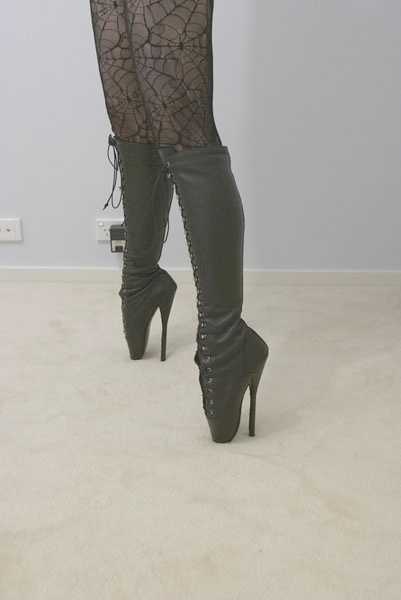
The ballet boot is a modern fetish shoe that fuses a pointe shoe with a high heel. The point is to lock the wearer’s feet almost en pointe, the way a ballerina stands, using long, thin heels — the style often called Dori shoes. Upright, the feet sit nearly vertical, so almost all of the body’s weight lands on the tips of the toes. A properly tight, firmly laced fit changes that: the boot grips instep and heel and takes some of that load off the toes. For boot-fetish and restriction play this is the footwear that turns stance itself into bondage. You do not need cuffs if the heel has already decided where the weight goes.
Heel height is usually 7 inches (18 centimetres) or more. The heel is made as long as it can be so the wearer’s foot — ankle and toes — is fully pointed and extended inside the shoe. Any longer and standing becomes impossible, or the maker has to add a platform. The shaft can stop at any height on the leg. Knee-high and thigh-high versions may have zippers so they can be put on and taken off without a fight. Thigh-high pairs are sometimes cut so the knee cannot bend, which restricts walking even further. There are also “ballet shoe” shapes that are not full boots: sandals, mules, and Mary Janes, many of them with buckles. Some styles add supports like the toe box and shank of a pointe shoe, but the structure only allows limited mobility. It is not a dance shoe with a fetish finish. It is a fetish object that borrowed dance hardware. The 7-inch / 18-centimetre number is the usual floor, not a fashion flourish: shorter than that and the ankle is not forced into the full point that makes the silhouette. Lacing is not decoration either. Loose, the wearer is standing on toe tips. Tight, the boot becomes a brace and the heel and instep take the body. That is the difference between a pair you can stand in and a pair that is only a photograph.
Ballerinas first danced en pointe in the Romantic era. The first recorded performance is Marie Taglioni in La Sylphide in 1832. The soft satin slippers of that period took decades to become the stiff-tipped pointe shoes of the twentieth and twenty-first centuries. Janice Barringer and Sarah Schlesinger’s The Pointe Book is the standard technical account of those shoes, the training, and the technique. Beside the ballet pointe shoe, Viennese fetish boots from around 1900 are the other usual ancestor. Those boots wore a dramatic 11-inch (28-centimetre) heel — longer than the sole — so standing and walking were impossible. The Viennese pair is the extreme version of the same idea: a heel that does not care whether you can stand. Ballet boots and ballet shoes have been easier to buy worldwide since they gained popularity in the 1980s. Valerie Steele’s Fetish: Fashion, Sex and Power (Oxford University Press, 1996) and Mary Trasko’s Heavenly Soles: Extraordinary Twentieth-Century Shoes (Abbeville Press, 1989, ISBN 978-1-55859-324-4) are the fashion-history shelves this design sits on. The lineage is mixed on purpose: a dance history of forced extension, and a fetish history of heels that refuse to let you stand.
Ballet boots, unlike the lower ballet shoes, are often used for walking by people who have practiced in them. They show up in pop culture and in fashion as well as in sex, even though a lot of outsiders assume they exist only as a sexual prop. The heels made for walking are a much higher quality than the pairs sold mainly as fetish wear. Cheap ballet boots are not meant for long standing or walking; often they cannot be used for standing at all, and they are not functional for dancing. They work as a fetish object for sexual gratification, and they raise the erotic charge with bondage and submission. That is why they turn up in BDSM play. The boots can hurt on their own. Soon after they go on, the calves often cramp and sting from overexertion if the wearer is not used to them. Beginners commonly find even a short attempt at walking or standing difficult and painful, which is part of the draw for masochists. Arch-training devices and techniques are sometimes used to increase the wearer’s instep so a foot will fit heels this extreme. Restricted stance is the point. The 7-inch heel, the lace that shifts weight off the toes, the knee-high zipper, and the thigh-high shaft that locks the knee are all ways of deciding, in leather and steel, how little the person in the boots is allowed to move. A Dori-style heel that puts the foot vertical, a shaft that will not let the knee fold, and a calf cramp that starts a few minutes after the laces are pulled — that is the ballet boot as equipment, not as a costume shop novelty.
![CN-166 Heisei Married Woman Underground Sex Path 5 Denki Akechi [Exclusive]](https://bdsmwild.com/wp-content/uploads/2026/09/CN-166-Exclusive.jpg)