
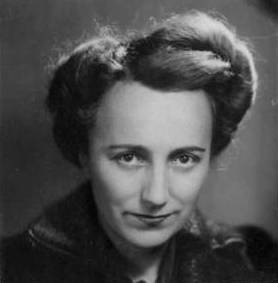
Anne Cécile Desclos (23 September 1907, Rochefort, Charente-Maritime – 27 April 1998) lived two public names. As Dominique Aury she was a demure Gallimard critic, journalist, and editor. As Pauline Réage she wrote Histoire d’O (Story of O), the 1954 sadomasochistic novel that still sits at the center of literary BDSM. The respectable secretary and the anonymous pornographer were the same person.
She grew up bilingual and was reading French and English early. After the Sorbonne she worked as a journalist until 1946, when she joined Gallimard as editorial secretary and began using Dominique Aury. She translated or introduced Swinburne, Evelyn Waugh, Virginia Woolf, T. S. Eliot, F. Scott Fitzgerald, and others, and sat on juries for major literary prizes. On the page Aury looked almost prudish — the opposite of the anonymous woman who would send O to Roissy.
The engine was her lover and employer Jean Paulhan, director of the Nouvelle Revue Française and twenty-three years her senior, a fervent admirer of Sade. He said no woman could write an erotic novel. To prove him wrong she wrote a graphic sadomasochistic book. It appeared under Pauline Réage in June 1954 as Histoire d’O. Paulhan wrote a sympathetic preface that did not name her. O’s rings, the château, consent that looks like annihilation — those images entered kink culture from that dare.
The book was an enormous, controversial commercial success. Speculation about the author ran for decades. Many refused to believe a woman had written it, let alone the Aury who appeared in print. André Malraux and Henri de Montherlant were among the men alternately suspected. The following March, authorities brought obscenity charges against the publisher and the still-mysterious author. The charges were thrown out in 1959. The judge still imposed a publicity ban and a restriction on sale to minors. After the ban lifted in 1967, Retour à Roissy appeared again as Pauline Réage; according to Angie David’s later biography, Desclos did not write that sequel. In 1975 she gave a long interview on erotic books with Régine Deforges, published by Story of O editor Jean-Jacques Pauvert; her authorship was still unknown. Viking issued an English edition of the interview in 1979. She publicly admitted she had written Story of O in 1994 — forty years after publication — in an interview with The New Yorker. Pauline came from Pauline Bonaparte and Pauline Roland; Réage she picked at random off a topographic map.
She was bisexual and had a liaison with historian Édith Thomas, who may have inspired the character Anne-Marie. She had a son from a brief marriage in her early twenties. Pola Rapaport’s 2004 film Writer of O mixed interviews with re-enactments. BBC Radio 4 broadcast The Story of O: The Vice Française, presented by Rowan Pelling. Maya Gallus’s Erotica: A Journey Into Female Sexuality includes the last interview with ninety-year-old Aury before she died.
In 2007 the National Leather Association International launched awards for SM, fetish, and leather writing; one category is the Pauline Réage Award for a fiction novel. In 2020 Desclos was inducted into the Leather Hall of Fame. Dates that matter: born 1907; Gallimard and the Aury name from 1946; Histoire d’O in June 1954; charges the next March; charges out in 1959; ban lifted 1967; identity owned in 1994; death 27 April 1998. A critic who could move Swinburne and Woolf into French answered a Sadean taunt with a novel that still defines literary female submission.