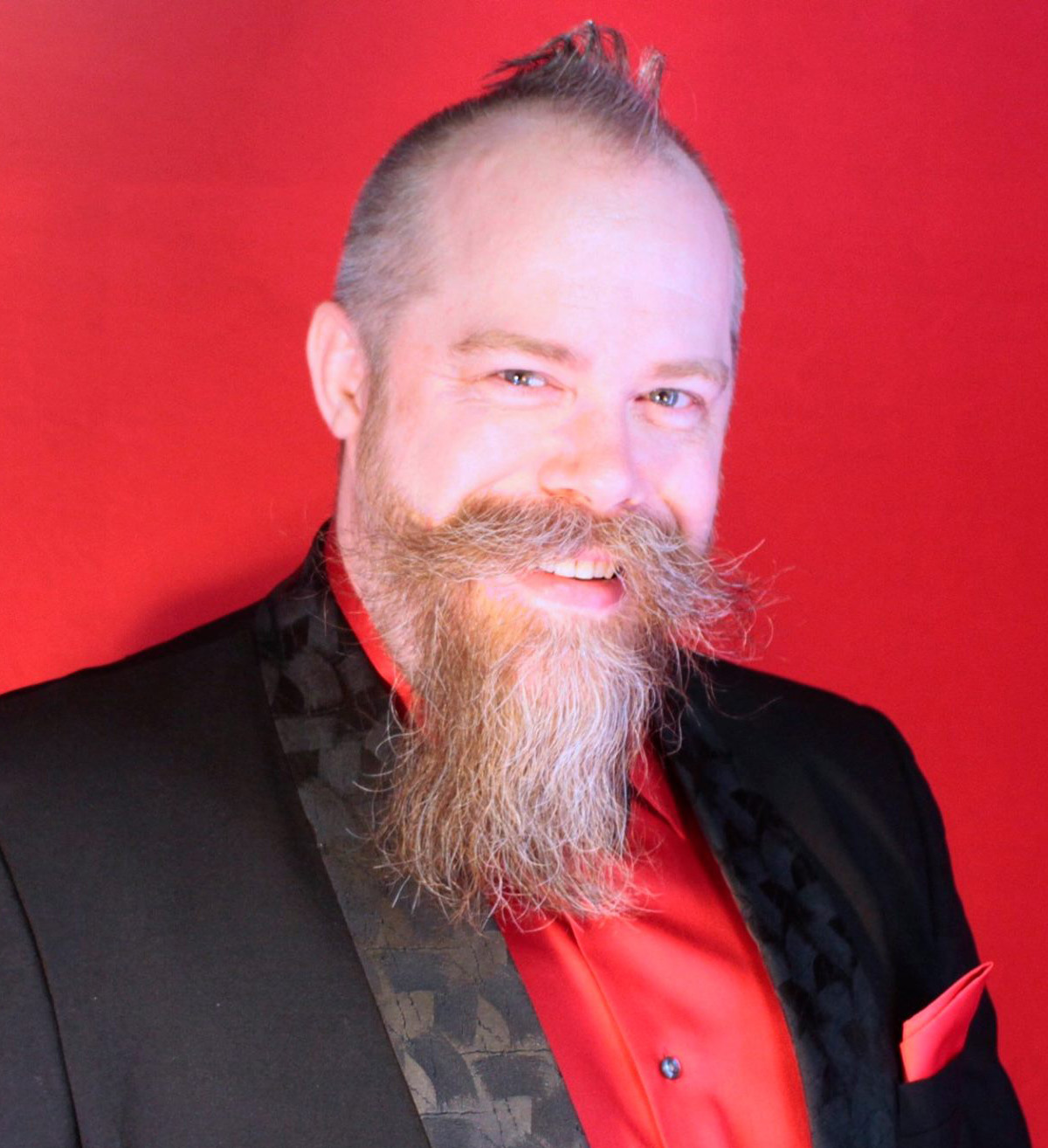
Andy Mangels, born 2 December 1966, is an American science-fiction writer, comics editor, and DVD producer who has spent decades forcing gay, lesbian, and leather lives onto pages that preferred them invisible. He is openly gay, a leather titleholder, and a bear-scene regular. Since 1988 he has run San Diego Comic-Con’s “Gays in Comics” panel. He founded Women of Wonder Day, which raised more than $136,000 for domestic-violence shelters over seven years. By 2011 he had put three books on the USA Today best-seller list. In 2004 he was Mr. Oregon State Leather. The Pantheon of Leather gave him the Northwest Regional Award in 1995, 2005, and 2011. For this site he is not only the man who wrote the Star Wars character guide. He is the leather advocate who treated comics fandom as a room that had to make space.
Pop-culture books and the USA Today list
Mangels’s nonfiction is mostly media reference work with a fan’s memory and a professional’s filing system. Star Wars: The Essential Guide to Characters (Del Rey, 1995) hit the USA Today list. So did two of the Star Trek novels he later wrote with Michael A. Martin. Other solo books include Beyond Mulder and Scully: The Mysterious Characters of “The X-Files” (Citadel, 1997), From Scream To Dawson’s Creek: The Phenomenal Career of Kevin Williamson (Renaissance, 2000), the 600-page Animation on DVD: The Ultimate Guide (Stone Bridge, 2003), Iron Man: Beneath The Armor (Random House, 2008), and Lou Scheimer: Creating The Filmation Generation (TwoMorrows, 2012), written with Scheimer. He contributed dozens of entries to Visible Ink’s The Superhero Book (2004) and The SuperVillain Book (2006). In 2016 he placed a short story in the prose anthology The X-Files: Secret Agendas.
The fiction that traveled farthest was franchise work. With Martin he wrote Star Trek: Section 31 – Rogue (June 2001), the first Star Trek property with gay lead characters — a fact that matters more in this biography than another starship ISBN. They also wrote the official prose continuation of Star Trek: Enterprise after the show was cancelled, including Last Full Measure (2006), The Good That Men Do (2007), which gave Trip Tucker a secret history, and Kobayashi Maru (2008); co-created the Star Trek: Titan crew and wrote its first two novels, Taking Wing (2005) and The Red King (2005); and closed the cliffhanger ending of television’s Roswell in Pursuit (2003) and Turnabout (2003), after the earlier Roswell: Skeletons in the Closet (2002). Other joint Trek work filled the Deep Space Nine relaunch — Cathedral in the Mission Gamma sub-series (2002), a story in Prophecy and Change (2003), Tales of the Dominion War (2004), Worlds of Deep Space Nine, Book II – Trill (2005) — plus Starfleet Corps of Engineers e-books collected as Ishtar Rising Books 1 and 2 (2003) and later in Aftermath (2006), The Lost Era novel The Sundered (2003) with Hikaru Sulu, the Sulu-centered Excelsior: Forged in Fire (2007), and a story in Tales from the Captain’s Table (2005). In 2008 they placed a story in Richard Dean Starr’s Tales of Zorro for Moonstone. The checklist is long because franchise publishing is long. The through-line is shorter: Mangels kept putting queer people in official canon and then went back to the dealer room to talk about it.
Comics: Gay Comix, Pride, and twenty-five years on a panel
From the 1990s he wrote stories and text pieces for the major houses. At DC: Justice League Quarterly, Who’s Who in the DC Universe, and later Wonder Woman ’77. At Marvel: Star Trek: Deep Space Nine, Star Trek Unlimited, Mad Dog, Adventures of the X-Men, Adventures of Spider-Man. Dark Horse published his Boba Fett: Twin Engines of Destruction; Wildstorm took a Star Trek Special story. Image published the Bloodwulf mini-series, Badrock & Company, and a Troll Halloween special. Innovation hired him for Child’s Play, A Nightmare on Elm Street, and Quantum Leap tie-ins; WaRP for Elfquest: Blood of Ten Chiefs; Topps for the Jason Goes to Hell adaptation. He scripted Platinum’s graphic novel Super Larry, World’s Toughest Man and, for Microsoft, RE-Man, billed as the first interactive online comic series. In July 2016 The New York Times, writing about Dynamite Entertainment, reported he was writing the intercompany mini-series Wonder Woman ’77 Meets The Bionic Woman, pairing Lynda Carter’s Diana with Lindsay Wagner’s Jaime Sommers, set to start that fall.
The comics work that leather and queer readers should actually remember is editorial. He edited the anthology Gay Comix from 1991 to 1998, issues 14 through 25 plus a special. He also wrote for it, including an early openly gay superhero named Pride. Under his run the book changed its name to Gay Comics — a symbolic step out of the underground-comix ghetto into the mainstream racks. He published multiple issues a year, raised page and cover rates, added a reprint fee, enforced a 50/50 gender split among creators, and occasionally brought in straight marquee names such as George Pérez and Sam Kieth to lift sales. A story he commissioned from Alison Bechdel for Gay Comics #19 later grew into Fun Home; Bechdel thanked him in her keynote at the 2016 “Queers and Comics” symposium at City University of New York.
He has written about comics and Hollywood for a stack of magazines — Amazing Heroes, Alter Ego/FCA, Anime Invasion, Cinescape, Comics Buyer’s Guide, Comics Interview, Comics Scene, Overstreet’s FAN, Hero Illustrated, Marvel Age, Marvel Vision, Sci-Fi Invasion, Sci-Fi Universe, SFX, Sketch, Starlog, Star Wars Galaxy Magazine, Star Wars Galaxy Collector, Toons, Wild Cartoon Kingdom, Wizard — plus overseas titles such as the U.K.’s Dreamwatch, Fantazia, Farscape Magazine, Star Trek Monthly, and Star Wars Magazine, and Italy’s Edizione Star and La Tomba Di Dracula. He writes regularly for TwoMorrows’ Back Issue!. In 2012 San Diego Comic-Con gave him the Inkpot Award for Achievement in the Comic Arts. He has presented at that con since 1988. The “Gays in Comics” panel is the one that lasted: he created it, moderated it, and ran it for twenty-five years, 1988 to 2012. That is a quarter century of making a dealer-room audience look at queer characters instead of pretending the capes were all straight.
Saturday-morning DVDs and a producer who stuffed the extras
His DVD work was mostly rescue and restoration of 1970s and 1980s children’s television, with Mangels writing, directing, and often hosting the extras. For BCI Eclipse / Ink & Paint he scripted and directed sixteen half-hour documentaries on the various He-Man and the Masters of the Universe releases, plus commentaries and liner material. From 2006 to 2008 he did the same job across nearly forty BCI sets: She-Ra: Princess of Power, The Legend of Prince Valiant, Flash Gordon, Blackstar, Space Sentinels, Freedom Force, Groovie Goolies, A Snow White Christmas, Journey Back to Oz, Defenders of the Earth, Ghost Busters – The Animated Series, Ark II, Dungeons & Dragons, Mission: Magic!, Space Academy, The Secret Lives of Waldo Kitty, Fraidy Cat, The New Adventures of Zorro, The Lone Ranger, The Legend of Bravestarr, Snow White: Happily Ever After, Jason of Star Command, Hero High, the live-action Ghost Busters, Fabulous Funnies, and The Secrets of Isis. When BCI closed in 2008 he moved to Genius Products for The Archie Show and Archie’s Funhouse, and to Time Life for a Real Ghostbusters box. He also wrote liner notes and supplied materials for Anchor Bay discs including Beastmaster, Highlander, Elvira: Mistress of the Dark, Plenty, Sleuth, and Can’t Stop the Music, and helped Paramount and Warner Bros. with other sets.
The work was praised in the specialist press. The Best of He-Man and the Masters of the Universe won Home Media Retailing’s 2005 TVDVD Award for Best 1980s Series. The Digital Bits’ 2006 Bitsy Awards said hiring Mangels to build extras turned BCI around: the company was “leading the pack” with nostalgic Saturday-morning sets “stuffed to the max with fantastic bonuses.” He became a regular guest on DVD panels at Comic-Con. The title list is a collector’s rabbit hole. The point for a biography is that he treated discarded kids’ TV the way he treated discarded queer comics: as something that deserved a commentary track and a proper transfer.
Mr. Oregon State Leather, Pantheon awards, and the rest of the fight
Mangels is active in gay community life, especially leather and bear scenes. He held the title Mr. Oregon State Leather 2004. The Pantheon of Leather Northwest Regional Award came in 1995, again in 2005, and again in 2011 — three times, across sixteen years, which is not a complimentary ribbon you pick up once and put in a drawer. Women of Wonder Day, the benefit he founded and ran for seven years, was not a one-off photo op: the $136,000 went to domestic-violence shelters and related programs, which is the kind of leather-community fundraising that never makes a Star Wars bibliography. He is a founding member of PRISM Comics, the nonprofit for GLBTQI comics fans and professionals, and sits on its advisory board. As an ordained Universal Life Church minister he officiated the Unity Wedding at Denver Comic Con in June 2016: ten couples, straight, gay, lesbian, and transgender, married in front of a crowd. In 2019 he and his husband were forced out of their home by a 113 percent rent increase. Statewide and national coverage of that fight helped push Oregon rent-control legislation; Governor Kate Brown invited him to the bill signing.
The performance life sits next to the leather one. He acted onstage in Kalispell, Montana — Brigadoon, A Christmas Carol, Once Upon a Mattress, Ira Levin’s Veronica’s Room — and in Portland with Stumptown Stages, JANE Theatre, Coho, and Lakewood, including The Great American Trailer Park Christmas Musical, Steel Magnolias, and The Secret Garden. He has done Portland fundraisers since the early 1990s. In mid-2011 he and Mark Brown founded Broadway Bears, “Portland’s Furriest Singers,” a cabaret of gay performers answering the way bearded and larger actors get passed over. They sang male and female material, comedy and pathos, solos through group numbers, six long-form multi-night concerts through summer 2016, plus local dates including Peacock in the Park. On screen he has taken bit parts in Leverage, The Librarians, and Grimm — including a two-episode 2015 arc as a featured member of the Wesenrein — and appeared in Untraceable, Comic Book: The Movie, A Change of Heart, and Total Reality. As a talking head he has turned up in documentaries for PBS, E!, and Warner Bros., among them Wonder Women! The Untold Story of American Superheroines, FANatical, E! True Hollywood Story, and extras for Wonder Woman, Batman: The Animated Series, the 1960s Batman, Filmation’s Super Friends and Wonder Woman sets, Batman: Gotham Knight, and Never Sleep Again: The Elm Street Legacy.
He works as a home-care worker for the State of Oregon, looking after elderly and disabled clients. He lives in Portland with his longtime partner and now husband, Donald Hood, and their dog Lucy. The résumé can read like a dealer-room CV: Star Wars guide, Trek novels, He-Man commentaries, an Inkpot. The leather half is the reason the page is here. Mr. Oregon State Leather 2004, three Pantheon of Leather Northwest awards, twenty-five years of “Gays in Comics,” Women of Wonder Day’s $136,000, a gay superhero named Pride, and the first Star Trek book with gay leads. That is the Mangels file for a BDSM and leather readership: a working writer who treated the scene as civic work, not as a weekend costume.