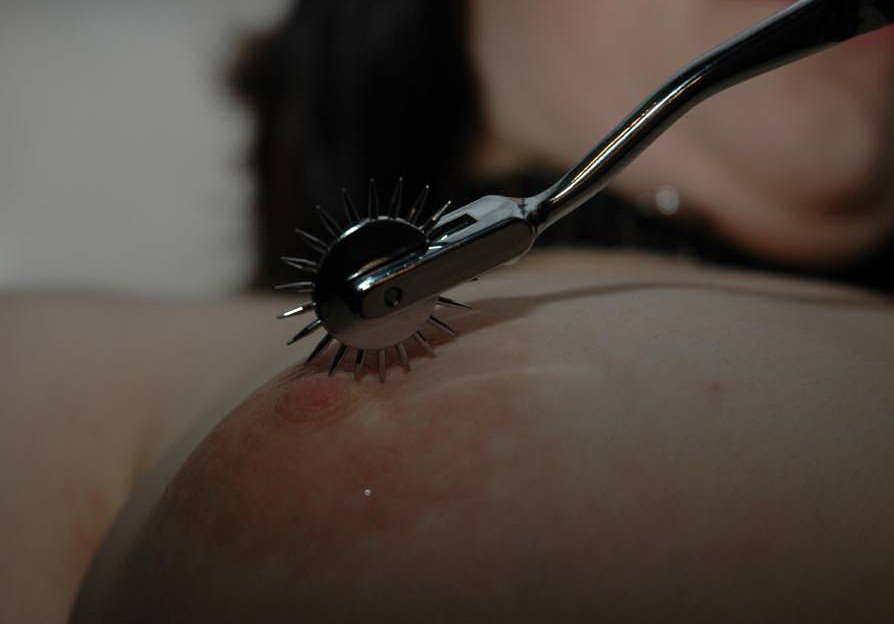
Algolagnia — from Greek álgos, pain, and lagneía, lust — names the sexual tendency to take pleasure and arousal from physical pain, often on an erogenous zone. Brain work suggests people with this wiring do not process nerve input the same way. In modern kink language this is close to what players mean by masochism, or by sadism when they are the ones delivering the pain. The older medical word is useful because it names the body event — pain read as lust — without immediately dragging in Krafft-Ebing’s crime-and-degeneracy story.
Schrenck-Notzing, Féré, and why Freud’s terms won
In 1892 Albert von Schrenck-Notzing coined algolagnia for “sexual” masochism, to split it from Charles Féré’s earlier algophilia. Schrenck-Notzing wanted lust, not Féré’s “love.” Definitions of sadism and masochism have moved ever since, in the clinic and outside it. Krafft-Ebing’s Psychopathia Sexualis used sadism and masochism; Freud took those terms into psychoanalysis, which is why they won and “algolagnia” lost. The neurologist Albert Eulenberg was another early researcher, in Sadismus und Masochismus (1902). Soon after, Havelock Ellis treated sadism and masochism as two faces of algolagnia — “Algolagnia Includes Both Groups of Manifestations” — but insisted the enjoyment of pain stayed inside an erotic frame, unlike Krafft-Ebing’s broader reading. Ellis laid the condition out across books that still map the territory: Analysis of the Sexual Impulse, Love and Pain, The Sexual Impulse in Women, and related titles. Eugen Kahn, Smith Ely Jelliffe, William Alanson White, and Hugh Northcote were other early psychological writers on the term.
Pain as a physical switch
By 1992 algolagnia was being described as a physical phenomenon: the brain interprets pain signals as pleasurable, and the psychology follows. Dolf Zillmann wrote that most algolagniacs experience their actions as active lust, not as a motivational puzzle. Patients could live ordinary lives, get aroused in ordinary ways, and have fairly ordinary intercourse, but once sexual pain started they could not control the reaction. One woman said she could not stop arousal or orgasm from pain even if she had not been aroused when the pain began. Other work has tied the pattern to aggression, hypersexuality, or control psychoses. MRI and computer models of neuron firing have shown that most people with algolagnia experience pain differently. Some may carry DNA errors such as SCN9A that scramble nociception. That is the laboratory version of what a masochist already knows in a scene: the hit is not a metaphor. It is a signal the nervous system has filed under sex.
From “disorder” to no crime link
Schrenck-Notzing, who called himself a sadist, thought algolagnia was a psychological disorder. That view started to crack when the Kinsey Reports showed that many apparently ordinary people enjoy pain in a sexual context. Norman Breslow later found that before 1977 only four studies in the whole scientific literature were empirical. One of the researchers Breslow treated as empirically valid, Andreas Spengler, concluded that earlier work was heavily burdened with prejudice and ignorance toward minority sexual practices, and that it had labeled harmless statistical outliers as pathology. In 1993 Thomas Wetzstein published a large sociological study of his local subculture that confirmed Spengler and went further. No empirical study has found a link between algolagnia — or the related features of sexual sadomasochism — and violent crime, or an increased sociopathic tendency, which had been the default assumption since Krafft-Ebing.
Algolagnia has fallen out of common use. The American Psychiatric Association’s DSM-IV-TR has no entry for it. Mosby’s Medical Dictionary has called inflicting pain “active algolagnia” and equated it with a pathological form of sadism, and equated pathological masochism with “passive algolagnia.” That equation only holds as a dangerous paraphilia if the pain is inflicted on non-consenting people or causes marked distress or interpersonal difficulty. Some current researchers still use the word for both pathological and non-pathological cases, and still link it to some — not all — BDSM. There is little ongoing research; most neurophysiologists look for neuropathological explanations of the reaction. If pain turns you on, you are standing in a lineage that medicine named, then pathologized, then mostly dropped. The scene kept the practice. The old Greek compound is just the lab label for the same nerve trick.