
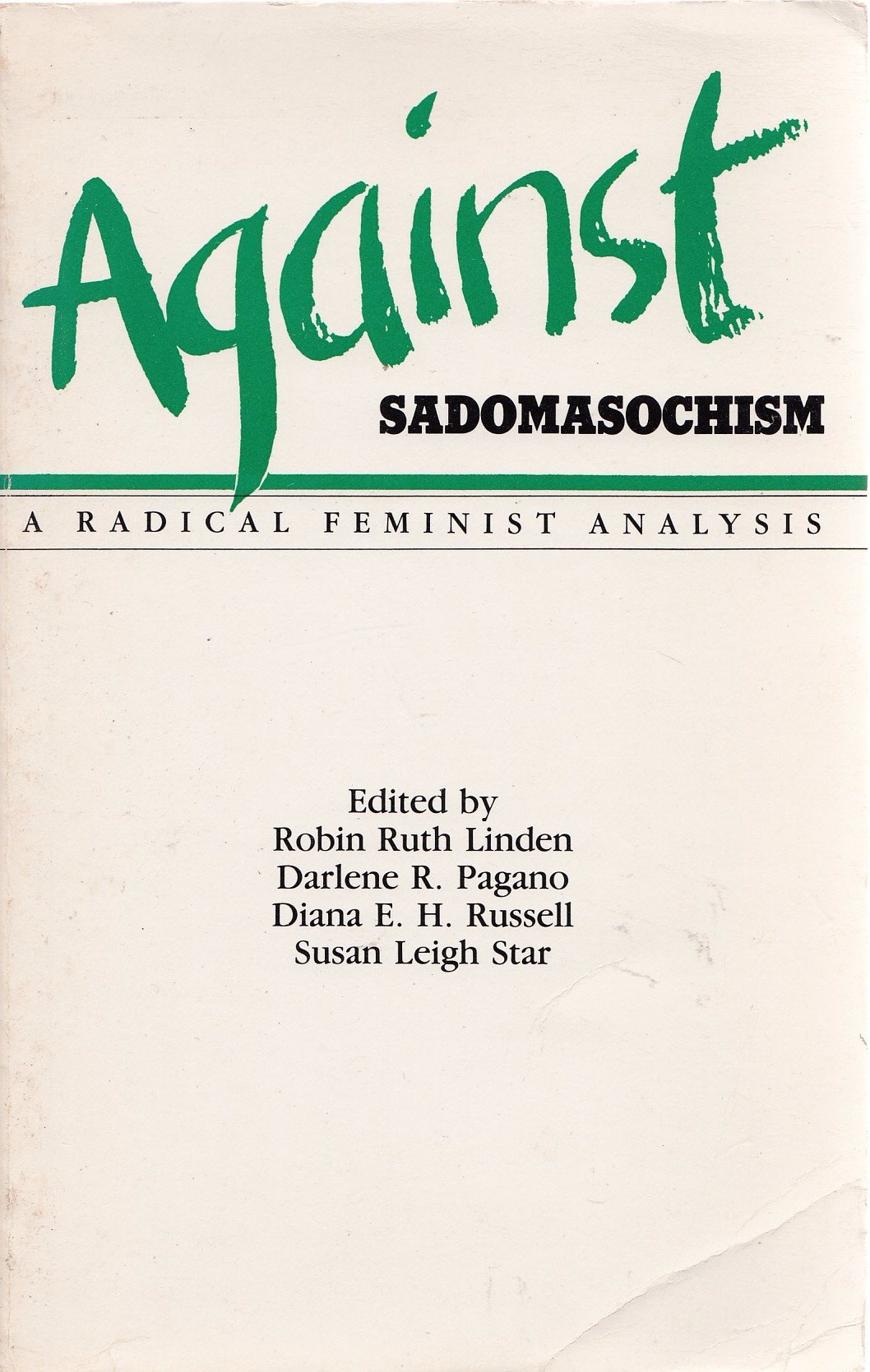
Against Sadomasochism: A Radical Feminist Analysis, published in 1982, is an anthology edited by Robin Ruth Linden, Darlene R. Pagano, Diana E. H. Russell, and Susan Leigh Star. Its core claim is blunt: for people who do SM or BDSM, this is not just a bedroom preference. The writers treat sadomasochism as an expression of patriarchal sexual ideology, and they read master/slave theater as the master’s house rebuilt as sex. Negotiated pain and roleplay are refused the status of politically neutral space.
The table of contents is almost a roll call of 1970s–80s radical feminism: Alice Walker, Robin Morgan, Kathleen Barry, Ti-Grace Atkinson, John Stoltenberg, Sarah Lucia Hoagland, Darlene Pagano, Susan Griffin, Cheri Lesh, and Judith Butler, then credited as “Judy Butler.” Butler’s essay “Lesbian S&M: The Politics of Dis-Illusion” goes after Samois, the San Francisco lesbian SM group; several other pieces in the book take a similar line. The tones differ. What they share is a refusal to treat consensual pain and dominance play as politically neutral.
On race and gender, Alice Walker’s letter, an interview between Audre Lorde and Susan Leigh Star, and a conversation among Karen Sims, Darlene Pagano, and Rose Mason argue that the SM movement ignores Black women’s experience and single out “master/slave” roleplay. Susan Leigh Star calls the use of swastikas and Nazi imagery by some BDSM people antisemitic and racist. Marissa Jonel and Elizabeth Harris write from personal SM history. Paula Tiklicorect and Melissa Bay Mathis use satire.
Susan Griffin’s essay, reprinted from Pornography and Silence with a new introduction, attacks Story of O — the novel whose title Samois took. Griffin’s line is that the book shows how a pornographic society turns a woman’s heart against herself. That method runs through the anthology: leather play read as a social script that trains women to consent to their own destruction.
Reception split. Carol Anne Douglas, reviewing for the lesbian feminist magazine Off Our Backs, recommended the book hard, called the arguments convincing, and found parts of it moving. Charles Moser, in The Journal of Sex Research, granted that the essays were well written and still called the book infuriating. He compared the feminist case against SM to religious cases against homosexuality, and said both pile on guilt that is not required. Those two reviews still make a useful pair: one side hears testimony; the other hears a moral panic with better footnotes.
The fight did not end in 1982. Samois’s Coming to Power sits on the opposite shelf. Against Sadomasochism kept telling lesbian SM that what it was doing was not a liberation project, but a continuation of patriarchal ideology.
![[Taiyo Tosho] 605510 The Scandal 10 Bondage Wedding 2 Mirai Hirooka](https://bdsmwild.com/wp-content/uploads/2026/08/605510-The-Scandal-10-1.jpg)

![HEI-005T Extreme [Gokuhon] Real Sex Anna Kaneshiro](https://bdsmwild.com/wp-content/uploads/2026/09/HEI-005T.jpg)