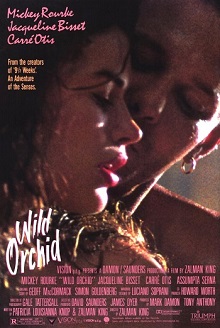
Wild Orchid, released in 1989, is an American erotic romantic drama directed by Zalman King. It is not dungeon BDSM. There is no formal contract and no negotiation list. The film watches a game of power and desire: control, spectacle, and a man who arranges other people’s sex because he will not risk his own, until a woman demands real contact.
Emily Reed interviews at a New York law firm. They will hire her if she flies to Rio de Janeiro the next morning. She accepts, and on the ground she meets Claudia Dennis, a senior executive. The two of them are there to close the purchase of a hotel. Claudia has to fly to Buenos Aires to see the owner, so she sends Emily to cover her date that night with James Wheeler, a very rich man who does not talk much. Bodyguards are at dinner. His questions are personal, and they are not bullying. Afterward they go to a street carnival. A masked man who looks like Wheeler tries to seduce Emily. She leaves. The next morning Wheeler sends orchids, denies that he was the one who approached her at the carnival, and offers a tour of the city as an apology.
Wheeler’s erotic language is watching. At a party, Emily and Wheeler join a married couple. Sailors harass the wife. Wheeler fights them off, and the four leave in his limousine. In the car he encourages the couple to have sex. The wife uses the chance to reconcile with her husband. Emily is unsettled, because Wheeler gets his charge from watching other people’s intimacy. During the hotel deal she tells him she is afraid that if she touches him he will vanish like a phantom. When she hugs him, he pulls away. He does not like being touched.
That night Emily is dressed for carnival. A masked man propositions her again and gives her a room key. Wheeler encourages her to take it. She understands that his own feelings will not move, so he arranges other people’s sex and tries to feel through them. She has sex with the stranger. Claudia then returns with the hotel owner, and the sides meet at the airport. Emily is humiliated: the owner’s lawyer, Jerome, is the masked stranger. He uses the encounter to pressure her toward a better deal. Once Claudia knows, she threatens Jerome. Close the deal, or she tells his wife. Claudia also tells Emily who Wheeler is: an only child, a stutterer when he was younger, self-made. Claudia has wanted him for a long time. He has never touched her.
Before the deal closes, someone buys the hotel deed. Claudia and Emily both know it was Wheeler, and he admits it. Claudia still pushes the sale, trying to go around him. At the party celebrating the sale, Claudia invites a surfer to her room and asks Emily to translate Portuguese. When Wheeler walks in, a threesome is implied. Afterward Emily accuses him of setting people up and then discarding them. He answers that people disappoint him on their own. He then signs the deed over and saves the deal. Emily tells him she loves him. He does not answer, and she leaves. That night he is waiting in her room. He explains that once he had money, women came after him. Games kept life interesting, until the games became the life and he could not stop. Emily says she will give him love if he will try to touch her. He refuses at first. When he fears she will leave, he reaches. They embrace, have sex, and later ride away together on a motorcycle.
Exteriors were shot in Salvador, Bahia, and Rio de Janeiro. King’s cut of the sex was judged too explicit for an R. The MPAA threatened an X, which would have wrecked the film’s commercial chances. He reluctantly trimmed part of a love scene between Mickey Rourke and Carré Otis. The press widely rumored that the two, who became lovers during the shoot, had unsimulated sex on camera. Both denied that. King stayed ambiguous. The rumor became part of the film’s erotic gossip either way.
Wild Orchid premiered in Rome on 21 December 1989, then opened in Los Angeles and New York in April 1990. Critics were cold. Rotten Tomatoes sits at about 9 percent, with an average near 2.9 out of 10. The consensus mocks the overblown editing, a Mickey Rourke on the way down, and an inexperienced Otis. The film drew two Razzie nominations: Worst Actor for Rourke, and Worst New Star for Otis. In its opening week in Italy it took about $403,210 from ten screens in six cities. Erotic curiosity still sold tickets.
Among films about power games, Wild Orchid is one of Zalman King’s sensual dramas, a near relative of 9½ Weeks, and an earlier mark on the road toward mainstream power-sex films such as Fifty Shades of Grey. The pattern is a rich controller, a younger adult newcomer, voyeurism, encounters he arranges, and a last demand for real touch. Wheeler’s refusal to be touched, the sex he stages for other people, and Emily’s night with the stranger are the film’s grammar of control without collars. Claudia’s parallel obsession, never touched, doubles the theme: money and status circle a man who turns intimacy into a spectator sport. Buying the hotel deed and signing it back plays as corporate dominance in a suit and sunglasses. Adult viewers can use the film to see how 1989 mainstream softcore coded dominance: voyeurism in a limousine, a masked stranger treated as an assignment, fear of touch worn as armor, and a climax that recasts the scene as a risk both of them take. Watch it as a glossy erotic power fantasy from King’s late-1980s brand. It is not a map of ethical BDSM.
![[Sanwa Publishing] Bitch Lady Bondage Training Video 2 Hours (SANWA MOOK)](https://bdsmwild.com/wp-content/uploads/2026/09/SANWA-MOOK.jpg)