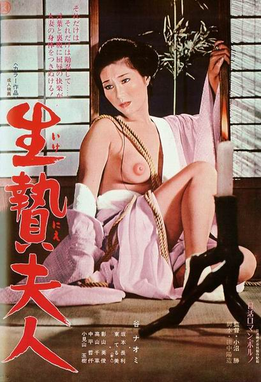
Wife to Be Sacrificed (生贄夫人, Ikenie Fujin) is a 1974 Japanese softcore S&M film starring Naomi Tani and directed by Masaru Konuma for Nikkatsu’s Roman Porno line. Television had been pulling audiences out of theaters. In 1971 Nikkatsu, Japan’s oldest major studio, went into the softcore field that independent pink-film makers had dominated, trying to stay out of bankruptcy. The Roman Porno strategy worked for three years. 1974 was another hard year. Konuma and Tani’s Wife to Be Sacrificed was the studio’s biggest hit that year. With the same year’s Flower and Snake, also Konuma and also Tani, it set the commercial and artistic mark for Nikkatsu’s S&M Roman Porno. It is still among the company’s top five commercial successes.
Tani had been the “Queen of Pink,” known for S&M in the pink-film world. Nikkatsu wanted her in Roman Porno for a long time. She refused, because the studio would not go fully into that genre. In 1974 Nikkatsu finally agreed to star her in an adaptation of Oniroku Dan’s novel Flower and Snake. That film was one of the studio’s first real successes of the year. Wife to Be Sacrificed followed at once: Konuma again, Tani again. Dan disliked Konuma’s handling of Flower and Snake and stayed off this picture. The two 1974 films opened the S&M Roman Porno cycle and made Tani the first of Nikkatsu’s SM Queens.
Ritual possession in a cabin
Akiko (Naomi Tani) finds her husband Kunisada (Nagatoshi Sakamoto) sitting in a car, watching a young girl urinate. The girl, Miko, then comes to Akiko in tears and says “Uncle” has vanished. Akiko turns her over to the police and goes on with her life, until police come asking where Kunisada is. He had disappeared three years earlier after his arrest for a sexual crime involving a high school girl. The film does not show that crime.
Kunisada tracks Akiko to her mother’s grave, kidnaps her, and takes her to an isolated cabin in the countryside. Through the long middle of the film he subjects her to degrading sexual torture. When he leaves to fetch her wedding dress, she escapes wrapped in a sheet, rope marks still on her. In the woods she meets two hunters. They rape her instead of helping. Kunisada finds her unconscious, cleans her, dresses her in traditional Japanese wedding clothes with full makeup, hangs her from pulleys in the cabin, and shaves her pubic hair. The sequence is ritualized ownership staged as bridal horror. It is a film image. The picture does not give suspension steps or safety procedure, and nothing here is a guide to hanging a person.
In the woods he finds a young couple, unconscious after a failed double suicide: Kaoru (Terumi Azuma) and Kiyoshi (Hidetoshi Kageyama). He rapes Kaoru, brings both of them to the cabin, and ties them. After giving Kaoru an enema, he forces a crossed pairing, Akiko with Kiyoshi while he takes Kaoru. The humiliation is meant to destroy the couple’s love. When he thinks he has succeeded, he unties them and lets them stay or go.
The outhouse, and a captivity that does not finish
The film’s most famous passage comes earlier, at an old-fashioned outhouse beside an abandoned house used for the location. Kunisada denies Akiko any chance to relieve herself for a long time, then forces her to defecate with the door open while he watches. A fleeting shot of excrement shocked audiences at the time. Years later Konuma said he had made the dropping on purpose. He thought a beautiful woman’s turd should be thick and brightly colored. That was the image he wanted. Because of the controversy he cut the one-second shot down to four frames, about a sixth of a second.
By the later cabin scenes Akiko has begun to accept Kunisada’s regime, and she looks as if she enjoys it. She pushes him with lines that demand harder whipping and more abuse. After one such session in the woods, they return and find the young couple has bound themselves together and finished the double suicide by strangulation. Akiko tells Kunisada they have played their last joke on him. Meanwhile detectives follow Miko, hoping she will lead them to Kunisada. She slips them. The police still find the cabin: the dead couple still tied, Akiko naked and bound. When they move to untie her she says, “Don’t untie me. I like it this way.” Asked where Kunisada has gone, she says he escaped, then laughs: “It’s funny, but I think he’s afraid of me.”
Under the end credits Kunisada walks the countryside holding Miko’s hand, while Akiko is still in the cabin, naked, tied, and squirming. The closing image is unfinished captivity, and fear that has switched sides.
Craft, cult release, and the arguments since
Among Roman Porno critics and fans the reputation is very high, often among the best of the series, sometimes as the single best. The San Francisco Chronicle called the experience “like watching a sexual madhouse.” The Chicago Tribune called it “artistically potent.” Thomas and Yuko Weisser, in Japanese Cinema Encyclopedia: The Sex Films, write that Konuma’s early sadistic films are well scripted, stylishly directed, and singularly harrowing, and they call this one easily his best. The critical brand is art-house craft applied to hard S&M inside a softcore film, with images that carry a dreamlike finish.
In 1998 Phaedra Cinema put the film back into American theaters on a double bill with A Woman Called Sada Abe. Some mainstream reviewers walked out in disgust within twenty minutes. Founder Gregory Hatanaka argued that these are “dark films, and very serious,” and that the shock is part of the appeal. The run repeated the film’s double life: standing among cult viewers, and revulsion in the mainstream.
In 2007 Image Entertainment and KimStim issued a DVD that includes Hideo Nakata’s 2001 documentary Sadistic and Masochistic. The extra runs 91 minutes. Konuma and Tani are reunited. They watch Wife to Be Sacrificed, then talk through the production over a meal. When the outhouse sequence comes up, Konuma jokes that he really should not have ordered curry. For many Western collectors of SM cinema, that disc is where they met both the film and an oral history of how S&M Roman Porno was made.
Nightmare logic, not a consent model
Adult viewers who know BDSM need the ethical line kept straight. The kidnapping, rape, enema, suspension, and forced “acceptance” in the plot are not a sample of SSC, safe, sane, and consensual. They are pink-film nightmare logic. In that logic, masochistic identification becomes the survivor’s last power move, and the husband’s fear becomes the punchline. Gary Needham and other writers have tried to read feminism through Akiko’s final lines. Real play lives in a different universe from 1974 Roman Porno fantasy. Do not treat Akiko’s smile in the ropes as a consent checklist. Keep safewords for a cabin you actually negotiate. The film is a commercial and aesthetic breakthrough: S&M Roman Porno could keep a studio afloat and crown a star. What it stages is a crafted, uncompromising cruel fantasy.