
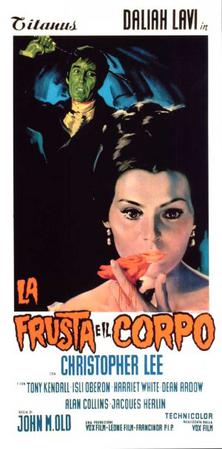
In 1963 Mario Bava, working under the alias “John M. Old,” directed The Whip and the Body (Italian title La frusta e il corpo). It is gothic horror, and kink and fetish viewers keep it because sadomasochistic desire runs the plot instead of sitting on the side. Christopher Lee plays Kurt Menliff, a sadistic nobleman. After Kurt is dead, his ghost returns to the seaside castle and to Nevenka (Daliah Lavi), now married to his brother. The entanglement is pain and desire. That is why the picture still circulates: the sadomasochism is the engine, not a garnish.
The setting is nineteenth-century Europe. Kurt is cast out of the family after an affair with Tania, the housemaid’s daughter, ends in Tania’s suicide. He comes back to the seaside castle, supposedly to congratulate his younger brother Christian on marrying Nevenka, Kurt’s former fiancée. Everyone knows Kurt’s cruelty. His father, Count Menliff, and the housemaid Giorgia hate him. Giorgia blames Kurt for the death of her daughter Tania. They still let him stay the night. The household tension sits under everything that follows.
The film’s SM statement is the beach. The next day Kurt finds Nevenka alone there and seduces her. They kiss. She panics and strikes him with a riding crop. He takes the crop and whips her back. She responds with sexual excitement, and they have sex. Pain is the spark, and the crop is the instrument between them. Consent inside this gothic melodrama is left murky, which is part of why Nevenka’s later state can be read more than one way.
That evening Nevenka does not return. Christian, the butler Losat (Luciano Pigozzi), and cousin Katia (Ida Galli) go looking. Katia is secretly in love with Christian. An unseen figure stabs Kurt in the throat with the same dagger Tania used to kill herself. Losat finds Nevenka unconscious on the beach. They bring her home and then find Kurt’s corpse. After the funeral the relationships rot. Christian suspects his father. Nevenka overhears Christian declaring love for Katia and begins to see Kurt in visions, including bedroom whippings that leave welts on her body. Count Menliff is then found dead in his room, killed the same way as Kurt.
As suspicion spreads, Nevenka disappears and is found in the family crypt in apparent ecstasy. She says Kurt carried her there and whipped her. Christian, Katia, and Losat also seem to feel Kurt’s presence. Christian decides the ghost killed the Count. He and Losat dig up Kurt’s body and cremate it to end the haunting. During the burning they hear sinister laughter and see a cloaked figure: Nevenka, out of her mind. She tries to stab Christian, flees into the crypt, sees Kurt again, strikes, and accidentally stabs herself. Dying, she tells Christian she has killed Kurt again, this time for good. Losat and Christian conclude that after murdering Kurt she went insane or was possessed, and that she then killed the Count. As Kurt’s body burns, a riding crop in the coffin seems to move by itself. Desire and the whip outlast the rational explanation.
On the production side, the producers showed the writer an Italian print of The Pit and the Pendulum (1961) and asked for something similar. Bava was brought in so one person could direct and photograph. The budget was under 159 million Italian lire. The schedule was six weeks of shooting plus one week of effects. Screenwriter Ernesto Gastaldi has said he wrote the script himself and that he had imagined a psychological nightmare in the manner of Clouzot. Bava read a baroque, decadent drama and pushed the color, the composition, and the ritual of the whipping “beyond belief.” That split is why the film feels more like an erotic gothic painting than like a tight thriller.
The censorship history is as much a part of the film as the plot. Italian censors first gave it a V.M. 18 rating. After the producers cut it themselves and appealed, it was reclassified V.M. 14. It opened on 29 August 1963. On 12 October 1963 it was seized for “several sequences that refer to degenerations and anomalies of sexual life,” and it returned in January 1964. A Rome court ordered the confiscation of scenes “contrary to morality” and the destruction of the poster. Export versions did worse damage. The American What! and the British Night Is the Phantom both run 77 minutes and cut heavily into the whipping, until the story barely holds together. For SM viewers the lesson is blunt: the erotic core that made the film dangerous is exactly what the export market erased.
Home video slowly brought uncut versions back. VCI’s 2000 DVD comes from a 35mm print, and Kino’s 2013 Blu-ray puts the beach crop and the whipping scenes back in view. Collectors still have to check the disc. A master derived from an export cut can soften the whip. Without the beach crop and the bedroom welts, the ghost plot collapses into a generic castle mystery, and the erotic motive for Nevenka’s madness disappears.
Reviews split. The Monthly Film Bulletin called the cut version “slow, repetitive, verging on parody,” and found the plot incomprehensible. Variety allowed that sophisticated audiences might laugh at the gothic trappings, but said real suspense is maintained and the cinematography is superb. Later, Slant Magazine scored the film highly and placed Bava at the peak of his visual powers. AllMovie argued that his visual style lifts an otherwise gloomy picture. On a BDSM film map, The Whip and the Body treats sadomasochism as plot engine and as visual poetry. Kurt is the aristocratic sadist as a sexual force. Nevenka is the masochistic, or trauma-bound, partner, and her desire outlives the man. The film is about desire that hurts, and about a body that still answers the whip from the other side of the grave.
![[Art Video] 1507 Amateur Girl Shy Training Raped Classmate Ayumi Watase, Keiko Harada](https://bdsmwild.com/wp-content/uploads/2026/08/Art-Video-1507.jpg)