
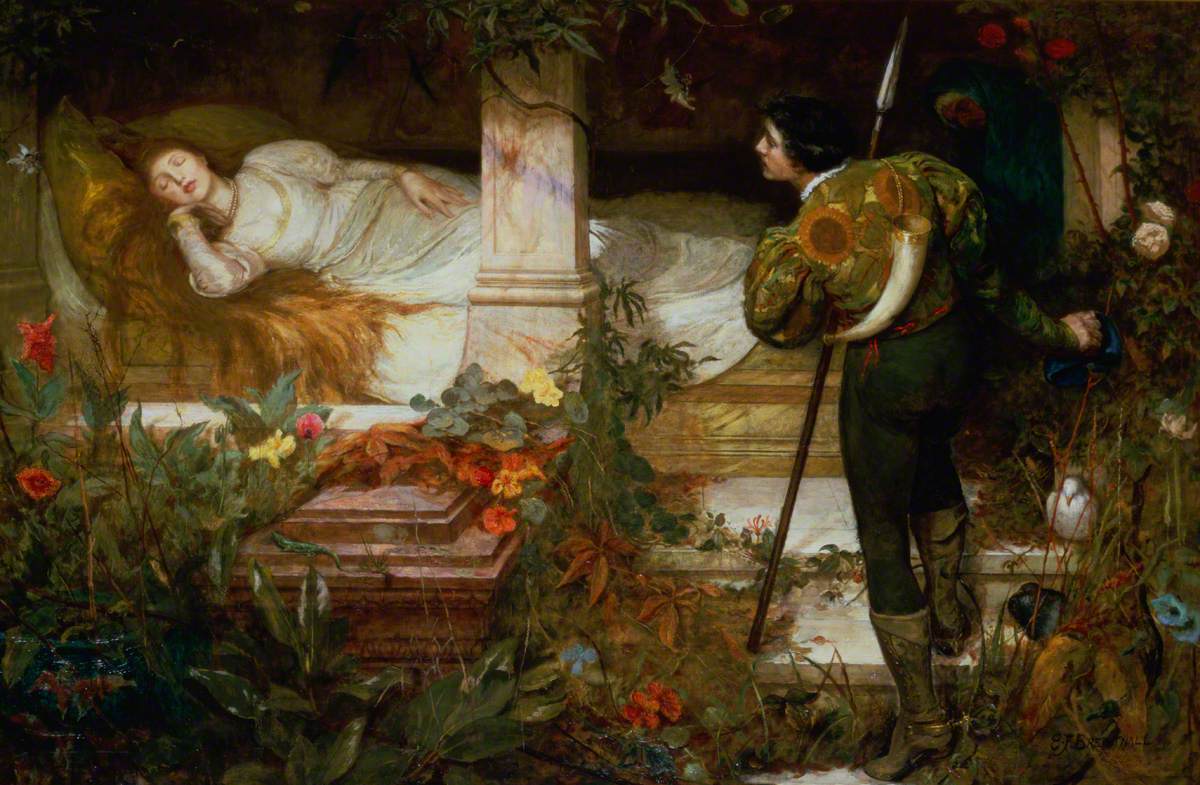
The Sleeping Beauty Quartet is four erotic BDSM novels Anne Rice published as A. N. Roquelaure: The Claiming of Sleeping Beauty (1983), Beauty’s Punishment (1984), Beauty’s Release (1985), and Beauty’s Kingdom (2015). They take the fairy tale and strip the metaphor until what remains is a medieval fantasy of sexual slavery: princes and princesses sent as tribute, trained naked in a queen’s castle, auctioned, pony-harnessed, kidnapped, and finally—because this is still a comedy in the old structural sense—married. The sex is explicit. The power is not a hint in the thorns. It is the plot.
Rice wanted a book where you did not have to mark the hot pages. She got a cult series, a library-challenge listing, audiobooks read by a Bewitched star, and, decades later, a fourth volume that turned the old Queen’s dungeon into a kingdom of voluntary surrender. For BDSM readers the quartet is one of the few mainstream-adjacent literary SM cycles that commits to maledom, femdom, bisexuality, male submission, and pony play in the same fictional weather, without pretending the heat is an accident of folklore.
Why Rice Put On a Cloak
After Interview with the Vampire (1976), Rice wrote two heavily researched historical novels, The Feast of All Saints (1979) and Cry to Heaven (1982). Neither repeated the first book’s critical or commercial success. Readers called Feast too dense. Reviews of Cry to Heaven were savage enough that she felt devastated. She had been circling a story set in Oscar Wilde’s period, then dropped it and went back to the erotic writing she had already tried in the 1960s. The brief she gave herself was brutal and useful: take away everything extraneous that a narrative could spare, and write sex that did not have to hide in a few marked chapters.
To buy creative room she took the pen name A. N. Roquelaure, from the French roquelaure, an eighteenth-century man’s cloak. She did not publicly own the trilogy until the later 1990s. The cloak was not coyness about kink. It was a working name that let a famous vampire novelist publish hard erotic SM without dragging every review back to Lestat. She finally came out as the author when the books no longer needed the disguise to exist.
The 1980s were also the years many feminists denounced pornography as a violation of women’s rights. Rice’s position was the opposite and she treated the trilogy as a political statement: women should be free to read and write whatever they pleased. That argument still sits under the pony tack and the village auction. The books are not a seminar. They are a famous woman novelist refusing to let anti-porn feminism set the limits of female literary appetite. A fourth novel, Beauty’s Kingdom, appeared in April 2015, thirty years after the original close, when the cloak was long gone and the Rice name could sell the sequel without a French coat.
The Claiming of Sleeping Beauty
Beauty does not wake to a kiss. The Prince penetrates her after a hundred-year sleep and walks her into a Satyricon of court slavery. He strips her and takes her to the kingdom of his mother, Queen Eleanor. There she is trained as a slave and a toy. The other naked slaves—dozens of them—are princes and princesses whose royal parents have sent them as tribute. They spend years learning to be obedient sexual property: spanked, used by nobles and by other slaves of both sexes, displayed, humiliated, made to crawl on hands and knees like animals, then returned to their own lands “enhanced in wisdom.” The official alibi is education. The texture is erotic captivity with a class joke: the highborn are the livestock.
In the castle Beauty meets Prince Alexi and they have sex with real hunger. He tells her how he was broken. He had been a stubborn prince who fought every attempt to train him until the Queen sent him to the kitchen, to be tortured by crude servants. The punishment there was savage enough that he began to lose his senses. After further humiliating training by a strong stable boy, he surrendered completely and became a slave who played the Queen’s sexual games on command. The story is a warning and a map. Beauty hears it and still disobeys. The first book ends with her sentenced to brutal slavery in the neighboring village while her master weeps. Willfulness is not a subplot. It is how the series moves her from palace training into the public marketplace of the second novel.
Beauty’s Punishment
Book two opens on the auction block in the village square. Beauty and another castle slave, Prince Tristan, are sold naked. The innkeeper Mistress Lockley buys Beauty. Nicholas, the Queen’s chronicler, buys Tristan. At the inn the Captain of the Guard forces Beauty to pleasure him, then takes her to a drunken soldiers’ orgy. Tristan is bound and harnessed as a pony, a tail plug in place, and made to pull Nicholas’s cart under the whip. At an orchard he is ordered to collect apples with his mouth and trained in the stable to “satisfy” other human ponies. Nicholas later has him paddled at the Public Turntable—a humiliation that wrecks the prince—then forces sex in bed.
The next day Nicholas marches Tristan through crowded streets, including a short, intense encounter with the Captain of the Guard, and then asks the question the whole pony plot is built to answer: what makes a strong, highborn prince obey this completely? Tristan, after hesitation, says he loves anyone who punishes him, however crude or low, and wants the loss of self inside the punishments until he “becomes” the punishments. Nicholas is moved, they have frantic sex, and the chronicler admits he is in love. The series keeps doing this: a piece of extreme public SM, then a private confession that the dominant is not only managing livestock.
Beauty watches a runaway, Prince Laurent, receive a harsh public punishment: bound to a wooden cross while the Captain whips his whole muscular body. Later she sees Tristan pulling a cart that carries Laurent in a penitential procession. Tristan begs to see Beauty; they reunite at Nicholas’s house and have sex while Nicholas watches from behind a one-way mirror. Then Arab soldiers raid the village and kidnap several naked slaves, including Beauty, Tristan, and Laurent. The book closes as they are sent across the sea to the Sultan’s palace. The geography expands. The slavery does not pause. Rice’s trick is to keep raising the stage—castle, village, ship, foreign court—without ever returning the characters to ordinary clothes for long.
Beauty’s Release
The third novel starts in a cage on the ship. Laurent turns over the recent cross punishment: pain, degradation, and the pleasure he will not deny. In the Sultan’s land, young boys groom the captives. Lexius, the steward, examines them. Beauty is taken to the harem and mounted on the phallus of a bronze statue, then greeted by Inanna, one of the Sultan’s wives. They have sex; Beauty is shocked to find that Inanna’s clitoris has been surgically removed. The harem is not a softer room. It is another rule-set, with its own mutilation already accomplished offstage.
Laurent and Tristan are put through an all-male sadomasochistic orgy, mounted on a cross and whipped. In private Laurent overpowers Lexius and rapes him. They are then brought to the Sultan, made to perform mutual fellatio in front of him; the Sultan anally penetrates Laurent. Afterward, while Laurent and Tristan begin training Lexius as their secret slave, a rescue party led by the Captain of the Guard arrives. Laurent takes Lexius onto the ship with Beauty and Tristan. On the last stretch of the voyage the Captain tells Beauty she is to be released because her parents demand it, and sent home to marry. She protests hysterically. The protest is the point. After two and a half books of erotic slavery, “freedom” arrives as a parental order and a wedding plan she does not want.
Back at the castle the Queen takes Lexius as a slave and sends him to the same merciless kitchen that broke Alexi in book one. She sentences Laurent and Tristan to the village stable: Laurent for rebelliousness, Tristan for failing to become a good slave. They live as ponies, pulling carts and plows by day, in homosexual orgies with other human ponies by night. Tristan, still in harness, has a temporary reunion with Nicholas. Then Laurent’s father dies and Laurent is summoned home against his wish to rule. The book ends as he marries Beauty and says they shall live happily ever after—or perhaps “a good deal happier” than anyone else could guess. The wink is not subtle. The marriage is the cover story. The dominance and submission will continue in private, now with crowns.
Beauty’s Kingdom
Twenty years after Beauty’s Release, Beauty and Laurent take the throne when Queen Eleanor dies. They try to keep the kingdom’s tradition of sensual surrender, but the terms shift: servitude is now framed as voluntary. The fourth book is the series talking back to its own 1980s premise. The original trilogy trained royal children as tribute property. The sequel, written in the consent-culture century, keeps the erotic furniture and changes the legal theory. Readers who loved the first three for non-con pageant will not get a simple repeat. Readers who wanted the heat without the kidnapped-princess engine get the later Rice attempt to keep the kingdom kinky after the joke of “happily ever after” has already been told.
Fairy-Tale Sex, Male Masochists, a Marriage Ending
Folklorists have been pointing at the erotic charge in Sleeping Beauty for a long time. Some versions have her raped and pregnant in her sleep, waking only after childbirth. Bruno Bettelheim heard Freudian symbols everywhere and read the princes who die in the thorns as a warning that sex before the right time destroys. Feminist critics have focused on the heroine’s extreme passivity and on the sexual nature of the awakening. Rice did not argue with those readings. She literalized them. The passive sexual awakening—or rape—that feminists had denounced becomes, in her rewrite, explicit sadomasochistic erotica. The thorns come off. The cock and the collar stay.
A crucial move, and the one that keeps the books from being only “woman suffers, men watch,” is Rice’s cross-gender identification with the submissive men: Alexi, Tristan, Laurent. Through their receptive, homoerotic scenes with dominant men she could use phallic power as erotic material and also turn it against itself. The female heroine is not the only body the novelist inhabits. The princes in harness, on the cross, in the stable, answering Nicholas about why they obey, are where a woman writer gets to write male masochism from the inside. That is why the quartet still matters to mixed-gender BDSM reading lists and not only to maledom-princess fetish. The boys are not comic relief. They are the other Sleeping Beauties.
The other structural difference from the tale is what happens after the coma. Extreme passivity is only the first chapter. Then come harsher trials. The Prince takes Beauty with her parents’ consent, having sold them a theory: after sexual servitude, slaves return with wisdom, patience, self-discipline, a full acceptance of their innermost desires, and an understanding of human suffering. The parents are sad and are promised a daughter “greatly enhanced in wisdom and beauty.” The education in hardship and liberation then ends, as Professor Amalia Ziv of Ben-Gurion University wrote in a 1994 Feminist Review essay, in a monogamous patriarchal marriage. Compared with darker SM novels such as Story of O, Ziv called the trilogy “definitely more of a comedy,” and “like all comedies, it ends in marriage.” That is a critic’s knife, not a dismissal. Rice’s SM cycle can go through pony stables and a Sultan’s cross and still land on a wedding with a dirty punch line.
Cult Sales, a Library Ban, Exit to Eden
The trilogy sold. It grew a cult. The commercial proof was the next erotic novel: Rice locked a contract for Exit to Eden (1985) with a $35,000 advance from Arbor House—about $108,000 in 2025 dollars. People inferred from the exclusive BDSM subject matter that she must be a dominatrix in life. Her husband, Stan Rice, answered that she was “no more sadomasochistic than she’s a vampire.” The line is still the cleanest celebrity-kink disclaimer on file. Writing the dungeon is not the same as running one.
In 1996 the director of the Columbus Metropolitan Library called the trilogy “hardcore pornography” and pulled every print and audiocassette copy off the shelves. Rice objected: the books were “elegantly sensual” and harmless to readers. The American Library Association put the trilogy on its list of the 100 most frequently challenged books of the 1990s—“challenge” meaning an attempt to remove or restrict material because someone, or some group, objected. That is how an SM fairy tale enters civic life in the United States: not only through mail-order erotica, but through a librarian’s refusal and an author’s public fight to keep the volumes in circulation.
Linda Badley of Middle Tennessee State University, in Writing Horror and the Body (1996), argued that rewriting the Sleeping Beauty myth as sadomasochistic fantasy let Rice explore “liminal areas of experience that could not be articulated in conventional literature, extant pornography, or politically correct discourse.” That sentence is academic, and it is accurate to the 1980s bind Rice was writing through. Mainstream literary sex was too polite. Existing porn was too stupid or too male-only in its implied reader. Anti-porn feminism wanted the whole shelf gone. The Roquelaure books occupied the leftover room: literate, repetitive, ceremonial, filthy, and narrated as if the reader were allowed to want all of it.
Audiobooks and a Television Deal That Stayed Early
In 1994 abridged cassette versions of the first three novels appeared. Amy Brenneman read The Claiming of Sleeping Beauty. Elizabeth Montgomery—Samantha from Bewitched—read Beauty in Beauty’s Punishment, with Michael Diamond as Tristan; she returned for Beauty’s Release with Christian Keiber as Laurent. A later CD edition used Genviere Bevier and Winthrop Eliot. The Montgomery credit is the pop-culture glitch that still makes people look twice. A sitcom witch’s voice selling village-square slave auctions is the 1990s in a single jewel case: SM literature trying to live in the same mall as nostalgia TV.
In September 2014 Televisa U.S.A. announced it had the rights to adapt the trilogy for television. Rice would executive-produce with Rachel Winter, a producer of Dallas Buyers Club. Winter had already approached Rice in 2012; those earlier plans had died. As of 2016 the series was still in early development. Adult readers should not hold their breath for a faithful pony-play network drama. The announcement is part of the reception history: even after the library challenges, a television company thought the property was a franchise rather than a stain.
How to Read the Quartet if You Already Live in the Scene
These are not manuals. They are fairy-tale pageants of non-consent, class humiliation, bisexual use, and pony service, written by a woman who said she was making a political claim for female readers. If you want negotiated contemporary BDSM, look elsewhere. If you want to see how a bestselling novelist turned Sleeping Beauty into a multi-book SM cosmology—Queen’s castle, village auction, Public Turntable, Sultan’s harem, kitchen torture, marriage as aftercare with a crown—this is the set.
Read Alexi, Tristan, and Laurent as carefully as you read Beauty. The series’ real innovation is not that a princess gets claimed by a cock instead of a kiss. It is that princes are broken in kitchens and stables, fall in love with their chroniclers, and still have to go home and rule. Read the parental “wisdom” speech as the lie every authoritarian erotic world tells about improvement through suffering. Read the marriage ending as Ziv did: comedy’s old machine, bolted onto a dungeon. Read Beauty’s Kingdom as the late attempt to convert tribute slavery into voluntary service without throwing away the furniture.
Keep Story of O on the other side of the desk if you need the colder French ancestor. Keep Stan Rice’s vampire joke in your pocket when someone confuses a bibliography with a bedroom. And keep the Columbus library’s “hardcore pornography” stamp next to Badley’s “liminal areas” sentence. Both are true in their registers. The Sleeping Beauty Quartet is hardcore, ceremonial, politically argumentative, and, for a certain kind of adult reader, still the place where the fairy tale finally admits what the thorns were for.
Publication order is the reading order. 1983, 1984, 1985, then the long silence, then 2015. The first three were a 1980s argument dressed as a fairy tale; the fourth is a twenty-years-later government of the same kink. Do not skip Alexi’s kitchen story in book one or Tristan’s answer to Nicholas in book two—those speeches are the trilogy’s theory of submission, such as it is. Do not skip Beauty’s hysterical protest when the Captain says she must go home and marry; that is the series admitting that “release” can be the cruelest order in a slave narrative. Do not skip Laurent taking Lexius onto the rescue ship. The boy who was whipped on a cross becomes a trainer of his examiner, then a king who winks at the reader. Rice’s SM is ceremonial and recursive: kitchen, stable, cross, harem statue, Public Turntable, wedding bed. The same bodies keep being sent through new rooms. That repetition is why the books work as erotica and why a Columbus librarian called them hardcore. They do not visit the dungeon. They live there until comedy, in Ziv’s sense, evicts them into a marriage that is still a dungeon with better linens.
)