
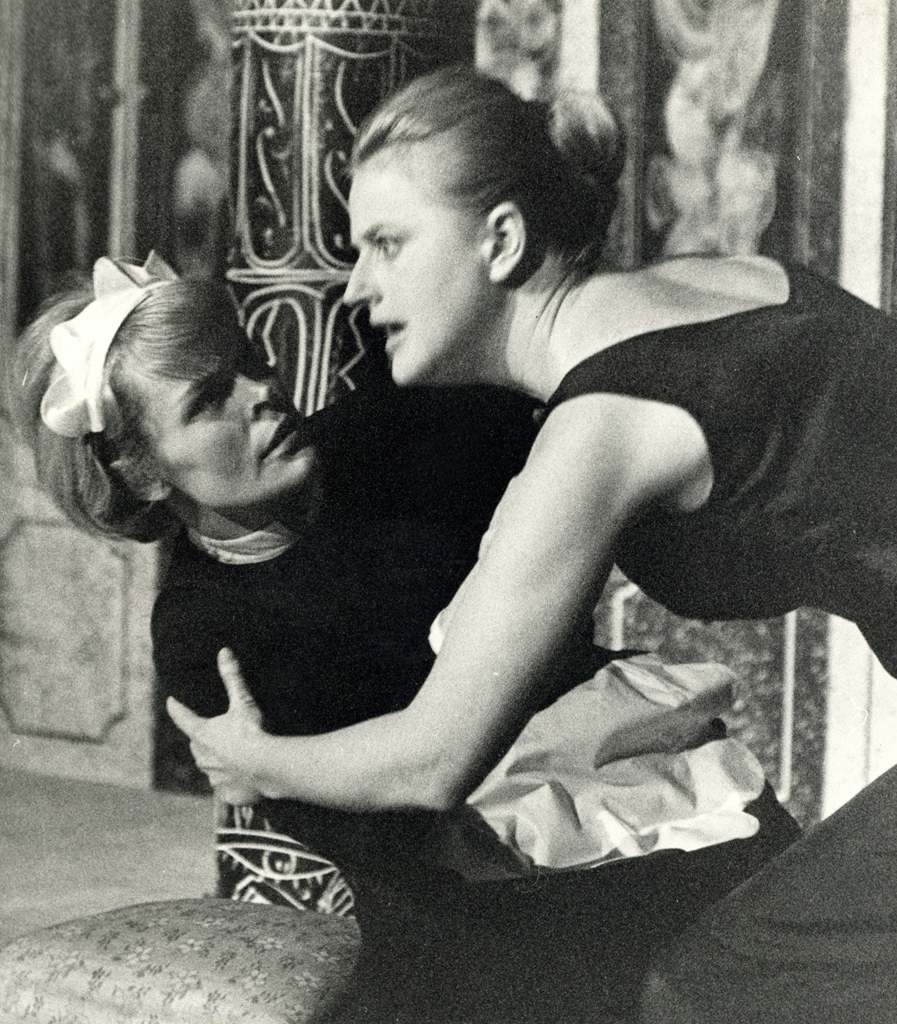
Jean Genet’s play The Maids (Les Bonnes) is not a slice of recorded life. It is a built power ritual. It opened on 17 April 1947 at the Théâtre de l’Athénée in Paris, directed by Louis Jouvet, and has been revived in France, Britain, and the United States. The story sits loosely on the 1933 Papin case in Le Mans. Christine and Léa Papin were real women who brutally murdered their employer and her daughter. They are not characters in the play. The real crime supplies the voltage: servants, a mistress, class hatred, spectacular violence. Genet did not write a documentary. He took those elements as the frame.
In his introduction, Sartre quotes a passage from Genet’s novel Our Lady of the Flowers: if there were a play written for women, it might be cast with adolescent boys. Later productions stretched that idea. Cross-gender casting and drag became common. The maids’ femininity is treated as costume and ceremony, not as naturalistic fact. The roles are adults. Casting a boy is not sexual content about a minor. It is a way of taking gender and power roles apart.
Two sisters trading top and bottom
Solange and Claire are sister maids. When Madame is out, they take turns playing mistress and maid. Whoever is Madame demeans and humiliates her sister. The swap carries a furtive erotic charge: service, insult, costume, and emotional sadism. Solange, the elder, switches between servant and tyrant inside the ritual. Claire, the younger, mirrors her and competes with her across the same line.
Their aim is to kill Madame, imagined as the only way out of submission. Slow pacing, furious arguments, and devotion to ceremonial detail mean they always fail to finish that killing at the climax. For BDSM and fetish readers this is not a manual. It is a map of D/s theater. Two people at the bottom of the social order take turns on top. The absent mistress is both the hated object and the erotic template. “Killing Madame” is an ending that never lands safely. Protocol, costume, scripted insult, and a failed climax are the structure of the night.
From the Greenwich stage to film
In the mid-1970s a Greenwich Theatre revival in London was filmed. Vivien Merchant played Madame, Glenda Jackson played Solange, and Susannah York played Claire. Director Christopher Miles and cinematographer Douglas Slocombe planned a camera that could move freely over the set, trying to carry Genet’s stage devices into film. For many English-speaking viewers this is the screen version they know. Release materials often date it 1975, but the shooting was finished in 1974, for the American Film Theatre.
In that film Genet’s maids do not need a dungeon to show dominance and submission. Costume, voice, posture, and insults timed to the second, plus the fantasy of murder as climax, are enough. Each sister has rehearsed both sides of the whip. When the real Madame returns, the game can collapse. The erotic charge of service stays tied to class hatred.
Men in the maid roles, and later star casts
The production history keeps moving gender around. The first British staging was in French in 1952, under the Institute of Contemporary Arts, first at the Mercury Theatre in Notting Hill Gate, London. Peter Zadek directed. Eduardo Paolozzi designed. Selma Vaz Dias played Solange, Olive Gregg played Claire, and Oriel Ross played Madame. After the transfer to the Royal Court Theatre, Betty Stockfeld played Madame, with sets by David de Bethel. Zadek also directed the first British production in English, which opened on 5 June 1956 at the New Lindsey Theatre Club: Vaz Dias again as Solange, Stockfeld as Madame, Hazel Penwarden as Claire. In New York, Tempo Playhouse staged it in 1955. Julie Bovasso played Claire first, then Solange, and won the first Obie Award for best actress. Off-Broadway was treating Genet’s servant sadism as serious modern theater, rather than a foreign scandal.
Casting men as the maids or as Madame became one way to test the ritual. In 1987 the Royal Shakespeare Company played it at the Barbican, directed by Gerard Murphy and designed by David Ultz. Miles Anderson played Claire, Murphy played Solange, and Patrick Bailey played Madame, three men in the maid and mistress parts. On 12 October 1981 a production directed by Clare Davidson moved from the Dublin Theatre Festival to the Lyric Theatre Studio Hammersmith, with Mark Rylance as Madame, a high-profile man in the mistress role. In 1990 Cesear’s Forum in Chicago cast male actors in drag as Claire and Solange and kept Madame female. Critic Albert Williams in the Chicago Reader linked that choice to the ceremony Genet wanted, “like the sacrifice of the Mass”: endless role changes, with female impersonation that is obviously fake, used as the poetic means.
Roman Viktyuk’s 1988 staging at the Satirikon Theatre in Russia became a landmark: expressive, visually extreme, androgynous, mixing Valentin Gneushev’s physical training, Alla Sigalova’s choreography, and Asaf Faradzhov’s music. It stayed in repertoire for more than thirty-five years and is still tied to The Melnikov Stage (formerly the Roman Viktyuk Theatre). In 2011 Buddies in Bad Times in Toronto used a mixed cast, Diane D’Aquila and Ron Kennell as Solange and Claire.
Blanchett, Huppert, and later revivals
In this century the play has kept drawing star casts. In 2013 the Sydney Theatre Company production, adapted by Andrew Upton and directed by Benedict Andrews, had Cate Blanchett as Claire, Isabelle Huppert as Solange, and Elizabeth Debicki as the Mistress. In 2014 that staging played City Center during the Lincoln Center Festival in New York. Andrews mixed theater and film: video cameras, stylized choreography, underground pop, a lot of profanity, and modern asides, including the Mistress mentioning that McQueen had designed a dress for her.
In 2016 Jamie Lloyd directed Uzo Aduba and Zawe Ashton as Solange and Claire, with Laura Carmichael as Mistress, at Trafalgar Studios in London, using the same translation as the Andrews and Blanchett version. In 2021 at Hobart Playhouse in Australia, Ben Winspear directed Marta Dusseldorp and Essie Davis as the sisters and Stephanie Jack as Mistress.
From Jouvet’s 1947 premiere, through the Obie-winning Off-Broadway run, the Jackson and York film, the RSC’s male cast, Viktyuk’s long Russian run, and star turns by Blanchett, Huppert, Aduba, and others, The Maids keeps coming back because the power ritual still works. Adult readers who map BDSM in literature and theater often set it beside Genet’s other work, and beside later films of domestic D/s and murder-fantasy roleplay. It is not a lifestyle manual. It shows two people building a private theater of top and bottom until the script asks for blood.