
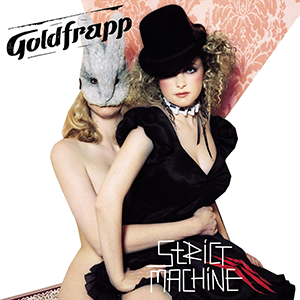
“Strict Machine” is the electronic dance single that folds a neuroscience experiment, control, and sexual machinery into one track. The British duo Goldfrapp wrote it with Nick Batt for their second studio album, Black Cherry. Goldfrapp produced it. Alison Goldfrapp had been reading about experiments in which scientists stimulated rats’ brains so the animals felt pleasure when they obeyed. She wrote from those images, and from what she called the more human side of machines, sex, and control. Actress Gwendoline Christie appears on the sleeve in a rabbit mask. The duo’s tour DVD Wonderful Electric takes its title from the lyric. Listeners who know BDSM did not need a secret reading. Critics called it a future S&M club anthem and tied the images to sadomasochism. It is a song. It is not a lab manual and not a negotiation guide.
Charts
Issued as Black Cherry’s second single on 21 July 2003, “Strict Machine” got strong notices and became Goldfrapp’s second UK top-30 single. A reissue on 10 May 2004 pushed it into the UK top 20, their first. In the United States it topped the Billboard Dance Club chart and reached number 3 on Hot Dance Singles Sales. It won the dance award at the 49th Ivor Novello Awards. Worldwide sales passed 170,000 copies.
On the first UK run it peaked at 25 and spent six weeks in the top 75. The reissue climbed to 20. In Canada it peaked at 26, Goldfrapp’s first charting single there, driven more by club play and fan sales than by BDS airplay. In Australia it reached 54, their only charting single in that market until “Ooh La La” in 2005. After the dance-floor heat of “Twist” and “Black Cherry,” “Strict Machine” became their first U.S. Dance Club Play number one, one week at the top, and a Hot Dance Singles Sales top-three cut.
What the critics heard
Peter Robinson at NME called it a solid-gold hit that should have been number one immediately. Andy Hermann at PopMatters wrote that if a future S&M club anthem existed, this was it. Dorian Lynskey in Blender linked the lyric to sadomasochism and set the track next to Donna Summer’s 1977 “I Feel Love.” Alexis Petridis in The Guardian heard tubthumping drums that recalled Gary Glitter, 1980s arena rock, and hardstep, and he still found the result fantastic and quiveringly sexy. In August 2009 Pitchfork placed it at 379 on its top 500 tracks of the 2000s. For kink readers the consensus is plain: electro-pop that sounds like obedience training and feels like sex.
A rejected remix, a video, and the covers
When Rachel Stevens released “Some Girls” in 2004, critics heard a likeness to Black Cherry and especially to “Strict Machine.” The Manchester Evening News called the similarity startling. The story that attached itself to the single: Goldfrapp had given producer X an unmixed copy to remix, rejected the result, and shortly afterward he wrote the Stevens hit. A refused remix pipeline, allegedly, seeded a near-twin. The producer in that account is named only as X.
Jonas Odell directed the video, graphic design mixed with live action, extending the album’s art direction. Alison Goldfrapp moves through black-and-white animation, dancers with Siberian husky heads, and kaleidoscopic butterflies. The architecture nods to Archigram. Performance was shot in London against bluescreen. Filmtecknarna in Stockholm did the animation. The picture argues the song’s point: a human body as an ornamented machine, desire as pattern, control as glitter rather than dungeon grit.
Other people covered it. The U.K. garage-adjacent trio Band of Skulls cut a folk version for Australia’s Triple J. Suzi Quatro covered the song on her 2011 album In the Spotlight and added two lines from her 1973 number one “Can the Can,” pointing at a melodic kinship. Jon O’Brien of AllMusic called her version a guitar-chugging mash-up of Goldfrapp’s electro reinvention and her own chart-topper. The official video, produced by Victory Tischler-Blue, formerly Vicky Blue of The Runaways, went up on the SUZI QUATRO OFFICIAL YouTube channel on 16 November 2011 and keeps those extra “Can the Can” lines.
The turn away from Felt Mountain
Black Cherry is the shift from the cinematic debut Felt Mountain toward dirtier electronics and club music sitting near glam. “Strict Machine” is the cleanest distillation of that turn. The drums stomp like the Glitter era. The synths feel like lab equipment that found a nightclub. Alison’s voice is both the scientist and the specimen. The Wonderful Electric tour and DVD stretched the lyric into a live brand. Formats and track lists on the original and the reissue stacked remixes for club DJs. That is how a mid-chart UK single became a U.S. Dance Club number one.
The Band of Skulls folk version for Triple J, and Quatro’s guitar mash with “Can the Can,” show the melody can bend. The obedience machine can be a folk confession or a glam stomp. The song does not teach negotiation or aftercare. It does what fetish-coded pop often does: turn laboratory obedience, machine sex, and control into a body-high on a dance floor. Power exchange between people is something those people agree to. It is not the same thing as a lab rat.