
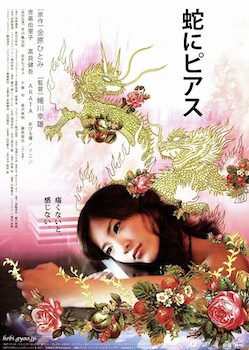
Snakes and Earrings (蛇にピアス, Hebi ni Piasu) is a Japanese novel by Hitomi Kanehara. It follows Lui, a young woman in Tokyo whose fascination with body modification and sadomasochistic sex drives her into increasingly dangerous choices. First published in 2003 in the literary magazine Shōsetsu Subaru as winner of the 27th Subaru Literary Prize, it was republished in 2004 after winning the 130th Akutagawa Prize. Reviews were mixed. Popular and academic critics still treat the book as a document of contemporary Japanese literature—not only for its raw portrait of post-bubble youth, but for the controversial commercialization of the author’s own life. It has sold more than a million copies in Japan, been translated into sixteen languages, and was adapted into a 2008 film by Yukio Ninagawa starring Yuriko Yoshitaka.
For adult, fetish, and BDSM-media readers it is not a how-to and not a romance of negotiated power exchange. It is a cold novel about tongue splitting, large-gauge jewelry, a full-back tattoo, bondage, sadomasochism, street violence, and the erotic logic of self-harm when ordinary feeling fails. Ama’s forked tongue is a love object. Shiba’s shop is a marking room and a sex room. Lui’s body is the site where modification, SM, and numbness meet. Consent in the book is partial, murky, or absent. That murk is the moral weather. Readers who want SSC sermons should look elsewhere. Readers who want to see how Japanese literary culture sold body-mod and SM as a youth-culture event will not find a cleaner case.
Kanehara: Dropout, San Francisco Reading List, the Story She “Had to Write”
As an elementary-school student in Japan, Hitomi Kanehara lost interest in academic subjects and began skipping school to socialize. Her father, Mizuhito Kanehara, a professor of sociology at Hosei University, took her on a year-long research trip to San Francisco, where she occasionally attended an American school. During that stay, with her father’s permission, she began reading fiction by Ryū Murakami and Amy Yamada that carried strong violent and sexual themes. The American year is not a tourist anecdote. It is the permission structure: a sociologist father, English-language school days, and Japanese writers who already treated sex and violence as literary material rather than as scandal to be hidden from a daughter.
She returned to Japan and attended middle school, then became anorexic and engaged in self-harm. Against the wishes of her mother, Chieko, she dropped out during her first year of high school, left home, and began writing stories—including Snakes and Earrings—that drew on cutting, suicidal thoughts, body modification, and living with different boyfriends. She has described the novel as the story she “had to write.” Her father supported the career in practical ways: he arranged for her to sit in a fiction workshop for sophomores at his university, and he edited the manuscript before it went in for the Akutagawa Prize. That scaffolding—workshop access, prize-path editing, a Hosei sociologist as first reader—later complicated the media story of a pure “street” voice. Either way, the heat of the book is inseparable from a biography Japanese magazines later sold almost as hard as the prose: dropout, body-mod culture, self-harm, and a young woman writing sex and violence without apology.
Plot: Forked Tongue, Shiba’s Shop, Teeth as a Love Token
A young woman named Lui admires her new boyfriend Ama’s split tongue, which she likens to the forked tongue of a snake. She has already experimented with large ear piercings. She decides she wants the same modification he has. Lui and Ama visit Shiba, a body-modification and tattoo artist, who begins the process of inserting progressively larger tongue studs. Stretching toward a split is not a single appointment. It is a sequence of hardware and pain. Lui finds herself interested in Shiba, returns to the shop without Ama, and secretly begins a violent sexual relationship with him that includes bondage and sadomasochism. Desire for the modified body and desire for the man who marks bodies become the same circuit.
One night, walking toward a train station, Lui, Ama, and Lui’s friend Maki are confronted in Shinjuku by two apparent gangsters. One grabs Lui’s breast while insulting her. Ama punches both men. After one flees, Ama keeps beating Lui’s attacker, using the heavy rings on his hand to knock out the gangster’s teeth. He gives the teeth to Lui as a symbol of his love. The gift is grotesque and sincere. It is also a preview: affection in this book arrives as damage you can hold. Despite Ama’s obvious feeling, Lui stays disconnected from him and continues the sexual relationship with Shiba, who is creating an intricate tattoo that covers her entire back. Love, violence, ink, and metal share one emotional register. Intensity is treated as proof of contact.
Lui later sees a television news story about a gangster beaten to death in Shinjuku and makes Ama change his appearance to avoid police recognition. One day Ama disappears. His corpse is found with evidence of sexual torture, rape, and strangulation. After she learns he is dead, Lui tries to speed the tongue split by inserting larger studs too quickly, causing intense pain. She stops eating and drinks only alcohol. Grief becomes another modification schedule. She then finds evidence suggesting that Shiba was Ama’s rapist and murderer. She suspects a previous sexual relationship between Shiba and Ama, but when a police investigator asks whether Ama was bisexual, she insists that he was not. With Ama gone, Shiba finishes the back tattoo. The relationship with Shiba slides into a more domestic pattern. Lui considers putting in a still larger tongue stud. The ending refuses tidy moral closure. Modification continues. Domestic quiet with a possible murderer is not redemption. It is another kind of seal.
Themes: Tribe, Gender, Pain, Virtuality, Postwar Bodies
Academic writing on the novel outside Japan has clustered around subcultural resistance, gender roles, and commodification. Mark Driscoll, in Cultural Critique, argued that the graphic descriptions of tattooing, self-harm, and violent sex revealed subcultures many readers did not know, but that Kanehara’s portrayal of her characters as “consumerist, closed-off, and unwilling or unable to communicate with people outside their tribe” reinforced popular stereotypes about Japanese youth—especially the part-time workers called freeters. David Holloway, in Japanese Language and Literature, reached a similar conclusion: Lui looks like a fringe character rejecting society’s rules, then ends up in a domestic role consistent with mainstream expectations of Japanese women. The subculture, in that reading, is a costume the plot takes off.
Rachel DiNitto, in Japan Forum, argued that expecting the book’s subcultural furniture to express resistance to mainstream Japan actually reflected a Western literary bias. She proposed instead that the novel resists through Lui’s experience of her own physical body in a society organized around commodification and virtuality. Pain, metal, and ink become ways to feel a body that shopping and screens have made abstract. Both DiNitto and Holloway have also placed Snakes and Earrings next to Japanese literature from the years just after World War II—Tamura Taijirō’s Gate of Flesh among them—in which characters take back control of their bodies after coercion and defeat, then use those bodies as sites of protest. The comparison is not that Kanehara is writing occupation Tokyo. It is that the body, once again, is the only politics the characters can afford.
Japanese scholars have put the book inside domestic literary trends rather than only inside “youth culture” sociology. Sociologist and poet Kiriu Minashita points to Lui’s personal experience of pain as a way to mediate between self and society, and treats the novel as part of an early twenty-first-century turn that takes women’s experience as a subject in its own right, not only as a function of relationships with men. Literary scholar Eisuke Kotani observes that Snakes and Earrings is a prominent example of a trend also visible in Motoko Arai and Risa Wataya: first-person, real-time narration of personal experience in everyday language, closer to the narrative feel of anime and manga than to high literary past tense, which leads readers to imagine that the main character is the author. That collapse of Lui into Kanehara is not an accident of naïve reading. It is what the style invites—and what the prize-week cameras then sold as authenticity.
Subaru Prize, Akutagawa, Street Fashion, a Million Copies
Snakes and Earrings won the 27th Subaru Literary Prize (すばる文学賞) for unpublished stories in 2003 and appeared for the first time in the November 2003 issue of Shōsetsu Subaru. In January 2004 it won the 130th Akutagawa Prize. It was the committee’s overall favorite, but the award was shared with Risa Wataya for Keritai Senaka, making the twenty-year-old Kanehara and the nineteen-year-old Wataya the youngest winners in the prize’s history. Committee member Ryū Murakami—the same writer Kanehara had been allowed to read in San Francisco—praised the “radical depiction of our time” in the winning works. The circle is almost too neat: the violent-sex novelist on the jury, the dropout daughter of a sociologist, a book about a split tongue.
Kanehara arrived at the announcement ceremony in “an off-the-shoulder, cut jersey shirt with exposed bra straps, a flared mini skirt, stiletto heels, mid-thigh nylons, multiple earrings and grey-tinted contact lenses.” Press accounts set that street-style image against Wataya’s “demure and old-fashioned” presentation. Interviews and photographs ran not only in national newspapers but in Japanese editions of GQ and Cosmopolitan and in Weekly Playboy. Kanehara’s interviews often discussed suicide and self-harm, reinforcing the public idea that she was an authentic narrator of Japanese youth culture. Rachel DiNitto later called the commercialization of that image “unprecedented.” Critics claimed the novel was chosen for marketing value to younger audiences and that the selection proved declining literary standards. Much of the attack landed on Kanehara rather than on the sentences. Janet Ashby, reviewing both prize novels in The Japan Times, criticized the “element of sexism” in the media hype but also found both stories “somewhat of a letdown,” with Snakes and Earrings carrying a “particularly unsatisfactory ending.”
After the prize the story was republished beside Wataya’s winning work in Bungei Shunjū and issued as a book by Shueisha. Within three months the Bungei Shunjū issue had sold more than 1.1 million copies—roughly double the magazine’s usual sales—and the book edition of Snakes and Earrings had sold more than 500,000. Combined with later printings the novel passed a million copies in Japan. Contemporary coverage noted that many middle-aged men bought Kanehara’s work but preferred the magazine edition to the book, whose cover was designed to appeal to women readers. The sales spectacle drew international attention, including a New York Times profile that called the novel “a powerful portrait of this post-bubble generation.” The prize, the outfit, the Playboy interview, the doubled magazine run, and the male readers hiding the women’s-cover paperback form one event: literature as youth-culture commodity, with SM and body mod as the product shot.
English Translation: Tokyo Nihilism, Geisha-to-Schoolgirl, a Strained Ending
Soon after the Japanese book appeared, Dutton bought English rights. In 2005 David Karashima’s translation was published by Dutton in the United States and Vintage Books in the United Kingdom. Reviews were generally positive. Kirkus Reviews called it “fascinating and unnerving.” Marie Claire called it “riveting.” The Village Voice called it “a gnarly blast of Tokyo nihilism.” Maya Jaggi, in The Guardian, praised “a debut novel about alienation that is shocking but not sensational” and said it “offers more than sociological interest.” That last clause is the defense the book needed in English: not only a dispatch from Japanese youth, but a novel.
English reviewers also placed it in broader Japanese literary fashion. Andrew Lee, in the Financial Times, praised Kanehara’s “simple, visceral eloquence” about Tokyo youth and cited the book as an example of a trend elevating high-school girls toward the iconic cultural status once held by the geisha. Victoria James, a former Japan Times editor writing in The Independent, grouped it with similarly explicit work by Ami Sakurai and Mari Akasaka, praising quality while doubting any long-term mainstream impact of young women’s novels about sex. Criticism of the translation often targeted length and ending. Prudence Peiffer in Library Journal found the “hasty conclusion” predictable even while praising description and character work. Christine Thomas in Artforum praised “keen observation of everyday reality” but found the ending strained by an effort to redeem the heroine. Karen Karbo in Entertainment Weekly compared the book to Bret Easton Ellis’s Less Than Zero, calling the ending “both chilling and oddly moving” while questioning originality. Across languages the pattern holds: strong sensory writing, cultural curiosity, unease about how the story closes.
Body Mod, SM, and Why Kink Readers Still Open It
For BDSM, body-mod, and fetish audiences the charge is not soft power-exchange romance. Progressive tongue stretching, planned bifurcation, large-gauge jewelry, a full-back tattoo, bondage, and sadomasochistic sex are written as linked technologies of sensation when ordinary affect will not fire. Ama’s street beating and the gift of teeth, Shiba’s double role as artist and sexual predator, Lui’s self-destructive acceleration of the split after grief—these sequences treat modification and SM as twin routes to feeling. The book does not lecture on SSC or RACK. It shows desire without a safety net. Gender and power stay unstable. Lui chooses Shiba and is marked by him. Bisexuality is raised over Ama’s corpse and denied to the police. The Shinjuku grope and Ama’s tortured body refuse to keep violence safely inside “play.” A kink-literate reading can still be exact: the shop scenes are about pain, marking, and erotic hierarchy; the murder is not a scene. Fantasy is not a license to kill. Kanehara is writing the collapse of that distinction, not a dungeon manual.
The tongue is the book’s central fetish object and its central metaphor. A snake’s tongue tastes the air. A split human tongue is a bought, stretched, forced version of that organ—identity you can flash on the train. Lui wants what Ama has before she wants a stable account of who Ama is. Shiba sells the process and then sells a different kind of intensity in private. The back tattoo is the slower twin of the tongue: months of needles instead of a sequence of studs, a picture that will not come off when the relationship does. Readers who live around piercing studios and rope will recognize the economy. Readers who do not will still feel the novel’s claim that a body can be the only remaining communications device.
Ninagawa’s Film: Shibuya Crossing, a Car Crash, CGI Hardware
A film adaptation directed by Yukio Ninagawa and starring Yuriko Yoshitaka, Kengo Kora, and Arata Iura began principal photography in November 2007. Ninagawa moved the story from Shinjuku to Shibuya so he could open on a panoramic shot of Shibuya Crossing, a gesture he said was inspired by Werner Herzog’s Fitzcarraldo. The transplant is not trivial. Shinjuku in the novel is night, gangsters, and a beating that becomes a news item. Shibuya Crossing is the postcard of Tokyo crowds. The film announces itself as a city spectacle before it becomes a body-mod story. Ninagawa cast Yoshitaka after an audition that required her to perform in the nude—an old director’s test that the production record simply states, and that later reviews of her performance have to live beside.
During the shoot Yoshitaka was in a serious car accident and spent several days in intensive care before returning to set. She later said the experience helped her understand her character’s pain. Most of the tattoos and piercings on screen, including Lui’s tongue piercing, were makeup and computer-generated effects. Kanehara wrote original lyrics for the theme song, which Chara performed. The literary author’s voice thus re-enters the adaptation as pop lyric rather than as a screenplay credit. The R-15 film opened in Japan in September 2008. It ranked fifteenth at the box office on its opening weekend with about US$100,000 in receipts and eventually grossed about US$510,000 in domestic theatrical release—respectable for a literary SM adaptation, not a blockbuster. Yoshitaka took Best Newcomer at the 32nd Japan Academy Prize, a Best Newcomer prize at the 51st Blue Ribbon Awards, and a Best Newcomer prize at the Japanese Movie Critics Awards. The film traveled to the 2008 Pusan Film Festival and the 2009 New York Asian Film Festival.
International reviews were rough. Russell Edwards, in Variety, panned the directing and the male leads while calling Yoshitaka an “alluring actress” who still “lacks the chops to carry the role.” Charles Webb, at Screen Anarchy, called it “the worst kind of art film that is unable to stimulate given its vacuous characters and inane situations.” The gap between Japanese newcomer prizes and English-language pans is familiar: a domestic star-making vehicle for a young actress in a scandalous literary property, and a festival object that foreign critics found empty. Viewers who knew Kanehara’s media image more than her sentences met Lui again as a cinematic body—tongue hardware, ink, and dangerous desire framed for film, much of the hardware painted and rendered rather than worn.
Sixteen Languages, One Commodity
The translation list is itself a reception history. Korean appeared in 2004 as 뱀에게피어싱, translated by Chong Yu-Ri for Munhak Tongne—fast enough to ride the Akutagawa news. In 2005 came Spanish (Serpientes y piercings, Makiko Tsujimoto, Emecé), Italian (Serpenti e piercing, Alessandro Clementi, Fazi), English (Karashima, Dutton), Chinese (蛇信舆舌環, Xiao Shimei), and Catalan (Serps i pírcings, Albert Mas-Griera, Columna). 2006 added Danish (Slanger & piercinger, Sara Koch), Czech (Hadi a náušnice, Jan Levora, Argo), Dutch (Slangen & piercings, Paul Wijsman, Prometheus), German (Tokyo love, Sabine Mangold, List—the one title that abandons snakes for a city-and-romance frame), and Greek (Η γλώσσα του φιδιού, Giannis Spandonis, Oceanida). 2007 brought Polish (Języki i kolczyki, Witold Nowakowski, Albatros) and Hungarian (Pirszinget a kígyónak, Mónika Nagy, Magvető), plus a Portuguese-language Brazilian edition, Cobras e piercings (Jefferson José Teixeira, Geração). Swedish followed in 2009 (Ormar och piercing, Helen Enoksson, Modernista) and Vietnamese the same year (Rắn và khuyên lưỡi, Uyên Thiểm, Văn học). Sixteen languages, a German retitle that sells Tokyo love instead of reptiles, and a speed that matches the Japanese sales spike: this is how a short, savage first novel becomes a world object.
What the Film Could Not Carry, and What the Book Still Does
The adaptation’s production facts explain a lot of the foreign pans. A nude audition, CGI tongue hardware, a relocated crossing, a car crash, and a pop theme with the novelist’s lyrics are a director’s toolkit for turning a short, cold first-person novel into a festival object. They are not a toolkit for Lui’s numbness. Ninagawa’s Shibuya opening, borrowed from Herzog’s obsession with an impossible ship, announces scale. Kanehara’s prose announces the opposite: a girl who cannot feel unless metal and rope intervene. Yoshitaka’s newcomer prizes say the Japanese industry wanted a star. Edwards and Webb say the export print did not have a center. Both can be true. The book’s center was never cinematic crowds. It was a mouth being stretched on a schedule.
That is why kink readers still need the novel more than the R-15. The film can show a back piece and a stud. It cannot easily show the police question about bisexuality, the refusal, the slide into domestic quiet with a man Lui believes killed Ama, and the last thought about a larger piece of jewelry. Those are literary moves. They are also the SM-adjacent ethical file: marking as intimacy, murder as the outside of play, housework as the last protocol. The million Japanese copies and the sixteen translations sold the author’s image and the snake-tongue hook. The sentences still do the colder job.
How to Read It on a BDSM Literature Map
Snakes and Earrings sits with other literary SM and body-ordeal novels rather than with instructional leather nonfiction. It is closer to the shock-youth line of Ryū Murakami and Amy Yamada—the books Kanehara was allowed to read—than to protocol handbooks or to the French lineage of Story of O. O is trained into a system. Lui is not trained. She shops for sensation, sleeps with the artist who marks her, and stays after the other man is found raped and strangled. The Akutagawa machine then trained the author, or at least dressed her, for a different kind of protocol: magazines, Playboy, a million copies, a Ninagawa film, sixteen languages.
The usable takeaway for adult readers is double. First, the novel is a primary early-2000s text of Japanese body-mod and SM as youth style: split tongue, stretchers, full-back ink, bondage, sadomasochistic sex, the studio as erotic workplace. Second, it is a warning about the collapse between play, self-harm, and real homicide. Ama’s murder is not a kinky twist. It is the book’s ethical ice. Shiba can finish a tattoo and share a kitchen after that ice. Lui can think about a larger stud. Kanehara will not tell you that this is healing. Critics who wanted redemption found the last pages strained. Critics who wanted resistance found a girl going domestic. Fetish readers who want the hardware will find it. Fetish readers who want a community ethics will find a vacuum. That vacuum is why the book still belongs on this site: not as a model household, but as the literary record of what body modification and SM look like when they are the only remaining way to feel, and when the man with the needles may also be the man who kills.