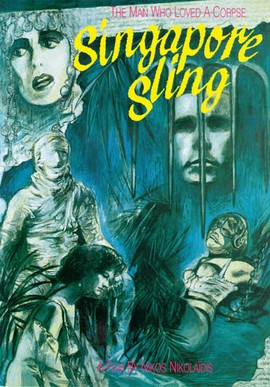
On 6 December 1990, Greek director Nikos Nikolaidis released Singapore Sling, a black-and-white underground art-horror film, in theaters. The Greek title is Singapore Sling: Ο Άνθρωπος που Αγάπησε ένα Πτώμα. In English it is often called The Man Who Loved a Corpse. Labels slide off it: film noir and neo-noir, black comedy, exploitation, thriller, crime, eroticism, horror. None of them fit cleanly. It is a nightmare that treats sex as a power game, and it is the film that made Nikolaidis’s cult name abroad. He had been directing since the early 1960s, and Western audiences barely knew him before this. Synapse Films issued the North American DVD. For a long time that was the only widely available home-video title of his in North America. Vinegar Syndrome released a Blu-ray in March 2024. The film also played in official selection at the Rimini Film Festival.
Adult viewers who know extreme cinema and BDSM culture should not take it as an SSC lesson. SSC here means safe, sane, and consensual. What is on screen — sadism, incest, necrophilia, torture — is staged as art-house decadence. The power exchange is non-consensual, criminal, and fatal. There is no safeword and no aftercare. The disorder is a psychotic inheritance, not negotiated kink.
The story is a closed mansion. The roles are played by adults. Two beautiful, deeply delusional women, a mother and her adult daughter, live inside the memory of a sadistic father. The film’s backstory is a crime, not a sex scene to linger on: while he was alive, the father raped the daughter when she was eleven, and he murdered servants. After his death he is a mummified corpse. The adult daughter has sex with that corpse on camera. The women kill servants and bury them in the garden. The film opens on a stormy night. They are half-dressed, just finished burying their disemboweled chauffeur, and they start another sex-and-murder game.
A lovesick detective arrives. He has been shot, and he has spent three years searching for Laura, the woman he loves, who is missing. Laura had been in this area. These two women already murdered her, and they decorated the kitchen with her viscera, shown in flashback. The daughter resembles Laura and wants male company. They take the bleeding detective prisoner. He will not give his name. They find a cocktail recipe in his notebook and call him Singapore Sling. Captivity becomes eroticized atrocity. He is bound and chained to a bed, vomited on, electrocuted, used as a sex slave, and put through tortures they treat as entertainment. As his strength returns, he joins the games more actively.
The women panic because the dead father’s kitchen knife is missing, and because they catch the detective digging a deep hole in the backyard. Even in madness they are lucid enough to know more than one person is going to die. Decadence and madness push the drive underneath. The daughter rebels against her mother’s authority and, with Singapore Sling, kills the mother. He then takes the mother’s place in the sexual scripts. During a reenactment of Laura’s murder, he fixes the kitchen knife to his penis and stabs the daughter, who is playing Laura. As she bleeds out she shoots him. He staggers to the garden and falls into the pit he dug. All three die. Lust, revenge, and dirt close the circuit.
Meredyth Herold plays the daughter. Panos Thanassoulis plays the detective, Singapore Sling. Michele Valley plays the mother. Nikolaidis builds the house’s grammar from bondage, captivity, forced sex, electrocution, vomiting, and necrophilia. Renaming the detective after a cocktail wipes identity the way a scene name can, except this “scene” is kidnapping and torture. The BDSM-coded game is not built on agreement. It is the psychotic legacy of a father who was a rapist.
While shooting, Nikolaidis thought he was making a comedy with elements taken from ancient Greek tragedy. When European and American critics called it one of the most disturbing films of all time, he started to doubt himself. After British censors banned a release in England, his conclusion was that something is wrong with all of us. That line is now part of the film’s legend, the director’s intent set against the audience’s trauma. The Icelandic neo-psychedelic band Singapore Sling took its name from the film. Frontman Henrik Björnsson told Belgium’s VRT Radio 1 in June 2003 that he chose the name because he liked the sound. He had been looking for a film called Singapore Sling, and only later described it as a dark 1990 Greek film about a man who has sex with a corpse and is called Singapore Sling. At the time of the interview he still hoped to see it.
Nikolaidis’s later film The Zero Years is another story of perversion and dominance, and it did not reach this cult peak. In November 2005 he announced that he intended to leave filmmaking for music. Scholars still work on the film. Mikela Fotiou’s 2014 conference paper pairs Singapore Sling with Nikolaidis’s See You in Hell, My Darling, on monstrous women and patriarchal subversion.
The picture is high-contrast black-and-white, nodding at classic noir while staging acts Production Code noir could not show. The mansion is a closed system: graves in the garden, viscera in the kitchen, chains in the bedroom. Thunder, rain, and half-dressed burial labor open it like a sick joke on gothic romance. Dialogue and the naming ritual — a cocktail label stuck on a silent man — mock identity. Nikolaidis mixes the ambition of ancient tragedy with exploitation content, which is why the labels fail. Tragedy wants inevitability. Exploitation wants shock. The film supplies both, and the triple death feels like structure rather than a twist. Next to later films that shoot BDSM romance as something respectable, this one refuses rehabilitation. As a historical document it shows how far underground European art film pushed eroticized cruelty around 1990. Britain banned it. Cult labels prized it. It is still in circulation. Real dungeon practice belongs on a different shelf.