
See-through clothing is not simply nudity. It is dress made so the body or the underwear shows through lace, mesh, chiffon, gauze, translucent latex, and materials like them. In fashion history it swings between scandal and high style. In fetish culture, and in the scene next to BDSM, it is exhibition play: skin suggested, genitals or breasts half revealed, without full nudity. This kind of cloth is often called illusion fabric, because it fakes the look of bare skin while the person is still dressed. Fishnet structures in sportswear, fully clear plastic rainwear, and latex’s natural translucency all feed rubber-fetish wardrobes. Some materials turn see-through only when wet or under hard light. That logic is built into the fiber. The people wearing it here are adults who have agreed.
From a Queen’s Chemise to the Caricaturists
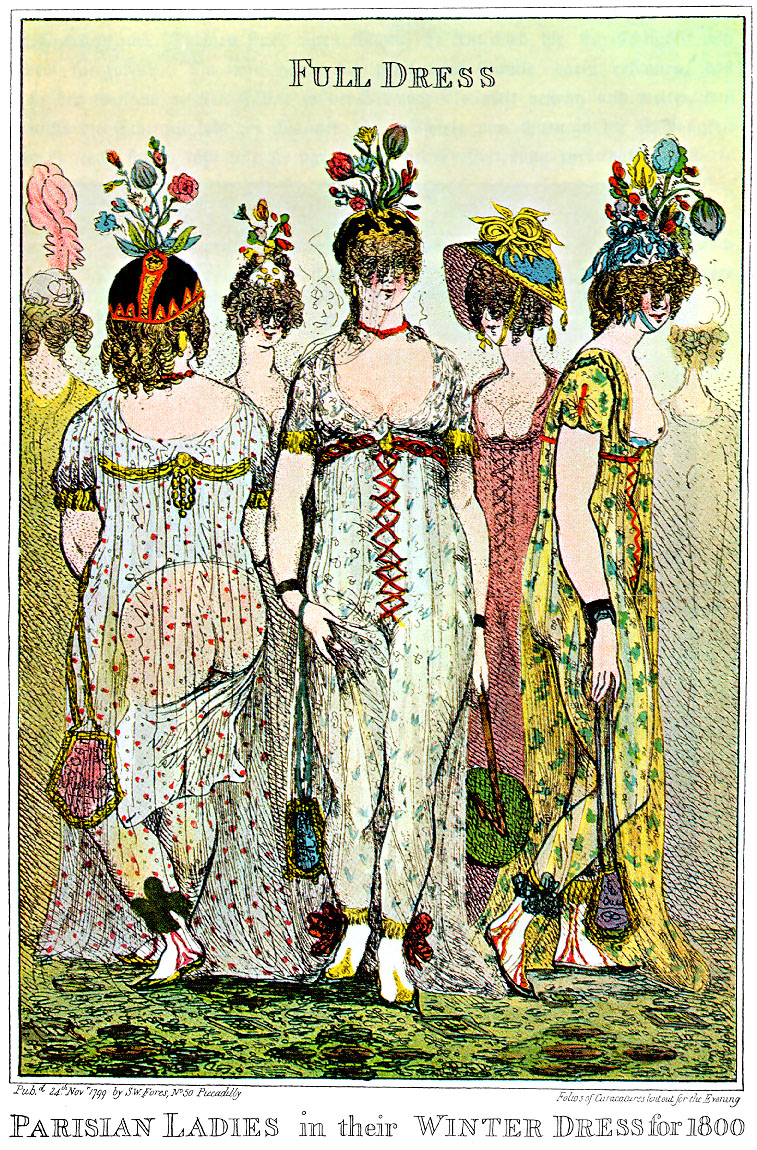
In the 1770s and 1780s, actresses in “Oriental” stage roles wore wrap dresses of thin gauze. Horace Walpole and others attacked them for looking like dressing gowns and for showing the body under muslin. Marie Antoinette’s 1783 portrait by Vigée Le Brun, in a white muslin chemise à la Reine that resembled an undergarment, helped push the look into fashion. Visiting France in 1784, Abigail Adams was shocked by how sheer and revealing fashionable Frenchwomen’s dresses could be, including those favored by Madame Helvétius. By the late 1790s Louis-Sébastien Mercier described demi-mondaines dressed à la sauvage: semi-sheer muslin over a flesh-colored bodystocking, breasts, arms, and feet bare. He blamed public nude statues for teaching the immodesty. Around 1800, neoclassical translucent muslin clung to the body and made “nudity à la grecque” a public spectacle. Caricaturists such as Isaac Cruikshank mocked transparency as a fashion vice. Through the nineteenth century, summer and evening dresses often used transparent cloth, but usually with a lining, or over an opaque layer, so polite society could still call it modest. Portrait painting already runs the modern fetish game. Sheer gauze sleeves over silk, ball dresses of sheer cloth over colored underdresses, black satin with transparent white gauze sleeves, Tissot’s sheer summer dresses with the lining visible, Klimt’s Sonja Knips in densely gathered sheer pink chiffon: each picture negotiates “I am dressed” and “you can see.” A mesh bodysuit at a party signs the same contract.
Peekaboo Blouses and the X-Ray Dress
In the early 1900s the peekaboo waist — a blouse of broderie anglaise or sheer fabric — drew complaints that flesh showed through embroidery eyelets or thin cloth. In 1913 the so-called x-ray dress, a gown judged too sheer or too revealing, set off a moral panic. That August the Los Angeles police chief said he would seek a law banning “diaphanous” x-ray dresses on the street. Portland mayor H. Russell Albee ordered the arrest of women in gowns cut too low, or split to the knee, under the same loose label. In 1914 Jean-Philippe Worth of the House of Worth faced a client who objected that her taffeta lining was thicker than cigarette paper. Worth warned that a thinner lining would create the x-ray-dress effect. Australian papers joined in. The Daily Telegraph of 24 November 1913 attacked “freak dresses” and peek-a-boo blouses of extreme transparency, and low-cut blouses that “invite pneumonia,” using public-health rhetoric as a weapon against sheer fashion.
Runway Shock and the Red-Carpet Naked Dress
In the late 1960s transparency made headlines. At a 1967 Missoni show in Florence’s Palazzo Pitti, Rosita Missoni had the models remove bras that were showing through the knits. Catwalk lights then rendered the clothes unexpectedly transparent over bare breasts. Yves Saint Laurent followed with see-through looks. In London, Ossie Clark showed sheer chiffon meant to be worn without underwear. The jewelry house Cadoro, designer Daniel Stoenescu, answered with “body jewellery”: metal-filigree breastplates inspired by a Pompeii Venus, working like bras you were supposed to see under a sheer blouse. In 1978 Patti Smith wore a see-through slip inside out on the cover of Easter and froze punk-era sheer into a rock image. A see-through dress Kate Middleton, later Princess of Wales, wore at a 2002 charity fashion show sold at auction on 17 March 2011 for $127,500. Sheer scandal has a resale price. From about 2006, designer runways used see-through fabrics heavily, feeding the sheer-fashion talk that dominated from 2008 on. Celebrity carpets kept almost-nude dressing in the mainstream. Megan Fox’s 2021 MTV VMA look showed torso and lingerie. A 2023 black sheer traced midriff and navel. Bianca Censori’s transparent mesh mini at the 2025 Grammys looked like full nudity underneath. Charli XCX’s sheer black dress at the 2025 Brit Awards left her breasts visible. The 2025 Vanity Fair Oscar party brought another wave of sheer “naked dresses” with underwear deliberately on show. High fashion and exhibition kink share the outline: the most reveal you can get under the smallest excuse of cloth.
On the Floor: Controlled Reveal and Material Fetish
Scene use splits roughly three ways. First, controlled reveal: sheer over lingerie you chose, so someone can decide what the room sees. Second, forced display inside a negotiated D/s dynamic — a submissive sent to a club in illusion mesh with no bra, or told to change into a wet-look sheer after a water scene. Third, material fetish: latex that goes translucent under light, clear PVC over gear, fishnet as a second skin that is almost not there. Agree photography rules, the venue’s dress code, and exit clothes beforehand. Sheer that works under dungeon red light can read as fully nude under a phone flash. Keep an opaque cover-up for the street and for cooling down. Sheer knits barely insulate, so in indoor temperature play the goosebumps are both a look and a logistics problem. See-through clothing is not always labeled BDSM gear. It is still core display tech for exhibitionism, a femdom presentation, a submissive’s parade dress, club protocol, and styling that sits next to latex and PVC. From Marie Antoinette’s chemise, through x-ray-dress bans, to modern red-carpet naked dresses, sheer fabric has long been policed as public sex, and markets have kept selling it. For an adult reader it is a tool: runway power, dungeon display, and the slow game of showing everything while still claiming you are dressed.