
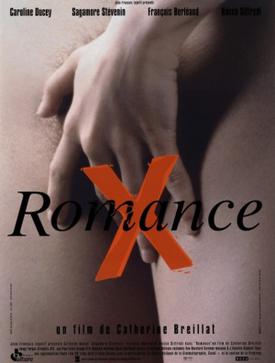
In 1999 the French director Catherine Breillat wrote and directed the arthouse film Romance, also known as Romance X. It is a landmark of late-1990s European “new extremism.” Breillat later called Anatomy of Hell a sequel in spirit. Romance is the film that made the method internationally notorious. Explicit sex on screen, including unsimulated acts, is used to map female desire, humiliation, bondage fantasy, and emotional emptiness. It is not industrial porn packaging. Breillat treats sex as philosophy and as combat. For adult viewers who follow BDSM and fetish culture, the film matters because it will not keep Marie’s sexual exploration inside a tidy lifestyle-consent frame. The result is formally daring and ethically contested.
Plot: from frustration to distance
Marie, played by Caroline Ducey, is an adult schoolteacher, romantically involved with Paul (Sagamore Stévenin) and frustrated by how little sexual interest he shows. One morning she meets the porn performer Paolo (Rocco Siffredi) in a bar and has sex with him. Separately, Roberto, a headmaster figure played by François Berléand, takes her home for a BDSM scene. Marie eventually asks him to stop, then admits she has imagined being tied and implies that she enjoyed being gagged.
On the way home a stranger rapes her in a stairway. The man leaves just as Paul returns, and Paul does not see what happened. After another session with Roberto, Paul shows a strong sexual interest and accidentally impregnates Marie. After a prenatal checkup reveals the baby’s sex, they have sex for the first time in months. It is also their last time. After a miserable night out, Marie wakes about to go into labor. Paul is already unconscious. Furious, she turns on the gas and leaves. Roberto drives her to the hospital. The film’s cruel logic finishes the story: she delivers the child, and Paul dies in the gas explosion. As the coffin is lowered, Marie watches from a distance with the baby in her arms. Casual sex, bondage that looks negotiated, rape, pregnancy, and lethal domestic rage share one cold climate.
Cast and the shoot
Breillat puts arthouse actor Caroline Ducey opposite hardcore star Rocco Siffredi on purpose, collapsing the line between prestige cinema and the porn labor market. The cast also includes Sagamore Stévenin, François Berléand, Ashley Wanninger, Emma Colberti, and Fabien de Jomaron. Sex on set went past polite simulation. Breillat has said an actor never pretends, that she does not impose more than the film absolutely requires, and that she still goes as far as the film requires. Ducey took the part knowing that “going all the way” was in the deal. Accounts of the shoot say she began thinking the film might help her leave a sexual relationship, then decided she wanted to stay with her boyfriend, and by the end was in considerable distress. The explicit coitus between Ducey and Siffredi forced classification boards to renegotiate what an arthouse film could show.
Release and classification
In Europe, Romance played mainstream arthouse circuits. The U.S. version was cut down to an R rating. The European original stayed unrated. The British Board of Film Classification passed the cinema version uncut. Home video briefly lost an ejaculation shot. In 2004 the film aired late at night on German public television. In Australia, the cable network World Movies showed the uncut original. Classifiers first refused a rating, then awarded R18+ on appeal, a case widely described as helping actual sex into Australia’s R18+ category. In Canada, particularly Alberta and the Maritimes, explicit sex was judged gratuitous and the film received A and XXX-style ratings. In June 2008 the Dutch public broadcaster VPRO aired the original in an erotica arthouse series. Each place had to decide whether Breillat’s sex was art, porn, or both.
2024: Ducey’s account
In 2024 Ducey published the autobiographical book La Prédation (“The Predation”), describing what she calls traumatizing sexual assault during filming, especially the staircase assault, and holding Breillat responsible. Before the shoot she says she raised concerns about scripted explicit assault involving simulated cunnilingus and sodomy. The director, she says, treated those lines as plot devices and promised that not everything on the page would be pictured. On the day, Ducey learned the “simulated” scene would be shot more explicitly. Breillat asked her to remove her pantyhose and pull down her underwear for realism. Trusting the director, she did. During the take, she says, the actor playing the attacker performed unsimulated cunnilingus without her prior consent and without warning from anyone on the production. She describes freezing, then coming back to herself at the sound of the film running out, and threatening the actor to stop. She also writes that Breillat masturbated the male actor so he could keep an erection for a second take that was fully simulated. Ducey says her contract stated the film would not be classified as pornography and that she would not take part in unsimulated sex. Breillat’s reply is that those scenes were not in the contract, but the actress agreed to film them anyway. Ducey has publicly refuted that, including in a sit-down interview for the French outlet Konbini. On-screen BDSM and sexual extremity are not automatically an ethical production.
Where it sits for adult viewers
Scholars have treated Romance as a map of female subjectivity and desire, including courtly love, desublimated desire, “horrible sex,” and shame. For adult viewers the film is still a hard, uncomfortable object. Submission and bondage are on screen. So are rape, a fight over how the images were obtained, and an ending in death rather than mutual aftercare. It belongs on a serious BDSM-media map as arthouse extremism about power and desire. It is not a lifestyle recommendation and not a model for how to run a scene. Watch it, if at all, with the formal daring and the production-ethics argument in view at the same time. It is also not a simple feminist endorsement.
![CN-213 Peach-Ass Girl Fierce Enema Misuzu Igarashi CS-216 [Exclusive]](https://bdsmwild.com/wp-content/uploads/2026/07/CN-213-CS-216-Exclusive.jpg)

![[Art Video] 1693 SM Madness VOL.11 Lewd Cheating Wife Punishment Method Natsuyo Saeki [Exclusive]](https://bdsmwild.com/wp-content/uploads/2026/08/Art-Video-1693-Exclusive.jpg)