
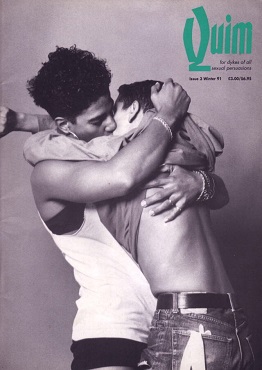
The full title is Quim: for dykes of all sexual persuasions. It was a British sex-positive lesbian softcore magazine, published from 1989 to 1994, with one further issue in 2001. Sophie Moorcock and Lulu Belliveau edited it. Belliveau had been a photo editor at the American women’s erotica magazine On Our Backs. The subtitle states the bet: lesbian sex does not have one correct answer. The magazine made room for different desires, kink, and explicit heat. It was written for adults.
Three things fed it. Shocking Pink was a young women’s zine published in London from 1979 to 1992. Chain Reaction was a lesbian S/M club that opened in Vauxhall in 1987. Sheila McLaughlin’s 1987 film She Must Be Seeing Things also sat behind the tone, and that film had already split opinion inside lesbian circles. Issues came out when money and copy were there. It was not a newsstand monthly.
The line was anti-censorship and pro-sex. Almost nothing was filtered inside the office. Most pieces came from volunteer contributors. Quim ran articles, fiction, art, and photography on fantasy, orgasm, masturbation, safer sex, sex toys, and sadomasochism. In 1991 a publication called Quim Notebooks circulated in gay bars and bookshops to collect stories and ideas. Issue one interviewed Susie Bright, editor of On Our Backs. Issue five focused on black lesbians’ lives. Issue six, the last, covered the eviction of a lesbian house and direct-action hub on Bird in Bush Road, and put that housing fight next to the sex.
Fiction came from Pat Califia, Jane Solanas, Jo Fisk, and Leonora Rogers Wright. Photography included work by Della Grace and Lola Flash.
The first issue met a hostile response, and two years passed before issue two. Because the material was explicit and sadomasochistic, lesbian and gay bookshops refused to carry it, including Sisterwise and Gay’s the Word. The gay press kept giving it bad reviews. Groups that opposed discrimination against gay people still treated lesbian S/M as too much sex, too much pain, or the wrong politics.

![Legend of Shima 113 Legend of Shima 113 Male and Female Slaves 2 ~ Sadistic Love and Hate ~ -Shikou Shima- [Shima Planning]](https://bdsmwild.com/wp-content/uploads/2026/08/Legend-of-Shima-113.jpg)