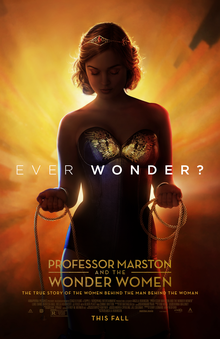
Professor Marston and the Wonder Women is a 2017 American biographical drama about psychologist William Moulton Marston, creator of the comic-book character Wonder Woman. Written and directed by Angela Robinson, it stars Luke Evans as Marston, Rebecca Hall as his legal wife Elizabeth, and Bella Heathcote as Olive Byrne, the Marstons’ polyamorous life partner. JJ Feild, Oliver Platt, and Connie Britton also feature. The film premiered at the 2017 Toronto International Film Festival and opened in the United States on 13 October 2017. Critics largely praised its thoughtful portrayal and the three leads—especially for adult viewers interested in how polyamory, feminist psychology, and bondage-adjacent fetish imagery fed the origin myth of a mainstream superheroine.
Plot: 1945 Testimony Framing 1928–1940s Life
The story is told in flashbacks from a 1945 testimony William gives to representatives of the Child Study Association of America—public moral scrutiny as the frame around private erotic and family experiment.
In 1928, William and Elizabeth teach and research at the associated Harvard and Radcliffe Colleges. William hires student Olive Byrne as a research assistant. Olive helps invent the lie-detector device and advance William’s DISC theory (Dominance, Inducement, Submission, Compliance—his psychological model of human relations). The three grow close. Lie-detector tests reveal, one after another, that they have fallen in love; all three begin a polyamorous relationship. When word of their unconventional arrangement spreads, the Marstons are fired from the university. Olive reveals she is pregnant and moves in. The trio decides to build a family and invent a cover story to hide the true structure of the household.
They settle in a New York suburb. By 1934, Elizabeth and Olive have both borne children by William—Olive two sons, Elizabeth a son and a daughter—while neighbors are told Olive is a widow taken in by the Marstons. William struggles as an author; Elizabeth becomes the main breadwinner as a secretary; Olive keeps the home and occasionally submits writing samples. They raise four children together; Elizabeth names her daughter after Olive.
In 1940, William finds a New York lingerie shop run by Charles Guyette, who introduces him to fetish-art comics and photographs. The imagery seizes William as a popular demonstration of DISC theory—submission and dominance as visual grammar. Elizabeth first disapproves, then softens when Olive tries on an outfit that later becomes a prototype for Wonder Woman’s costume. After limited writing work, Marston invents a female Amazonian superheroine for comics: a vehicle for DISC ideas, lie-detector research, and the real influence of Elizabeth and Olive, meant to push feminist equal-rights themes through a mass medium. He pitches to publisher Max Gaines at National Periodical Publications; Gaines accepts and suggests simplifying the name to “Wonder Woman.” The comic is an instant hit and brings the household prosperity.
A neighbor then walks in on the three of them having sex. The children are bullied and pushed out of school. Fearing further attack and ostracism, Elizabeth reluctantly demands that Olive leave with her children. At the same time Wonder Woman is accused of overtly sexual, sadomasochistic, and lesbian imagery—charges that lead back to the 1945 testimony framing the film. Leaving the hearing, William collapses and is rushed to hospital. Dying of cancer, he asks Olive to see him and Elizabeth again and works to reconcile them. He persuades Elizabeth to submit to Olive for once—she should not always dominate. The Marstons kneel and beg Olive’s forgiveness; Elizabeth admits she cannot live without her. Olive returns.
Epilogue text states that William died in 1947; Elizabeth and Olive lived together as a couple for another 43 years until Olive’s death in 1990; Elizabeth lived to 100. It also notes that sexual imagery (and Wonder Woman’s superpowers) disappeared from the comic after William’s death; in 1972 Gloria Steinem reclaimed the character on the cover of the first issue of Ms. magazine; Wonder Woman’s powers were eventually restored.
Cast
- Luke Evans as William Moulton Marston
- Rebecca Hall as Elizabeth Holloway Marston
- Bella Heathcote as Olive Byrne
- Monica Giordano as Mary
- JJ Feild as Charles Guyette
- Chris Conroy as Brant Gregory
- Oliver Platt as Max Gaines
- Christopher Paul Richards as Teen Donn
- Connie Britton as Josette Frank
Production and Release
Principal photography began in early October 2016. Sony Pictures Worldwide Acquisitions took worldwide rights; Topple Productions and BoxMedia (formerly Boxspring Entertainment) produced, with Amy Redford and Terry Leonard among producers. Annapurna Pictures released the film on 13 October 2017 after the September TIFF world premiere.
Critical Response
Critics commended Robinson’s thoughtful handling of Marston’s intricate personal life. On Rotten Tomatoes the film holds an 87% approval rating from 181 reviews, average 7.3/10; the critics’ consensus says the film “winds a lasso of cinematic truth around a fascinating fact-based tale with strong performances from its three stars.” On Metacritic it scores 68/100 from 38 critics—“generally favorable.”
David Sims in The Atlantic praised how Robinson depicts the evolution of the trio’s love—from Olive’s girlish fascination with William to deeper infatuation with Elizabeth—without fetishizing their fluid sexuality as a sideshow. Christy Lemire called the film a timely affirmation of feminine power and of how female wisdom and strength charge hearts, influence culture, and inspire authenticity. Justin Chang of the Los Angeles Times praised the chemistry among the three leads, highlighting Hall as Elizabeth moves from furious self-possession toward humble assertion of a need she did not know she had.
Family Pushback: Fiction vs. “True Story” Marketing
William and Elizabeth Marston’s granddaughter Christie Marston criticized the film, arguing that the idea Elizabeth and Olive were lovers is purely fictional. She clarified she was not offended by the notion and could not “swear” no such relationship existed, but as a close confidant of her grandmother she could “say with 99.99% certainty that they did not.” In her account, Elizabeth’s views on sexuality were progressive, yet the bond with Olive was close friendship and mutual dependence, not a sexual couple. Despite “true story” promotion, the family was never consulted and the director did not attempt contact.
Yereth Rosen, granddaughter of Josette Frank (the Child Study Association figure played by Connie Britton), criticized the film’s extremely conservative portrayal of her grandmother—calling the real Josette “pretty much the opposite of a Focus on the Family-type arch-conservative Christian,” not least because she was not a Christian. Those family objections matter for kink-history viewers who care about how poly and SM-coded origin stories get Hollywood-smoothed or over-eroticized: the film’s Guyette fetish shop and bondage-costuming beats are central to its adult appeal, while descendants dispute the sexual reading of Elizabeth and Olive.
Accolades
The film was nominated for a Saturn Award in the category Best Independent Film—genre-circuit recognition that sits beside the Rotten Tomatoes / Metacritic “generally favorable” scores rather than awards-season sweep language.
DISC Theory, Guyette Fetish Art, and the Bondage Grammar of Wonder Woman
For adult BDSM readers, three non-negotiable hinges separate this biopic from generic superhero origin fluff. First, DISC theory—Dominance, Inducement, Submission, Compliance—is not background color; the film argues that Marston’s psychology of power exchange is the intellectual engine of Wonder Woman’s capture-and-release, bracelets, and truth-telling iconography. Second, the Charles Guyette lingerie-and-fetish-art shop sequence is the explicit pipeline from underground bondage photography and comics into mainstream costume design—Olive modeling a proto-Wonder Woman outfit as the erotic proof-of-concept. Third, the 1945 Child Study Association hearing frames Wonder Woman’s “overtly sexual, sadomasochistic, and lesbian” imagery as a public morals panic: the same culture war that still shadows any discussion of early Wonder Woman panels full of binding, domination, and rescue-as-submission play. Whether every historical claim matches family memory, the film’s thesis for kink cinema is clear: the Amazon was born from a poly household and a fetish shop, not only from a pure civic feminism brochure.
Why Kink and Comics Readers Watch It
For BDSM-adjacent film lists, Professor Marston and the Wonder Women is the rare studio-scale biopic that treats polyamory, female dominance and submission within a triad, lie-detector science, and Charles Guyette’s fetish-art pipeline as the emotional and visual origin of Wonder Woman—ropes, bracelets, and costume as DISC theory made flesh. Related keywords include bisexual women on screen, counterstereotype superheroines, portrayal of women in American comics, and the long fight over whether Wonder Woman’s early bondage and SM-coded panels were progressive feminism, soft porn, or both. Robinson’s movie argues both: mass-feminist myth and erotic household experiment. Family members dispute the lovers thesis; critics largely embraced the performances and the refusal to treat fluid sexuality as carnival sideshow. Adult audiences who already know that early Wonder Woman was full of capture, restraint, and power-exchange imagery will find the film’s Guyette-to-costume sequence the kink hinge—and the 1945 morality hearing the culture-war hinge—of a love story that ends with two women living on together decades after the psychologist who drew their Amazon died.
The usable takeaway for bdsmwild readers is not that every comic panel was a session diary. It is that mainstream American superhero culture absorbed, then purged, then later reclaimed a heroine born from a poly household, a dominance-submission psychology model, and a 1940s brush with fetish photography—before Steinem’s Ms. cover and restored powers made her a second-wave icon again. Watch it for Hall, Heathcote, and Evans as a negotiated (and then shattered, then repaired) triad; for the fetish-shop origin beat; and for the frank reminder that “Wonder Woman” was never only a children’s franchise origin—she was also a public argument about who is allowed to love, who is allowed to kneel, and who gets fired for it.