
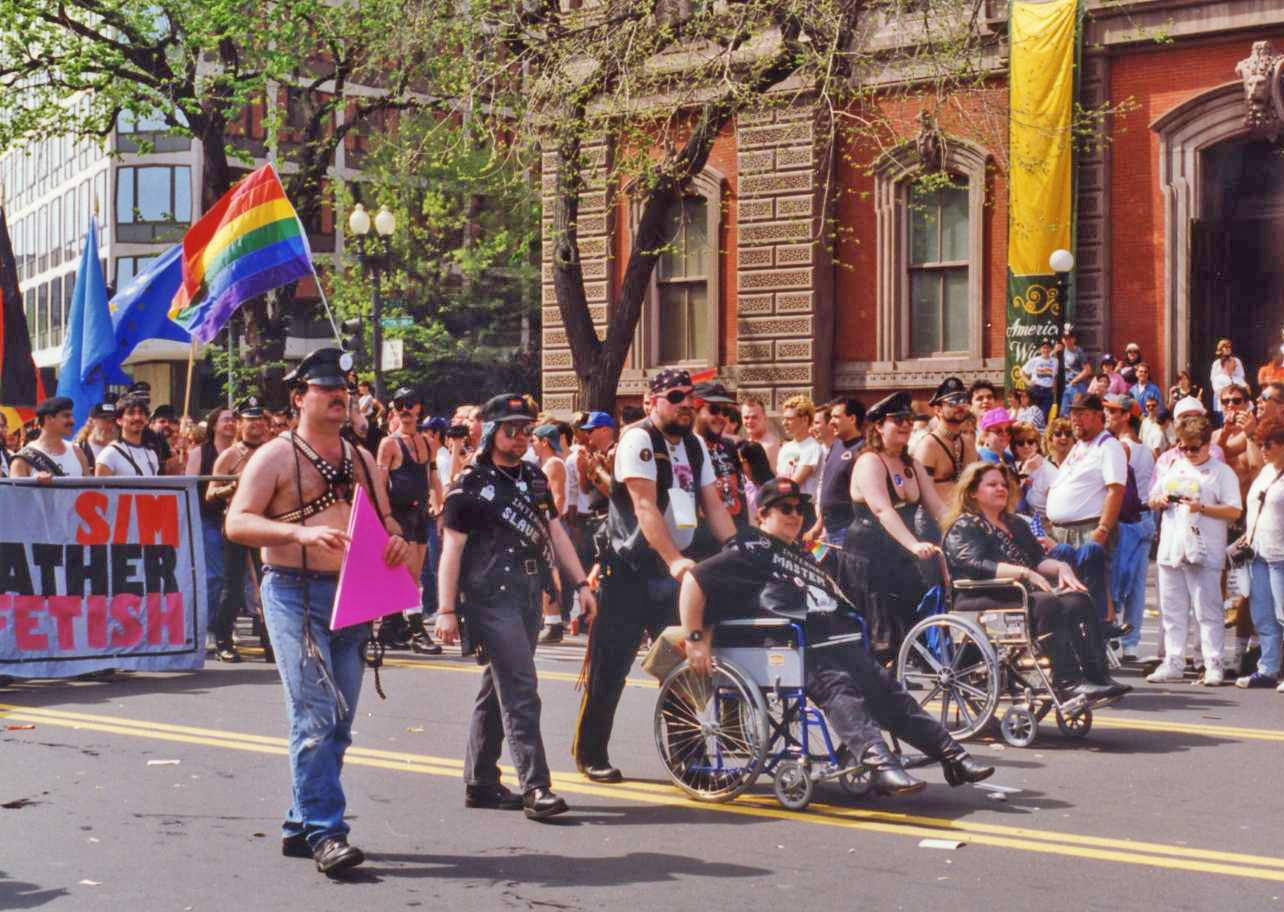
Leather subculture is the cluster of dress, bars, clubs, protocol and sexual style organized around leather garments—jackets, vests, boots, chaps, harnesses—and around the erotic charge those objects carry. Wearing leather is one way participants mark themselves off from mainstream sexual culture. Many people inside the scene treat leather as inseparable from BDSM: high protocol, sadomasochism, Master/slave language, bootblack service. Others come for the motorcycle, the bar, the masculine or butch presentation, or the simple sensory hit of hide on skin. Black leather can mean heightened masculinity, borrowed sexual power, outlaw independence, fetish material, or all of those at once. For a BDSM site the useful definition is practical. Leather is not only a fabric. It is a historic gay and lesbian sexual public, a bar architecture, a contest circuit, a set of arguments about “Old Guard,” and one of the main visual languages through which kink announced itself to the twentieth century.
Gay leather as a coherent subculture took shape in the late 1940s and 1950s in major U.S. cities, then in other urban centers across industrialized countries. It developed about twenty years after heterosexual European and American fetish circles, and largely apart from them. There is evidence of BDSM among gay men before the Second World War, but that “pre-leather” world has been thinly researched. Pathologization and criminal law made people careful; few records survive. The same caution covers leather’s first postwar years. One exception is Samuel Steward (1909–1993), who documented kinky encounters with other men in the United States and took part in Alfred Kinsey’s 1949 study of gay BDSM practice. Steward’s notebooks are a reminder that the scene existed as sex and craft before it existed as a marketable identity.
Formative Years: Bikers, Bars, and the Look (1940–1968)
The formative period ran through the 1940s and 1950s and drew on two main groups: postwar California bikers in Los Angeles, and “pre-leather” butch BDSM players in New York. The leather look surfaced first in Los Angeles and was then taken up in New York, Chicago and San Francisco. A large share of the early community were queer service members returning from the war and clustering in big U.S. cities in 1945 and 1946. Military drill, male homosocial life, and a refusal of civilian softness all fed the style that followed.
In Los Angeles the gay leather scene grew out of a wider biker-leather culture. Protective motorcycle clothing was tough cowhide or horsehide. Biker style spoke a postwar disaffection whose notoriety—and therefore its glamour—exploded after sensational coverage of the 1947 Hollister “riot.” The 1953 film The Wild One, with Marlon Brando in jeans, T-shirt, leather jacket and a cloth cap that later inspired leather bike caps, sold an image of masculine independence to men bored with official America. Leathermen have quoted the film for decades as formative: masculine, sexual, radical. The movie did not invent leather symbolism, but it standardized a look and gave it national distribution. Artists such as Tom of Finland and Etienne (Dom Orejudos), drawing over-endowed leather musclemen for Physique Pictorial and other physique titles, carried the outlaw-biker erotic into gay visual culture. Motorcycle life also offered an alternative to gay scenes organized around high culture, musical theater, or camp.
Pioneering gay motorcycle clubs included the Satyrs, founded in Los Angeles in 1954, and Oedipus, which split from the Satyrs in 1958. The community that grew from those clubs became the practical and symbolic ground for open play with kink and S&M. Even early on, styles differed: strict, formal SM built on military models; informal “rough sex” or “buddy sexuality” associated with bike clubs; leather fetishism as a material taste; and mixtures of all three. Regional variation was wide, which is why later arguments about the “original” or “true” tradition are so heated—and why some historians doubt that the most romantic versions of leather history ever existed as a single system. Over time, people who mainly wanted the clothes and the bar atmosphere joined those who were there for kink.
New York already had a small gay BDSM network in the 1940s, organized by word of mouth, encoded personal ads, and private parties. Between 1950 and 1953 Bob Milne, who had moved from Boston after clashes with police that included a conviction for homosexual acts at home, hosted recurring parties and was known well beyond the city. New Yorkers picked up California-style biker leather in the mid-1950s, probably around The Wild One. Dedicated motorcycle clubs did not arrive there until the 1960s. Early bars used by leathermen clustered at 50th Street and Third Avenue in the so-called bird circuit: the Golden Pheasant Restaurant, the Blue Parrot Cafe, the Swan Club. Later came Shaw’s (1953), the Lodge (1954) and the Big Dollar (1959). The Lodge imposed a leather dress code, mostly motorcycle jackets.
After Milne left in 1953, Frank Olson became New York’s connector: telephone introductions, leather-friendly bars, private parties in the city and at Fire Island. During the mid-1960s crackdown on gay bars ahead of the 1964 World’s Fair, he held the loose network together. In 1970 he and his lover Don Morrison opened the Eagle’s Nest, later the Eagle. A later oral-history line captures the function: if you knew Frank Olson, you could meet other people into S&M. In London the equivalent name was Felix; in Berlin, George. The promise was a heavy sex night and a reasonable hope that if you got tied up, you would not get killed. That is proto-scene ethics in one sentence: access, risk, and a named person who stood behind the introduction.
Dedicated leather bars spread slowly through the 1950s and 1960s in New York, Chicago, Los Angeles, San Francisco and Europe, then exploded in the 1970s. Lucas Hilderbrand has argued that bars gave the scene coherence and a place to assemble. Before Stonewall, patrons lived with regular raid risk. Motorcycle clubs’ bike runs offered outdoor parties and sex away from the vice squad. In the 1970s bars also began sponsoring leather contests and functioning as sexual spaces. Sex in bars was illegal and mostly tolerated; back rooms, dark corners and basements became standard architecture. From the 1960s on, the bar was the main entry point for newcomers and a machine for turning leather into a consumable aesthetic, often enforced by dress codes. Joseph Bean, Guy Baldwin and John Preston all came into the scene in the mid-1960s. Baldwin later put it cleanly: his introduction to leather life was really his introduction to leather bar life.
The first leather bars were often ordinary rooms that groups of leathermen colonized. The best-known example is Chicago’s Gold Coast, a late-1950s hangout that Chuck Renslow bought after the owner’s unexpected death and reopened in 1960 as a queer-owned leather bar. Iconic murals by Renslow’s partner Dom Orejudos—Etienne—covered the walls; Orejudos also designed the logo and posters. In San Francisco, South of Market became the leather hub in 1962 when the Tool Box opened at the east corner of 4th and Harrison, running until 1971 and drawing clubs such as the Satyrs and Oedipus. The Tool Box went national in June 1964 when Paul Welch’s Life feature “Homosexuality In America”—the first time a major national magazine treated gay life as news—opened on a two-page spread of Chuck Arnett’s 1962 mural of life-size leathermen. Hal Call had steered the photographer there, hoping to kill the myth that all homosexual men were effeminate. The article called San Francisco “The Gay Capital of America” and pulled leathermen toward the city. When the Stud and Febe’s opened on Folsom Street in 1966, more leather businesses followed, laying the street that would later hold Folsom Fair.
The Golden Age (1969–1982)
The 1970s are the heyday, the so-called Golden Age: rapid growth, more organization, thicker networks, more visibility. Bars sponsored pageant-style contests. Bootblack stands appeared in U.S. bars—the Gold Coast in Chicago, the Ramrod in New York. The hanky code, colored handkerchiefs as a shorthand for sexual taste, became a new piece of street semiotics. The first leather contest was probably Mr. Gold Coast, held at the Chicago bar in 1972 and rebranded as International Mr. Leather in 1979. Notable sex clubs of the period include New York’s Mineshaft (1976–1985), Chicago’s Inferno weekend (from 1976) and San Francisco’s Catacombs (1975–1984). The late-1970s “leather daddy” type, already carrying sadomasochistic associations, fed the broader queer “daddy” archetype that later generations take for granted.
Earlier decades had run on oral tradition and personal referral. Growth across many cities produced print, and print produced a kind of standardization. East and West Coast scenes had not even agreed what S and M stood for—sadist and masochist, or slave and Master—or which side keys should hang on to mark a role. Larry Townsend’s The Leatherman’s Handbook (1972) is usually called the first nonfiction book about the leather scene. In 1974 Drummer launched in Los Angeles and became the most successful American leather magazine, selling overseas. It pushed leather as a lifestyle and masculinity as a gay ideal: quality writing, erotic photo series, illustration, fiction. John Preston’s novel Mr. Benson first ran as a serial in Drummer in 1979–80, with a claimed press run of 42,000 copies an issue. For kink media history those objects matter as much as any bar: a handbook and a magazine taught people in smaller cities how to dress, how to signal, and what a leather life was supposed to feel like.
Berlin in the 1970s had a large leather scene around Nollendorfplatz. Peter Berlin, one of Tom of Finland’s models, put the aesthetic on film in titles such as 1973’s Nights in Black Leather. In 1975 Europe’s biggest fetish event, the Easter Berlin Leather Festival, began under Berlin Leder und Fetisch e.V. MSC Hamburg had already started an annual “international leather-party” in 1972. From the late 1970s younger European men also fused leather power-play with gay skinhead style and social-fraternal groups.
Women forced the door. Cynthia Slater’s late-1970s campaign for women to be accepted in San Francisco’s gay leather scene brought her mainstream notice. She persuaded the Catacombs—the most famous fisting club in the world, originally a gay men’s space, open 1975–81 and again 1982–84 in a second location—to admit lesbians. Slater was an early S/M safety advocate and a major AIDS educator by the end of the decade. She hosted Society of Janus safety demonstrations, carving room for women inside a culture that was already a Venn diagram of gay men, kink, fetish and leather. Pat Califia, then a lesbian, was a San Francisco leather activist credited with defining an emerging lesbian leather subculture. On 13 June 1978 Califia, Gayle Rubin and sixteen others founded Samois, a lesbian-feminist BDSM organization that lasted until 1983 and was the first lesbian BDSM group in the United States. In later decades people have tended to treat leather as a subset of BDSM rather than BDSM as a subset of leather. Even so, the most visibly organized SM world tied to leather has remained a leather subculture, as International Mr. Leather (1979), SM in the UK (1981) and International Ms. Leather (first held 1987) still show.
In 1979 the new San Francisco lesbian motorcycle club Dykes on Bikes led what was then the Gay Freedom Day Parade for the first time and has led it ever since—the event became San Francisco Pride in 1994 and now includes a leather contingent. By the mid-1980s lesbian riders in other cities were forming their own clubs. Leather and Lace, a women’s leather/BDSM support and social group, started in Los Angeles in 1980. Its members learned “old guard” traditions from the men of Avatar and ran a code of conduct and a uniform that could be worn only after a member had earned the right. Protocol as pedagogy, not costume-shop cosplay, is the point of that story.
AIDS, Mobilization, and Public Leather (1983–Present)
HIV/AIDS hit leather communities hard in the mid-1980s. In the 1980s and early 1990s lesbian leatherwomen often helped care for gay leathermen with AIDS. Titleholders used their platforms for fundraising and advocacy; kinksters joined existing rights groups. Hostility came from two directions. Mainstream society and parts of vanilla queer culture blamed supposedly “extreme” and “unsafe” gay kink—especially fisting—for the epidemic. A nationwide campaign to close sex clubs and bathhouses succeeded, shutting institutions that had been central to the community. Forced closures and tighter bar regulation sped gentrification already eating industrial districts. Leather neighborhoods that had exploded in the 1970s shrank fast.
In 1984 the Folsom Street Fair was held for the first time, made possible by housing activists and community organizers who wanted fundraising capacity and a place to connect people to services and information—safer sex, for example—that bathhouses and bars had been positioned to distribute. It remains the world’s largest leather event and the main outdoor showcase for BDSM products and culture. Jack Fritscher’s 1984 collection Corporal in Charge of Taking Care of Captain O’Malley (Gay Sunshine Press) was the first leather-fiction collection and the first collection of fiction from Drummer. The title play later appeared in Winston Leyland’s Lambda-winning anthology Gay Roots (1991).
Competing at International Mr. Leather in 1986 pushed Steve Maidhof to organize an education-and-activism conference for the growing leather, SM and fetish community. He recruited Cookie Andrews-Hunt, Wayne Gloege, Billy Jefferson, Jan Lyon, George Nelson and Vik Stump from Seattle’s scene. Together they incorporated the National Leather Association in the summer of 1986 and hosted the first Living in Leather conference that October. The group added “International” in 1991 and ran Living in Leather gatherings until 2002. After a slump around 2000, NLA-I became more active again and now runs awards for fiction and nonfiction. In 1987 Judy Tallwing McCarthey, a lesbian and the first International Ms. Leather, was the leather community’s keynote speaker at the Second National March on Washington for Lesbian and Gay Rights.
The community also pushed to depathologize consensual BDSM. From 1987, leathermen Race Bannon and Guy Baldwin campaigned to get BDSM practices out of the Diagnostic and Statistical Manual. DSM-5 excludes consensual BDSM from diagnosis when the interests cause no harm or distress. That clinical shift is one of leather’s quieter political wins: a generation of titleholders and therapists arguing that negotiated pain is not, by itself, a mental disorder.
The Leather Archives & Museum in Chicago was founded in 1991 by Chuck Renslow and Tony DeBlase as a community archives, library and museum of leather, kink, fetish and BDSM history. They built it in the AIDS years, when belongings and histories were being lost, suppressed or thrown out. In 1997 the National Coalition for Sexual Freedom formed to push a legal and social environment in the United States that would treat consenting adults in BDSM-leather-fetish, swing and polyamory communities as rights-bearing people rather than automatic suspects. In 2002 the Washington Post publicly highlighted Jack McGeorge’s leadership in Washington, D.C.’s leather and BDSM scene. McGeorge had not hidden; his name was on websites. He offered his resignation to Hans Blix to protect the credibility of UNMOVIC before the Iraq weapons inspections. Blix refused it. A spokeswoman for Kofi Annan later said being into BDSM was no more likely to be a cross-cultural problem in the Middle East than any number of other issues. The episode is a late cousin of the Mosley problem: a public kink identity colliding with a serious job, and an institution deciding the kink was not the disqualifier.
Mark Leno became the first out leatherman to serve as a U.S. state legislator, in the California Assembly from 2002 to 2008. In 2005 Viola Johnson started the Carter/Johnson Library & Collection, thousands of books, magazines, posters, art, pins, newspapers, programs and ephemera of leather, fetish and S/M erotic history. The Leather Hall of Fame began inducting members in 2009. Leather & Grace, a now-defunct group of Unitarian Universalist kinksters founded in 2011, combined a red flaming chalice with the leather pride stripes. San Francisco created an LGBTQ and Leather Cultural District in South of Market in 2018; it includes the South of Market Leather History Alley, four works of art that opened in 2017. In 2024 the city’s Recreation and Park Commission voted to name a park at Natoma and 11th streets for leather leader Rachele Sullivan—believed to be the first U.S. public park named for a leather leader. Late leather is one facet of semi-organized alternative sexuality. Some people describe long introspection before claiming the word. Others never tie the clothes to BDSM at all. They just like the hide.
The Myth of the Old Guard
Today “Old Guard,” “Old Leather” or “Old Guard Leather” means several things. Originally it named the scene’s beginnings, from the end of the Second World War to the mid or late 1960s. That period has been so romanticized in fiction and in practitioners’ own stories that some treat it as origin myth and others as roots. Thom Magister’s fiction is a common example. The usual portrait is a secret, close-knit community of men—often motorcycle clubs—who built a uniform, hierarchical, high-protocol BDSM practice on military models and lived by initiation, brotherhood, discipline and excellence. This “pure form,” the story goes, was pushed underground in the 1960s when bars opened and newcomers arrived, not all of them interested in BDSM or fetish. The same narrative often scolds later commodification, politicization, “safe, sane, consensual” education, and the teaching of outsiders—trends that began in the 1960s and peaked in the 1980s.
Serious argument about whether that Old Guard existed as described has run since the late 1980s. Mark Thompson’s 1992 anthology Leatherfolk gathered contradictory views. “New Guard” or “New Leather” appeared as a foil: casual versus strict, informal versus formal. Gayle Rubin, Jack Rinella and Joseph Bean have pointed out that both styles were present from the start. Today “Old Guard” is also used as an insult for older members whose ideas about “correct” behavior or who belongs in the scene read as outdated or toxic. Revival handbooks such as John Weal’s The Leatherman’s Protocol Handbook (2010) claim initiation by Old Guard instructors and a uniform protocol all traditional leathermen supposedly followed. Critics say the book is not faithful to the historical record and imports practices from other sources, including heterosexual Gorean BDSM. For working players the adult take is simple. Protocol is a craft some houses still teach. It was never one Vatican. Treating 1955 as a lost golden age is usually nostalgia, not ethnography.
Women, Lesbians, and Parallel Institutions
Gay men remain the most visible leather demographic, but leatherwomen have their own title system in International Ms. Leather, the corollary to IML. Joan Jett is a public example: a leather pride sticker sits on her touring guitar. Relatively few lesbians were visible in the earliest years. Califia, Rubin and Samois changed that map. Judy Tallwing McCarthey’s 1987 IMsL win made a lesbian the first woman titleholder on that international stage. New York’s LSM admitted only members to the knowledge that the letters stood for Lesbian Sex Mafia. Dykes on Bikes and Leather and Lace, already described, are the two other institutional markers: one a motorcycle club that seized the front of a pride parade, the other a women’s house that took protocol from men and then enforced its own uniform rules. In the plague years, care work ran along those same networks. Leather feminism in this history is not a footnote about inclusion. It is clubs, title contests, safer-sex teaching, and women keeping men alive.
Deaf Leather, Bootblacks, Age
In 1986 the Baltimore Leather Association of the Deaf—BLADeaf, after several earlier names starting from Maryland Lambda Alliance of the Deaf—became America’s first deaf leather club. Founders were Elwood C. Bennett, Scott Wilson and Harry “Abbe” Woosley Jr. Because the Baltimore Eagle was its home bar, BLADeaf calls that Eagle the first bar in the world to house a deaf leather organization. In 1989 a deaf chapter of the National Leather Association, later International Deaf Leather, was founded by Michael Felts, Philip Rubin, Bob Donaldson, Rolf Hagton, Jim Dunne, Bobby Andrascik and Charles Wilkinson. IDL ran contests for International Ms., Mr. and Boy Deaf Leather, plus the Michael Felts Lifetime Achievement Award (given in 1997 to Woosley) and an International Deaf Leather Recognition Award (given in 1998 to BLADeaf). International Deaf Leather ended in 2021. Deaf leathermen have kept competing at IML; the 1992 contest had three deaf contestants. Accessibility here is not a modern HR add-on. It is a club history going back to the mid-1980s.
Bootblacks became newly visible as a subculture of their own when local, regional and international bootblack contests spread in the 1990s and early 2000s. Stands and classes are now standard at events, contests, conferences and parties. The work is service and conservation: jackets, vests, boots, chaps, harnesses, and also rubber, neoprene and other gear. Many of those objects were gifted, earned or inherited. Bootblacks keep the physical kit and collect the wearers’ stories. They are one of the scene’s main oral-history professions, not a novelty side hustle.
In the United States men’s leather has often been associated with men over forty, but younger leathermen have been arriving in larger numbers. In much of Europe and Australia the older leather world is already mixing with younger leather people and with broader kink, fetish and gear communities. Europe’s late-1970s fusion of leather, gay skinhead style and fraternal groups such as BLUF is part of that longer age conversation: different generations using the same hide to mean slightly different things.
Flag, Art, Tartan
Tony DeBlase designed the leather pride flag and first presented it at International Mr. Leather in Chicago on 28 May 1989. He treated it as a first draft and expected revisions. Some community members wanted a say; most took the original as it was. It has not been substantially redesigned. In June 1989 a leather contingent carried it in a Portland, Oregon pride parade—its first pride appearance. The stripes are now as readable, inside the scene, as the rainbow is outside it.
Artists and photographers gave the emerging culture a face: bar murals, magazine spreads, comics, drawings that made taboo fantasy visible and portable. Oral histories return again and again to Tom of Finland. Men identified with figures drawn as masculine and virile, a rebuttal to homophobic stereotypes of effeminacy. Tom’s drawings helped unify a gay leather aesthetic that fed the 1970s–80s “clone” look. One often-quoted line says the work was not pornography but salvation. Most leather artists remain little known outside the erotic circuit because of the content. The famous exceptions are Robert Mapplethorpe and Tom himself. The Tom of Finland Foundation, founded in 1984, promotes erotic art and supports artists with scholarships. Other central names include Chuck Arnett and Dom Orejudos. The San Francisco Leather History Alley (2017) put some of that visual history on the street. In 2022 a leather pride tartan was registered with the Scottish Register of Tartans—an oddly formal afterlife for a flag born at a Chicago contest.
Clubs and Organizations
Leather has always run on organizations, from 1940s informal networks and 1950s–60s motorcycle clubs to today’s education-focused groups. Early bike clubs were social hubs and inconspicuous covers for the first BDSM associations. Los Angeles had the Satyrs (1954) and Oedipus (1958). Early San Francisco clubs included the Warlocks (1960) and the California Motor Club. Chicago’s first was Second City Motorcycle Club (1965), with Chuck Renslow as first president; it laid the base for Chicago Hellfire Club (1971), founded expressly to facilitate BDSM sex and sponsor of Inferno since 1976. New York’s gay motorcycle clubs came later: Empire City MC (1964), the New York Motorbike Club (1967), Cycle MC (1968).
In Europe the first leather club was London’s Sixty Nine Club (1965). Other early groups include Senses (1969, UK), MS Amsterdam (1970), MSC Rhein-Main Frankfurt (1970), Loge 70 (1973, Switzerland), MSC London (1973) and MS Belgica (about 1974) in Brussels. The European Confederation of Motorcycle Clubs, founded in 1974 as the first European confederation of kink and leather clubs, had leatherman Felix Jones as a key figure. Sydney’s early clubs included the South Pacific Motor Club. Dykes on Bikes formed in San Francisco in 1979. Over time clubs appeared that named leather and BDSM outright: Samois; Hellfire; San Francisco’s 15 Association; New York’s Eulenspiegel Society; the Society of Janus (often associated in memory with San Francisco’s educational SM world). Gay Male S/M Activists (GMSMA, 1981–2009) and the Lesbian Sex Mafia, both founded in New York in 1981, committed to open enrollment and education for newcomers. The slogan “safe, sane, consensual” comes out of the GMSMA environment. Clubs that organize around marginalized people inside leather include Onyx, founded in 1995 for and by gay and bisexual BIPOC men, and, more recently in Europe, Proteus Leather Club for trans and non-binary leather people.
Bars, Districts, Museums
Bars and clubs were the first distinct subgenre of gay bars, and their look—dim, industrial, dress-coded—is still the iconic “gay bar” in a lot of popular memory. They gathered in working-class and industrial neighborhoods: South of Market in San Francisco, the Meatpacking District in Manhattan. Many cities had or have leather bars; some concentrated them into districts. The most famous stretch is the “Miracle Mile” on Folsom Street. Dozens of independently owned bars are named Eagle or a variant; they share a focus on leather, kink and masculinity rather than a single corporate owner.
Named districts and rooms include Amsterdam’s Warmoesstraat—home, around 1955, to the country’s first leather bar—plus the now-closed Cockring and the Eagle. In 2015 Het Parool said the darkroom had been “consigned to history because of Grindr,” a line that captures how hookup apps ate some of the sexual function bars once held. Berlin’s map includes Scheune and Tom’s Bar on Motzstraße, New Action on Kleiststraße, and the Nollendorfplatz area. Chicago stacked the Gold Coast, GayLife, Man’s Country bathhouse and the Chicago Eagle along a block of Clark Street from Ainslie to Winnemac. New York’s Mineshaft (1976–85) and Anvil (1974–85) sat in the Meatpacking District. San Francisco’s LGBTQ and Leather Cultural District covers the old concentration: Fe-Be’s, the SF Eagle, the Stud, the Ramrod, the In Between. Mexico City’s Tom’s Leather Bar, in Condesa, has run special nights for the Mexican leather community since 1995.
Many LGBT archives collect leather material; substantial holdings include the Australian Queer Archives in Melbourne and Chicago’s Leather Archives & Museum. Viola Johnson’s Carter-Johnson Leather Library travels a collection of books, magazines, pins and ephemera. Official recognition has gone further than most kink worlds ever get. San Francisco’s Leather History Alley includes Gayle Rubin’s narrative etched in black granite, Mike Caffee’s “Leather David,” a reproduction of Arnett’s Tool Box mural, standing stones for institutions including Folsom Fair, leather-flag pavement, and bronze bootprints honoring 28 people from the city’s leather communities. On 25 May 2018 the Chicago City Council named a stretch of Clark Street in Uptown “CHUCK RENSLOW WAY,” unveiling the sign during the anniversary of International Mr. Leather, the contest Renslow founded. Gold Coast and Man’s Country had stood on that same street. A city putting a leather bar owner’s name on a sign is not the same as decriminalizing SM. It is still a public admission that the culture had civic weight.
Folsom, Contests, and the Calendar
Folsom Street Fair, begun in 1984, is the September street fair that caps San Francisco’s Leather Pride Week, on Folsom between 8th and 13th in SoMa. It is California’s third-largest single-day outdoor spectator event and the world’s largest leather gathering. Folsom Street Events now also runs Folsom Europe and other dates. Other large fixtures include Easter Berlin (Europe’s biggest leather event), International Mr. Leather, Mister Leather Europe, Amsterdam Leather Pride, and Folsom Street East in New York. Local bars and clubs run feeder pageants into those regional and international titles. The contest circuit is easy to mock as a beauty pageant in chaps. It is also how the culture picks spokespeople, raises money, and teaches protocol in public.
Leather on Screen, in Print, on Stage
Beyond the clothes, leather entered mainstream narrative as danger. Jay Green’s 1970 murder mystery Cruising became William Friedkin’s 1980 film, which showed pieces of the men’s leather world to a wide audience and treated homosexual desire and violence as two sides of one coin. Some scenes are set at the Mineshaft (filmed at the Hellfire Club) with extras recruited from Mineshaft patrons, including a fisting sequence. Filming in 1979 met heavy protest from gay communities who did not want their bars used as a serial-killer backdrop. The movie is still the default vanilla citation for “leather equals murder,” which is why scene people hate it and media historians cannot ignore it.
Village People, launched in 1977, bottled the look for radio. Jack Fritscher has said Jacques Morali drew the four original characters from the Mineshaft’s dress code. Glenn Hughes, the group’s original leather biker, went there often, wore the horseshoe moustache and the leather kit on and off stage, and kept a motorcycle in the house. Eric Anzalone was the leatherman/biker from 1995 to 2017; Hughes stayed in management and was still storming New York on a custom Harley. People magazine put him on a 1979 beautiful-people list as “Leatherman.” Heavy metal lifted the same wardrobe. Judas Priest’s Rob Halford, who is gay, wore black leather on stage as early as 1978 to promote Killing Machine (Hell Bent for Leather in the United States) and later said the leather subculture was the source. He added a roaring motorbike; the rest of the band followed. Late-1970s fans of Priest, AC/DC and Meat Loaf copied leathermen because the clothes read as toughness: battle jackets, combat boots, studded belts, Schott Perfecto jackets. Freddie Mercury started adding leather on Queen’s 1978 News of the World tour and was in a full leather kit by the 1979 Jazz Tour, citing clubs he frequented. Joan Jett’s leather-pride guitar sticker is a later, explicit nod. Laura Antoniou’s 2013 satire The Killer Wore Leather murders a titleholder at a fictional international contest modeled on IML—leather writing about leather’s own circus.
None of that pop leakage replaces the internal history: Steward’s notebooks, the Satyrs, Olson’s phone tree, Renslow’s Gold Coast, Arnett’s mural in Life, Townsend and Drummer, Slater at the Catacombs, Samois, Folsom Fair, IML and IMsL, BLADeaf, the Leather Archives, NCSF, a San Francisco park named for a leather leader. Leather is gear, yes. It is also a seventy-year experiment in how a stigmatized sexual public builds bars, protocol, care networks, archives and a flag—and then argues, endlessly, about whether the argument itself is a betrayal of the first men in horsehide jackets.
For adult readers mapping BDSM identity, the practical lessons are blunt. Dress codes still make rooms. Mentors still matter more than merch. Old Guard is a story some houses live and others reject. Women, deaf contestants, bootblacks, BIPOC clubs and trans leather groups are not late guests; they have their own founding dates. Apps thinned some darkrooms without deleting the need for physical space. And the difference between leather as a fashion quotation and leather as a culture is still the same test it was in 1960: whether you have people who will vouch for you when the cuffs close.