
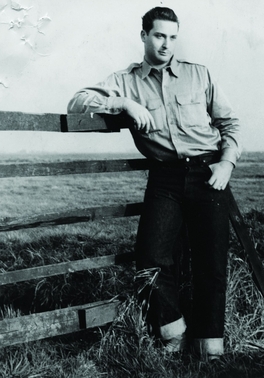
Larry Townsend, born Michael Lawrence Townsend, was an American writer of dozens of erotic and leather-culture books. He was born on 27 October 1930 and died on 29 July 2008. In leather history he is both a novelist and the person who wrote the field guide: dungeon etiquette, gear, and fantasy, put into paperbacks you could carry, at a time when many cities still treated the scene as pure underground. He lived in Silver Lake, Los Angeles, the local leather counterpart to San Francisco’s SoMa, where bars, private parties, and print fed each other.
As a teenager in Los Angeles his neighbours included Noël Coward, Irene Dunne, and Laura Hope Crews. He attended the Peddie School. From 1950 to 1954 he was a Staff Sergeant with U.S. Air Force air intelligence squadrons in Germany, running NCOIC Operations. After discharge he entered the small underground Los Angeles leather scene. Biographical notes say he and Montgomery Clift once shared a lover. In 1957 he took a degree in industrial psychology from UCLA, then worked in the private sector and as a probation officer with the Forestry Service.
In the early 1960s he went into homophile political work. Around then he met Fred Yerkes (27 August 1935 – 8 July 2006). They were companions for forty-three years. In 1972 Townsend was president of H.E.L.P., the Homophile Effort for Legal Protection, founded in 1969 to support gay men during and after arrests. He helped launch the H.E.L.P. Newsletter, an ancestor of Drummer, which started in 1975.
His best-known books are Run, Little Leather Boy (1970) and The Leatherman’s Handbook (1972). Pioneer erotic houses such as Greenleaf Classics and Olympia Press’s Other Traveler imprint issued those titles. Sean illustrated the Handbook. The paperbacks were among the earlier ones to carry gay BDSM and leather practice to a wider readership.
Townsend was also a photographer and a witness to the salon around Drummer. The magazine often ran his fiction and treated him as a house authority on leather life. His column Leather Notebook ran in Drummer for twelve years from 1980, then in Honcho until 2008. After the Handbook had already made his name, the periodical voice kept going for nearly thirty years.
His last novel, TimeMasters, came out in April 2008. In June 2008 he wrote the introduction “Who Lit up the Lit of the Golden Age of Drummer” for Gay San Francisco: Eyewitness Drummer, looking back at how the magazine carried leather fiction and photography through the AIDS years and after. On 29 July 2008 he died at Cedars-Sinai Hospital in Los Angeles, at 77, of complications from pneumonia.
The Leather Archives & Museum in Chicago holds an oral history interview with him. His manuscripts are at Yale University Library as the Larry Townsend Collection (MS 1975). In 1995 National Leather Association International gave him the Steve Maidhof Award for national or international work. In 2002 he received the Forebear Award at the Pantheon of Leather Awards. In 2016 he was inducted into the Leather Hall of Fame. Jack Fritscher’s memorial essay “Spill a Drop for Lost Brothers,” on Townsend and The Leatherman’s Handbook, won the NLAI Cynthia Slater Non-Fiction Article Award in 2009. The books are a reading history of leather and gay SM, written for adults.
![[Fuji Kikaku] AS-03 Essence of Bondage 3 Bondage Bloomers Binding Kyoko Yamaguchi Asako Mochizuki -Chimuo Nureki- (Essence of Bondage 3 Bondage Bloomers Binding) fuji-0067 [Exclusive]](https://bdsmwild.com/wp-content/uploads/2026/08/AS-03-fuji-0067-Exclusive.jpg)