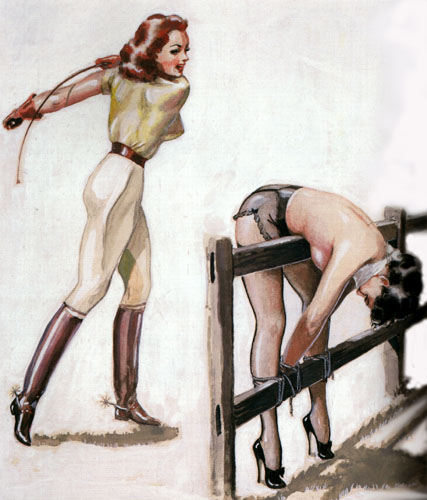
John Alexander Scott Coutts (9 December 1902 – 5 August 1962) is known by the pen name John Willie. In fetish-art history he is the bridge between the private custom photographs of the Charles Guyette era and the commercial boom under Irving Klaw. Painter, photographer, cartoonist, and founding publisher of the underground magazine Bizarre, he showed that this visual style could run as a magazine people actually received, rather than staying a private commission. The world he drew is clean in line and filthy in implication: rope, high heels, and carefully built capture scenes, with fetish treated as stylish adventure rather than clinical pathology. That cheerful, meticulous manner brought the work back into view when Bettie Page nostalgia and leather fashion returned in the 1970s. In 2009 he was inducted into the Leather Hall of Fame.
From Sandhurst to a high-heel club
Willie was born in British Singapore to a middle-class British family and returned to Britain with them in 1903. He attended the Royal Military College, Sandhurst, and was commissioned as a second lieutenant in the Royal Scots. In 1925 he was forced to resign after marrying the nightclub hostess Eveline Fisher without his commanding officer’s permission. Respectability and his private life collided early, and that collision maps the rest of the life. The couple emigrated to Brisbane, Australia, in 1926 and divorced in 1930. In Australia he joined a local High Heel Club, his entry into organized “shoe lover” networks and fetish print culture. The club’s mailing list let him sell illustrations and photographs. Under the name Achilles he ran a company that made exotic footwear, fetish desire turned into small manufacturing. He met Holly Anna Faram in 1936. In 1942 she became his second wife, his muse, and a frequent model in the photographs that filled Bizarre.
The underground relay
In 1945 Coutts moved to North America. He wanted New York. Immigration trouble kept him in Montreal for a while before he could enter the American underground publishing world. Pioneer merchant Charles Guyette brought him into the American fetish network. He later worked with Irving Klaw. The sequence matters: Guyette’s custom photos and garments, Willie’s magazine and cartoons, Klaw’s mass mail order, then the next illustrators, Gene Bilbrew and Eric Stanton. Willie’s clean ink line and theatrical scenes shaped those successors. The name John Willie became a brand for an optimistic, non-clinical bondage aesthetic. He survived postal censorship by suggesting the scene instead of stating it, and he kept the tension.
Sweet Gwendoline and U69
His best-known characters ran in Bizarre and in other magazines. Sweet Gwendoline is the blonde, or light-haired, perpetual captive: resourceful enough that the predicament stays interesting, and still doomed to be tied. Opposite her is the dark-haired dominatrix U69. In some printings the number was too blunt and the label was censored to U89. She is the one who builds Gwendoline’s traps. Sir Dystic d’Arcy, well-meaning, clumsy, and incompetent, supplies the comic male relief in a bondage theater centered on women. Sweet Gwendoline was not confined to the underground. From June 1947 to February 1950 she ran in the mainstream girlie magazine Wink, which helped the character outlive any single underground issue. Willie joked that his studio was a cheerful place, nothing like the distress drawn around Gwendoline. The gap between a cheerful production and drawn misery is the fetish theater.
Bizarre: letters, costume, and the censor
Bizarre began in late 1945 and appeared irregularly through 1959. Willie got past postal and police censorship by avoiding full nudity, homosexuality, open violence, and anything that would read as plainly “perverse.” Bondage and costume fantasy were packaged as fashion eccentricity and playful “unorthodox” style. Issues mixed photographs of Holly, costume plates from reader ideas, and long reader letters on high heels, bondage, amputee fetishism, sadomasochism, transvestism, corsets, and body modification. Critics said he invented the letters. He insisted they were real. Either way, the magazine worked as an early forum: people who thought they were alone found a correspondence network. Publication stopped completely from 1947 to 1951. In 1956 he sold the title to an editor known only as R.E.B., who produced six more issues before the magazine folded in 1959. Issue 23 introduced the illustrator Mahlon Blaine, a marker collectors still use when dating the late numbers.
Editorial politics, then Guernsey
In Bizarre, Willie argued for something close to mutual enjoyment, against hypocrisy, and for fantasy fashion. He wrote against a shame regime that policed desire into a perversion label, and he thought mutual pleasure should be discussable before marriage. That rhetoric is kin to later leather and fetish community talk. In 1961 a brain tumor forced him to shut the mail-order business. He destroyed the archives, returned to Britain, and lived with his sister on Guernsey. He died in his sleep on 5 August 1962. His art also appeared in Japan’s Kitan Club, one of the few Western fetish artists to cross into that postwar Japanese SM pulp world. Bélier Press and Taschen have kept reprinting the collected work and the photographs. Jared Harris played him in the film The Notorious Bettie Page. Willie did not invent rope or high heels. He industrialized a mid-century visual grammar of fetish, and he left early evidence, for the history of BDSM media, that the culture wants images and also infrastructure: letters, catalogs, and characters who come back.