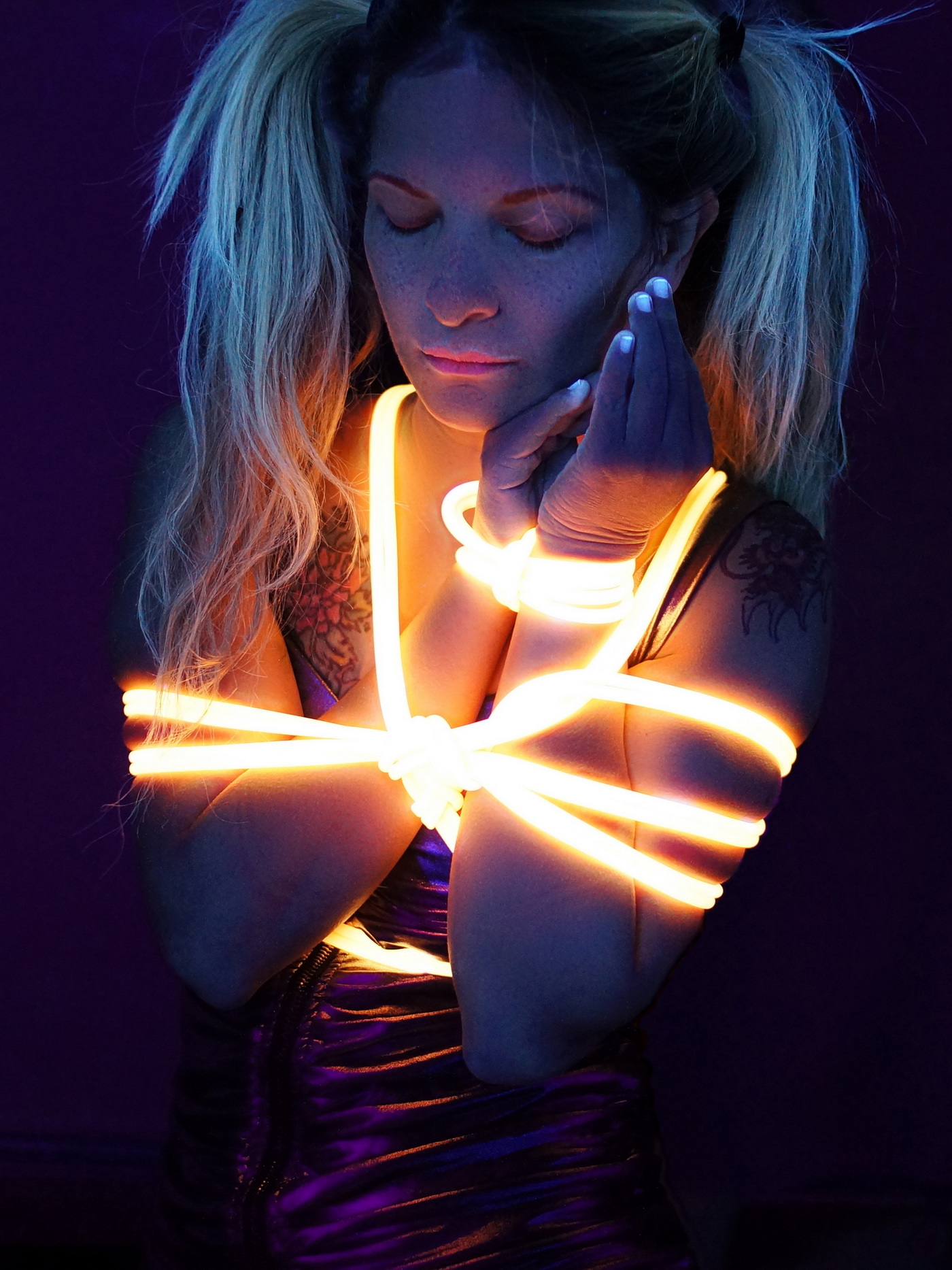
Kinbaku (緊縛) means binding tight. The related word kinbaku-bi is the beauty of that tight binding. Western BDSM borrowed the Japanese rope style, fought over it, and put it on stages from Tokyo to Berlin. The usual picture is a body held in patterns that look simple and dense at once, tied with thin plant-fiber rope: jute, hemp fiber, or linen. A common diameter is about 6 mm, sometimes down to 4 mm, and a working length is often 7 to 8 meters. In Japanese that plant-fiber cord is asanawa (麻縄). Shibari (縛り) in ordinary Japanese just means tying something. In English-language BDSM after the 1990s, shibari became the brand name for this decorative rope. The popular origin story traces the look to samurai restraint of captives and treats hemp rope as a Japanese sign of power, the way handcuffs are in the West. Useful as myth. Incomplete as history. Erotic kinbaku grew out of late-Edo pictures, postwar SM magazines, and live shows, not out of a secret dojo where warriors practiced orgasmic hogties. The martial ancestor, hojojutsu, did exist, and many of its patterns were meant to injure a captive. What bedrooms and studios kept was the silhouette, the friction, and the theater. What they dropped was the intent to wreck a captive’s body. The partners are adults who have agreed. The pattern names below are words you will hear. They are not tying steps and not permission.
Sexual bondage shows up as a noticed Japanese practice in the late Edo period, roughly 1600 to the 1860s. Seiu Ito is usually called the father of kinbaku. He studied hojojutsu and is credited with turning prisoner ties and period aesthetics into a modern erotic art. He did not invent rope in a vacuum. Kabuki and ukiyo-e already knew how to make a bound body look like a picture. He researched the martial catalog and pushed the image into photography, illustration, and the SM imagination then forming. In the 1950s, magazines such as Kitan Club and Yomikiri Romance printed the first naked bondage photographs a mass audience could buy. Before that, a lot of the male-magazine nude was just a nude. In the August 1952 issue of Kitan Club, writer and bakushi Minomura Kou and bakushi Tsujimura Takashi put the word kinbaku into circulation specifically to separate erotic bondage from ordinary tying. On that record, kinbaku is a mid-twentieth-century erotic name. Western claims that shibari is the ancient authentic term, and kinbaku a marketing upgrade, run the other way. In the 1960s, performers including Eikichi Osada began live SM shows heavy with rope. The people who do the work are called nawashi (rope master) or bakushi (from kinbakushi). Live kinbaku is not a seminar with better lights. It is a show: timing, music, the model’s face, the rigger’s hands, the audience’s breath. The style left those rooms.
Jute, nylon, and why the lock matters
Material changes the feel. The Japanese default is a loose-laid, three-strand jute rope. Natural fiber bites itself, so twists, wraps, and simple knots can hold a harness by friction instead of a pile of hardware-store hitches. Traditional working lengths run 6 to 8 meters. Imported rope for larger Western bodies is often 7 to 8 meters. Jute smells like dry grass and holds by friction. Colored nylon and similar synthetics, popular in the West, win on color and easy washing, and they photograph like candy. Traditional Japanese technique assumes the first conversation. A lot of Western bedroom rope assumes the second. Mix them and keep the same way of locking a wrap, and you invent accidents.
The finished picture is picky. Ties follow particular kata and aesthetic rules. They are often asymmetric, and sometimes they are uncomfortable on purpose. The pleasure is supposed to live in the tying, rather than waiting for the photograph. The rope is treated as an extension of the nawashi’s hands: pressure, pace, and attention into the other person’s nerves. Full nudity is common because the rope is drawing on skin. Sexual humiliation is common because being arranged for someone else’s eye is part of the grammar. Neither is required. A partial harness worn on a stage and a fully naked suspension in a private room can both be kinbaku if the rope and the attention are doing the job.
What was changed so a lover is not a captive
The patterns are the point, and many of them come from hojojutsu ties that were altered so a partner could still feel. That change is the ethical difference. A prisoner tie meant to numb an arm is a weapon. The same outline, opened, padded, and timed with communication, can be a scene. Ushiro takatekote, the box-style upper-body tie, is the chassis under a lot of other harnesses. The ebi, or shrimp tie, was an Edo-period torture position. In modern play it is filed with semenawa: a compressing fold of the body, rope that is supposed to hurt inside a negotiated frame. Leave someone in it too long and the “cute shrimp” stops being cute. This is not a lesson. Hanging loads nerves and circulation. Getting a person down matters more than getting them up. Suspension stays risky. It is negotiated adult play, not prisoner handling.
Classic patterns exist in variants. Names you will hear, as vocabulary only: one wrist (katate kubi shibari), both wrists (ryoute kubi shibari), handcuff style (tejou shibari), prisoner-escort handcuffs (renkou tejou shibari), hands behind the back (ushiro te shibari), hands behind the head (koutou ushiro te shibari), reverse prayer (gote gasshou shibari), elbows bound in front (maete hiji shibari), high hands in front (zenpou takate shibari), the rifle tie (teppou shibari), and tasuki shibari, which borrows the criss-cross of a kimono cord. Torso and hip words include a crotch rope (mata nawa shibari), turtle-shell (kikkou shibari), diamond lattice (hishi nawa shibari), and karada, the word Western riggers use for a full-body rope dress. Standing and seated forms include an upright, almost still tie and cross-legged agura. Leg work includes legs bound in a line and futomomo, calf folded to thigh. Hanging language includes a standing partial suspension (tachi tsuri), one foot up (kataashi), and the hanging letter-M with the legs open. Asymmetry is a stated feature. Learn the names so you can find a demonstration. A glossary is not permission to load a body you have not been taught to read.
Two words the West wanted to split
Western scenes like a split: shibari as pure artistic rope, kinbaku as the sensual, sexual practice. Inside Japan the two words have stayed tangled and overlapping. One view treats shibari-for-the-whole-art as a Western misuse of a generic tying word. Another treats them as nearly interchangeable for erotic bondage. Seiu Ito used shibari in the 1950s. A 1980s how-to video series by Nureki Chimuo is titled Introduction to Shibari, which is a Japanese rigger putting the word on the box. A few people who teach in the West, including Kinoko Hajime and Osada Steve, do draw a feeling-based line. That is a teacher’s split, not a ruling from a Kyoto court. Related words: kinbakushi is a kinbaku master, bakushi the short form, shibaru the verb, nawashi a professional rope artist. The words are not a purity test.
Photographers put the rope on gallery walls. Nobuyoshi Araki in Japan, Jim Duvall in the United States, and Hikari Kesho in Europe are the names usually cited. The pictures taught non-Japanese viewers that this was an aesthetic, and a still photograph can hide the safety work a live rigger cannot hide. Pop culture keeps turning the look into costume or into a crime prop: Romanian singer NAVI’s video “Picture Perfect,” the Jonas Brothers’ “Sucker,” and an episode of The Good Wife that uses the bondage as a murder method. None of that is negotiated play, and none of it is a method. The English books that actually taught Western scenes are few and specific: Lee Harrington’s Shibari You Can Use, Master “K”’s Shibari: The Art of Japanese Bondage and The Beauty of Kinbaku, Midori’s The Seductive Art of Japanese Bondage with photographs by Craig Morey, and scholarly writing by the musician Masami Akita. After the 2000s, online teaching exploded. A video can show a wrap. It cannot feel a radial nerve going numb. Kinbaku became a global BDSM dialect because it is beautiful and because it is specific. The captive stays in the history book. If anything in this history is worth calling authentic, it is the 1952 magazine distinction, the 1960s live show, a nawashi who can hold a room, and the decision to rewrite a prisoner tie until the model can still feel their hands. The myth is a door. It is a bad house.