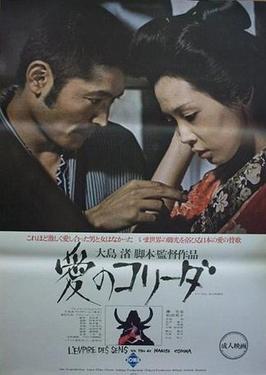
In the Realm of the Senses, known in French as L’Empire des sens and in Japanese as Ai no Korīda, “Bullfight of Love,” opened in 1976. Nagisa Ōshima wrote and directed this French-Japanese erotic art film. It retells the Sada Abe murder case of 1936 as explicit fiction drawn from a real killing. It was aimed at mainstream art houses, not at theaters that showed only adult films, and the release caused an international scandal. For BDSM and extreme-erotica audiences it remains a screen foundation for erotic strangulation, possessive power exchange, and private lust collapsing into public crime. It is not a consent manual. It shows two adults leaving ordinary social time for an erotic absolutism that ends in fatal asphyxia and mutilation.
Sada Abe and Kichizo Ishida, Tokyo 1936
The story is set in Tokyo in 1936. Sada Abe, a former prostitute working as a hotel maid, begins an affair with the hotel’s owner, Kichizo Ishida. The relationship becomes a run of sexual experiments and mutual indulgence. Ishida leaves his wife to follow her. Jealousy and possessiveness rise, and he grows eager to please her. They find that she is most aroused by strangling him during sex. He dies that way. She then cuts off his penis. In the film she carries the organ for four days until her arrest, smiling brightly. Blood writing on his chest says, in essence, that Sada and Kichi are together forever. This is not a detective story. It is a closed pressure chamber: in the social repression of militarizing 1930s Japan, the line between violence and love goes vague, and the pair answer that society with sexual obsession and power. Negotiated breath play has safewords and aftercare. This relationship has no exit. The “aftercare” four days later is a police record. The film is a negative example, not a method.
French paperwork, Japanese charges
Japanese law would not have tolerated Ōshima’s uncompromising version as a purely domestic production. The crew registered the film as a French enterprise and shipped the undeveloped footage to France for processing and editing. At the Japanese premiere, some sexual images were optically censored by reframing and blur. The publisher San’ichishobo issued a book of stills and script notes. In 1976 the Japanese government brought obscenity charges against Ōshima and the publisher. He testified: “Nothing that is expressed is obscene. What is obscene is what is hidden.” They were acquitted at trial in 1979. In 1982 the Tokyo High Court upheld that verdict.
Abroad, the bans lasted for years. The 1976 New York Film Festival premiere was blocked, and the film was later shown uncut. West Germany had a similar fight. One adult image that censors treated as especially intolerable shows Ishida putting an egg into Sada’s vagina, having her expel it, and eating it. Home video in the United States waited until about 1990, though film clubs sometimes ran uncut prints earlier. Belgium was the last European holdout; the ban lifted in 1994, and Belgium then stopped censoring films. At the 1976 London Film Festival the British censors preferred a private-club screening to heavy cuts. In 1977 the Obscene Publications Act came to cover films. The Gate Cinema Club opened the film in 1978. Wider UK cinema release waited until 1991, and video until 2000, with an 18 certificate. Sex between the adults stayed in. One shot involving a minor was reframed; this article does not describe that shot. Australia banned the film, then allowed it, and did not release a complete cut until 2000. Israel banned it in 1987 for sexual content. Uncut editions later circulated in France, Germany, the United States through the Criterion Collection, the Netherlands, and elsewhere. In the 1970s most Canadian provinces rejected it, except Quebec, Manitoba, and British Columbia. Broader approval came around 1991, while the Maritime provinces still blocked it under older rules. Brazil’s military dictatorship banned it for explicit sex; the ban lifted in 1980. A 1991 broadcast on Portugal’s RTP sparked a fight about whether the timeslot was appropriate. A later RTP2 broadcast passed almost unnoticed.
Tickets, reviews, and the books
The box office was strong for an explicit art film fighting censors. France sold about 1,730,874 tickets, roughly €4.67 million or $5.20 million. The 1978 German release sold about 693,628 tickets, roughly €1.80 million or $2.45 million. Together, France and Germany drew nearly 2.42 million admissions and about $7.65 million in gross.
Trade reaction split. Boxoffice granted Ōshima’s nerve and still called the film dull. In 2009 Peter Bradshaw gave it five stars in The Guardian and said it had not dated, because films actually about sex are still rare. In 2012 Sight & Sound called it still confrontational: unsimulated sex, an attention to psychology, and a 1930s Japan turned outward, while the lovers try to be completely private under constant watching, including the audience’s. Empire summed up the split. Some people take it as a serious study of death and eroticism. Others take it as repellent pornography. The style is hard to deny. Rotten Tomatoes later sat near 86 percent from 36 reviews, about 7.7 out of 10, with a consensus about broken taboos and a fearless psychosexual story.
The critical literature is thick. Beverley Buehrer places the film among Ōshima’s works on delicate subjects. Christine Marran, in Poison Woman, asks whether it counts as political subversion. Patrick T. M. Kenny links Japanese law to the shunga tradition of Hokusai. Raymond Durgnat treats it as a landmark of foreign-language cinema. Joan Mellen’s monograph is a usual English-language introduction. Criterion editions include Donald Richie’s notes on Ōshima and pornography. From Kōji Wakamatsu’s pink-film work on the production to Criterion’s archive decades later, the film is both an erotic record and a legal battlefield. For kink viewers who practice breath play, it is a dangerous counter-example. In media history it is a central 1970s statement that unsimulated sex and lethal erotic obsession can share a frame with a political allegory about privacy inside an expanding state.