
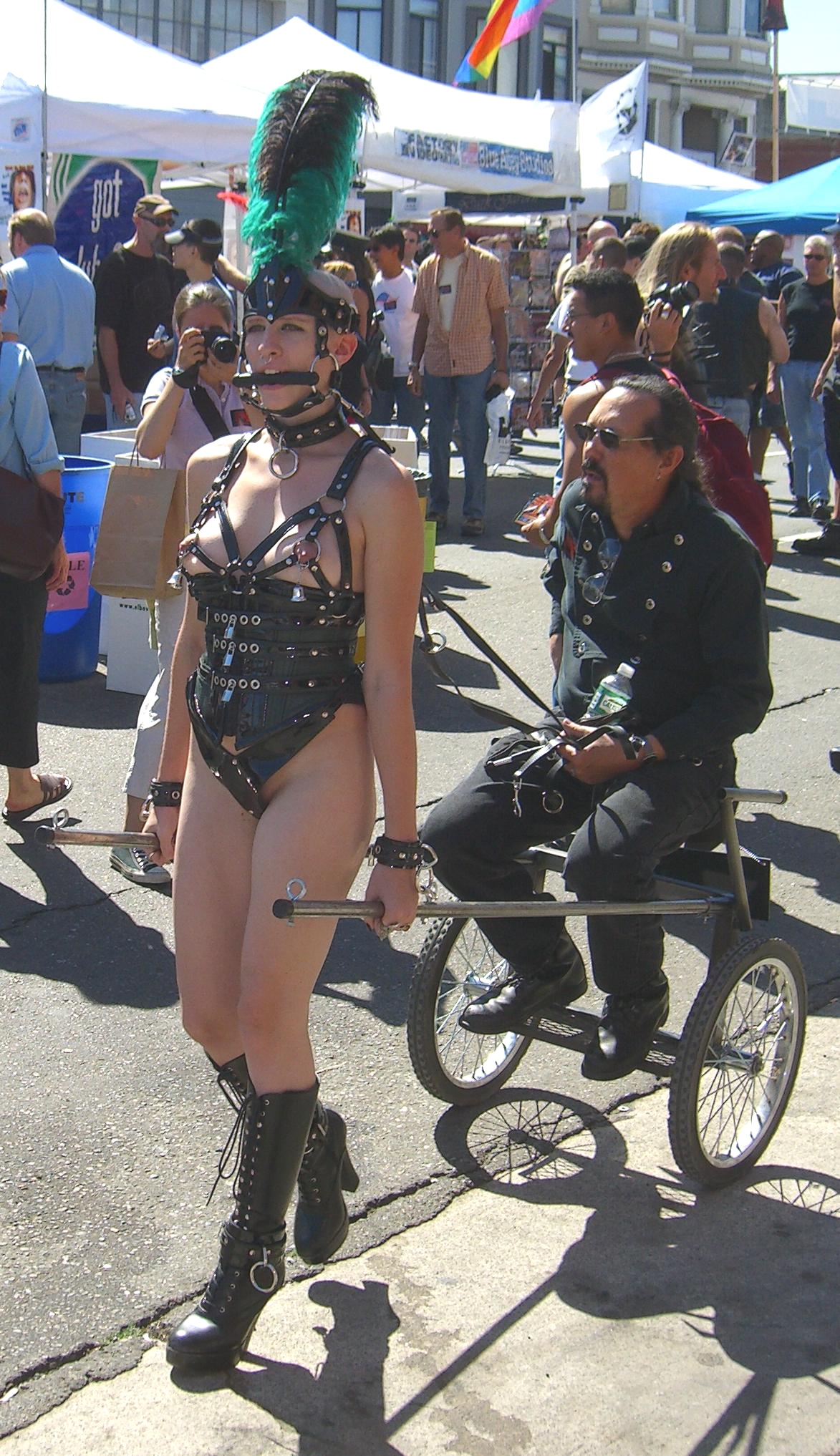
A human pony harness is bondage gear built for restraint, decoration, and work play, including pulling a cart. The people in it are adults acting as ponies. They are not children, and they are not horses. Leather is the usual material. Rope, biothane, and other strong stuff show up too. The shape borrows a horse harness and is cut for a human body. Buckles pull it snug so it does not simply slide off.
The main harness wraps the torso and usually carries D-rings for a lead rope or a chain. Once it is buckled, bit-gags, plumes, and other horse-coded pieces are common. Hands can be strapped behind the back. For cart work or any real load, leave the hands free. A fall is much worse if the pony cannot catch themselves. Strap paths are moved to fit human shoulders, ribs, and hips, while the silhouette still reads as breastplate, girth, and traces.
In a scene the pony may be led, hitched to a wagon, or set to pull some other load. A handler or trainer sometimes drives that with a horsewhip or a riding crop. For some fetishists the harness is the sexual toy and the games around it are the whole kink. In a wider BDSM practice the same rig shows up in outdoor bondage, public exposure, a sadomasochistic session that needs a secure torso, or play that controls head and body together.
Full-body restraint means watching circulation, breathing, and fall risk. Use hardware you trust, and keep a way to get the wearer out quickly. Outdoors, watch the ground. Whether the scene is pony fetish on its own or a broader power exchange, it stays inside limits the adults actually set, with a safeword and aftercare. The harness does not make that optional.