
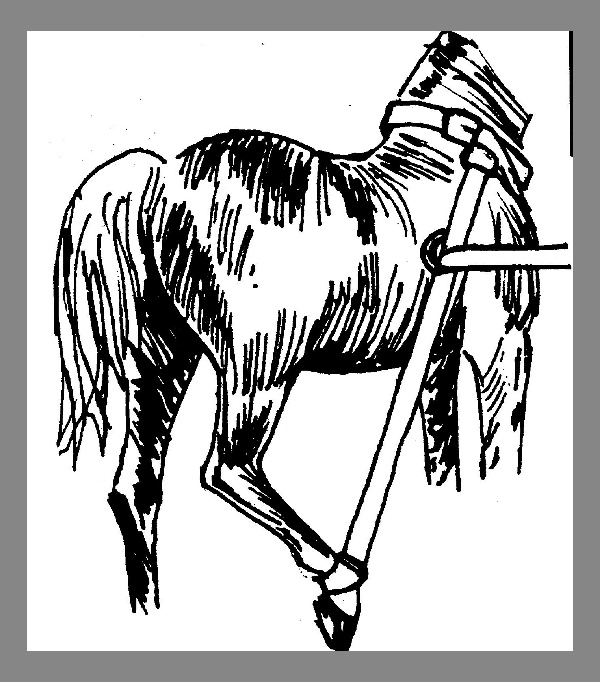
A hobble, also called a hopple or a spancel, is a restraint that limits how an animal moves. Horses are the usual case. Dogs and other animals get them too. In bondage the same idea is put on a person. The logic is still a shortened stride and a controlled gait. One or more legs are tethered. Materials include leather, rope, and synthetics such as nylon or neoprene. For adults who know BDSM, a hobble is the physical limit, and also helplessness, a set posture, and the friction of not being able to run at full speed.
A stock tool, older than the dungeon
Hobbles go back at least to ancient Egypt. Two hieroglyphs are believed to depict them. A silver vase from a fourth-century B.C. tomb at Chertomlyk, in today’s Ukraine, shows one as well. Persians also hobbled horses. In the Anabasis, Xenophon says a Persian army is useless at night: the horses wear halters and are usually hobbled too, so they cannot bolt the way they would if left loose. In Western riding, a hobble answers open country where there is nothing to tie to. Common types include a braided vaquero hobble around the front pastern or cannon bone, light and fancy, and only for a short time; a figure-eight hobble made of three pieces of leather, two rings, and a buckle, which also works as a belt and is a stockman’s multi-use strap; and a twist hobble of soft leather or rope with a twist between the horse’s legs. There is also the humble, which fixes one leg; the sideline hobble, which links a front leg and a back leg to limit jumping; and multi-leg straps for surgery or other special handling.
Training, and which pattern cinches
Teaching a horse to accept hobbles is a kind of sacking out, a desensitizing process. If the horse later tangles in barbed wire or meets pressure from a fence, it has been taught to yield to pressure on the leg instead of fighting, which is how legs get cut. The designs diverge by job. A service hobble for breeding runs from the mare’s hocks to a neck strap and protects the stallion from kicks. A casting hobble drops a large animal by pulling the hind-leg ropes. A drovers’ grazing hobble uses a chain and a swivel so the horse can graze and move a short distance. A mounting hobble has a quick release, so a rider can handle a fractious horse. The vaquero, the figure-eight, and the twist are unsuitable for training, because they can tighten around a leg and injure it. The braided vaquero is lighter and only for short use. The quick release belongs to the mounting hobble.
What “hobble” means on a person
In adult erotic use, hobble stretches from “limit the walk” to “couple the legs” or “shorten the step.” It usually means ankle cuffs on a short chain, a strap above the knees, or clothing that forces minced steps. The erotic version cares more about posture and the power in the room than about simply stopping travel. The hands can stay free, or they can be fully bound. A human body is not a horse’s. A long, tight cinch needs attention to circulation, especially at the ankles and knees. Hardware that tightens when someone thrashes needs a quick release and a material matched to how long the scene will run. The point is not to freeze the person the way a hogtie does. It limits how they are allowed to walk, inside a power exchange that was already negotiated.