BDSM is a portmanteau of bondage, discipline, domination, submission, sadism, and masochism. In the community those activities are often just called play. The abbreviations grew out of classified ads, where people needed euphemisms that would get past editors, censors, and obscenity law. Capitalization is part of the dialect. Dominant-side words are often capitalized — Top, Master, Dom — and submissive-side words are often lowercase — bottom, slave, sub — even when ordinary grammar would not do that. D/s means Dom/sub. A slave may refer to herself as “i” to mark the difference from the person she serves. Some people call that slashy speak an affectation. Others treat it as a real community habit. Lifestyle, scene, and kink are looser umbrellas. BDSM is still the label that travels.
The useful split is between who does the action and who holds the power. A top does the action. A bottom receives the sensation. A top is not automatically dominant. A Dominant, or Dom, exercises control. Domme is the word for a female dominant. A submissive, or sub, gives up control, and that is not the same role as bottom or as slave. A slave consensually cedes control of major parts of life to a Master or Owner. That dynamic stresses service and obedience, and it may include a collaring ceremony. TPE, Total Power Exchange, means the dominant’s authority over the submissive’s life is broad. 24/7 means the protocols run all the time, including outside scenes. A switch changes by context, partner, or activity. Training is the dominant teaching the behavior they prefer. Service submission is doing service inside a sexual or BDSM frame. Those two are not the same thing. Collared means a submissive or slave is treated as owned. The collar marks that claim. It is not just an accessory. In pup play it marks a claimed pup as distinct from a stray. A ProDom or ProDomme is a professional who exchanges BDSM services for money or goods. The words describe a structure. What a given collar means is whatever the people wearing it agreed.
Caregivers, brats, Goreans, and the rest of the role list
Roles move. DDlg, Daddy Dom / little girl, and MDLB, Mommy Domme / little boy, are caregiver-style D/s. The center is trust and care. Sex is not required. They sometimes overlap ageplay. Ageplay here is adults acting a psychological role. It is not children, and it is not a claim about anyone’s actual age. ABDL, adult baby/diaper lover, combines infant role-play and diaper fetish. The people doing it are adults.
A brat is a sub who is mischievously disobedient by agreement, often testing or drawing in a brat tamer. If that disobedience turns into directing the top outside what was negotiated, people call it topping from the bottom, and they usually mean it as an insult. If the top wants the provocation, bratting is consented play. The Gorean lifestyle comes from John Norman’s novels, with its own slavery aesthetic, and it is often treated as separate from the wider BDSM culture. Vanilla means someone who is not into kink, or sex that is not BDSM. WIITWD, What It Is That We Do, is a slightly wry name for alternative sexuality when “BDSM” feels too narrow. High protocol and low protocol describe how strictly etiquette is enforced. TNG, The Next Generation, marks groups aimed at younger adults, roughly 18 to 35. Still adults. The labels help people locate themselves. Like clothes, they mean what the person wearing them says they mean.
Consent, safewords, and risk slogans
Consent is mutual agreement to the terms of a scene or a relationship. Hard limits are absolute noes. Soft limits are hesitant edges that may be tried carefully if they are negotiated. A safeword is agreed in advance. Yellow usually means ease off. Red means stop now. If someone cannot speak, the signal has to be nonverbal: a fist, a dropped object. SSC — safe, sane, and consensual — is the older slogan. RACK, Risk Aware Consensual Kink, stresses informed risk rather than a fixed idea of “safe.” PRICK, Personal Responsibility, Informed, Consensual Kink, puts personal responsibility in the same frame.
Edgeplay means higher physical or emotional risk. Bloodplay involves blood; it is not therapeutic bloodletting. Breath play restricts breathing and is high risk. Gunplay brings real or simulated firearms into a scene. What counts as edge is subjective. None of those are described as methods here. CNC, consensual non-consent, is advance agreement to act, inside a defined scene, as if refusal is part of the play. The dominant may continue through in-scene protests. The real consent was made beforehand, and it does not cover distress outside that frame. Aftercare is the wind-down: talk, comfort, water, and coming back from subspace or domspace. Subspace is the bottom’s altered state — time goes strange, the room drops away — and the top has to watch, because speech may fail. Domspace is the dominant’s parallel focus or rush. Sub drop and top drop are the delayed crash, mood and body, sometimes for days. Aftercare can ease a drop. It does not guarantee there will not be one. A dungeon monitor, the DM, enforces house rules at a party and handles basic care. A munch is a non-sexual meetup in an ordinary place, for talking and meeting people, not for sex on the spot. These are ways of talking about stopping, risk, and responsibility. They are not a warranty.
Bondage, impact, and sensation
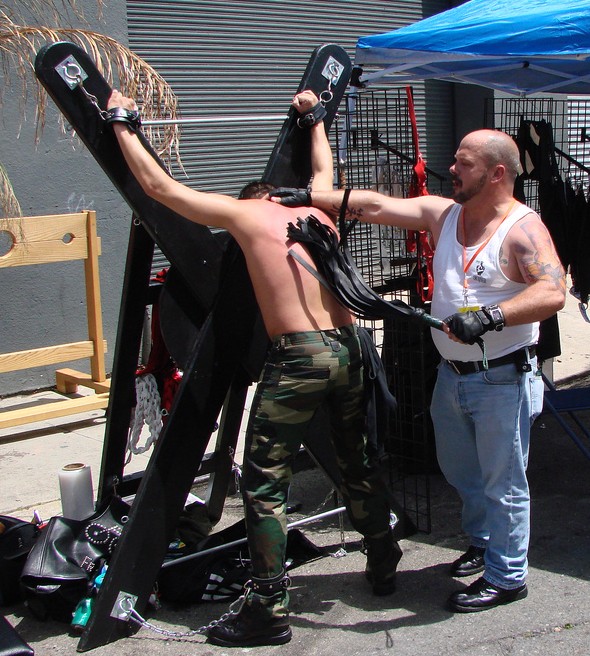
Bondage is physical restraint, from one limb to the whole body. Rope bondage includes Western rope and Japanese kinbaku / shibari, tight binding with an aesthetic aim. A hogtie binds wrists and ankles together behind the back. Mummification wraps the body so it cannot move. Breast bondage shapes the chest. Breast torture applies pain to it. Inspection, often in a Master/slave scenario, has the sub strip and present for checks of posture, grooming, and duty. Handkerchief codes, the hanky code, use color and which pocket — left or right — to signal interests and top or bottom side in leather contexts. Plain speech has partly replaced them.
Impact play uses whips, floggers, paddles, and similar tools. Warm-up matters, and so does staying off the spine and the kidneys. Sensation play is aimed at temperature, texture, and feeling rather than at a role story. Knife play uses the edge or the point for fear and touch. Needle play places sterile needles and carries a blood risk. Wax play drips hot wax. Knife play and needle play both need strict cleanliness; this glossary does not give a procedure. Contrapolar stimulation is the “hurts and still feels good” mix. Good pain is intensity someone wants. Bad pain is harm. The safeword is how people mark that line. Pain slut is scene slang for a sub who wants heavy pain, not a diagnosis. A masochist gets pleasure from receiving pain. A sadist gets it from giving pain. Many switches do both.
Toys, fluids, denial, and the high-risk names
A butt plug is an anal toy. Some lock, and some carry a tail, so the sensation sits next to a pet look. Fisting is a hand in the vagina or rectum. Pegging, in the usual sense, is a woman anally penetrating a man with a strap-on. Both reward lube and patience. Figging uses peeled ginger for a burning sensation. Enema play eroticizes enemas. Golden showers involve urine. Scat play involves feces. Shame is often part of the charge. Erotic humiliation is verbal or physical degradation for arousal. In financial domination, findom, a finsub gives money to a money Dom. Inside a negotiated dynamic that is the kink. Outside it, it is theft.
CBT — cock and ball torture — along with pussy torture and tit torture, is genital or breast pain play, and it has limits around circulation and tissue damage. Chastity devices and erotic sexual denial block orgasm with hardware or with an agreement, and the point is to keep arousal high. Forced orgasm and post-orgasm torture keep stimulating when the body is already hypersensitive, which can turn into pain. Breath control restricts oxygen. It sits deep in edgeplay. Done wrong, it kills. Gunplay, real or simulated firearms in a scene, is the same class of risk. These entries name the type of play. They are not steps. What a body can take is particular to the people involved. Shared vocabulary is a starting point. The agreement between partners is the rule that counts.