
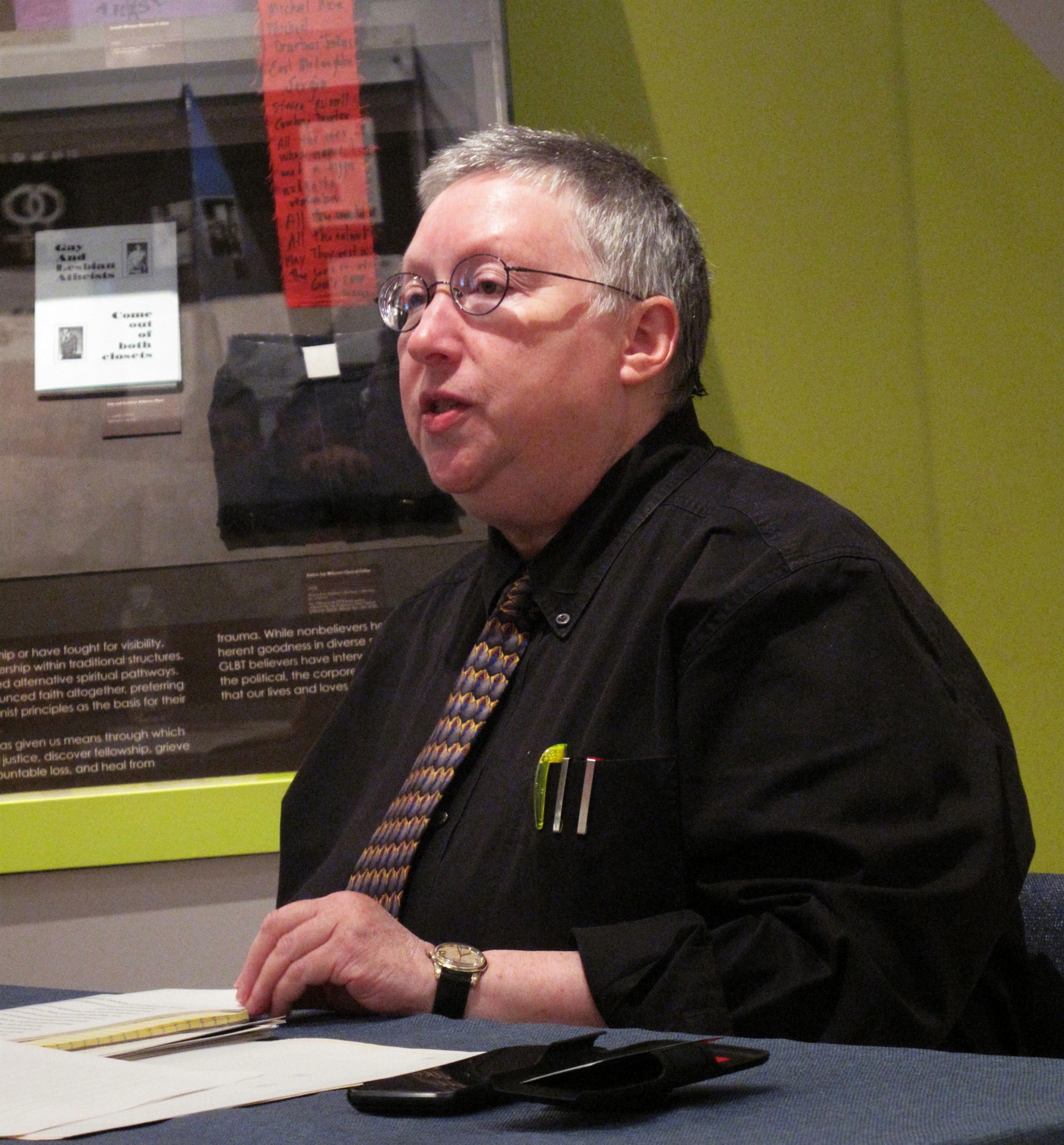
Gayle S. Rubin is one of the few people whose name turns up both on queer-theory syllabi and on leather hall-of-fame ballots. She was born on January 1, 1949, into a white middle-class Jewish family in South Carolina, while public schools there were still segregated. As one of the few Jews in her Southern city, she resented white Protestant dominance. She was the only Jewish child in her elementary school, and she says she was punished for refusing to recite the Lord’s Prayer. Those years left her with what she has called an abiding hatred of racism in all its forms, and a respect for how stubborn it is. In 1968, as an undergraduate at the University of Michigan, she joined an early feminist consciousness-raising group and wrote for women’s-movement papers. In 1970 she helped found Ann Arbor Radicalesbians. In 1975, when Graduate Employees’ Organization 3550 formed, she and Anne Bobroff put out a leaflet, “The Fetishization of Bargaining,” arguing that bargaining alone does not move management. The same year she wrote “The Traffic in Women: Notes on the ‘Political Economy’ of Sex,” the essay that first made her a major feminist theorist.
In 1978 Rubin moved to San Francisco to study gay male leather as a living community, as an anthropologist, not as a clinician pathologizing individuals. She joined Cardea, a women’s discussion group inside the mixed BDSM organization Society of Janus. On June 13, 1978, a core of lesbian members, including Rubin and Pat Califia, founded Samois, the first lesbian BDSM group in the United States. It stayed active until 1983. In 1984 she co-founded The Outcasts, a social and educational group for women who wanted to do BDSM with women. In 1994 she finished her anthropology Ph.D. at Michigan with the dissertation The valley of kings: Leathermen in San Francisco, 1960–1990. She is an associate professor of Anthropology and Women’s Studies at the University of Michigan, and she has served as the F. O. Matthiessen Visiting Professor of Gender and Sexuality at Harvard.
The Traffic in Women
In “The Traffic in Women,” Rubin coined “sex/gender system”: the set of arrangements by which a society turns biological sexuality into products of human activity, and in which those transformed sexual needs are met. Drawing on Claude Lévi-Strauss, she treats kinship as a system in which men exchange women. That exchange creates gendered roles of giver and gift, and it moves sexual access, status, names, and rights. In that system men act as the capitalists of the exchange and women as the commodities.
She also uses Marx. Reproducing labor power depends on women’s housework, which turns commodities into what a worker can live on. Capitalism needs women to produce surplus and does not give them an equal claim on capital. Rubin’s line is that gender is a socially imposed division of the sexes, not a natural necessity. Her conclusion is that a society which left that now functionless sex/gender system could imagine something else: no hierarchy, identities not sorted by gender, and sexuality in more than one form.
Thinking Sex and the Charmed Circle
“Thinking Sex,” first published in 1984 in Carole Vance’s anthology Pleasure and Danger, is widely treated as a founding text of sexuality studies and queer theory. It asks how groups on the left or the right, feminist or patriarchal, sort sex into good and bad. Rubin’s Charmed Circle puts privileged sex inside: the couple, monogamy, the same generation, bodies only. Stigmatized forms sit outside: sex alone or in groups, promiscuity, cross-generational sex, sex with manufactured objects, and so on.
She maps the ideas that structure Western sexual politics. Sex negativity treats sex as dangerous unless marriage, reproduction, or love redeems it. The fallacy of the misplaced scale loads acts with more moral weight than they can bear. A domino theory of sexual peril says that if one “bad” act crosses the line, order collapses. Another fantasy is that there is one proper way to have sex. Against that ranking she argues for benign sexual variation: different sexual cultures get the kind of respect anthropology learned to give cultural difference, without an automatic verdict of inferiority.
In 2009 the University of Pennsylvania held “Rethinking Sex” on the essay’s twenty-fifth anniversary. Rubin spoke to nearly eight hundred people on “Blood under the Bridge: Reflections on ‘Thinking Sex.’” A 2011 special issue of GLQ included that reflection. She has been clear about the passages on sex and children: they were written in the 1980s climate of panics about Satanists and kidnappers. She has said she never supported the abuse of minors, and that right-wing readers misread the argument.
Archives, contests, and the leather city
Rubin’s work keeps high theory next to street history. She belonged to the San Francisco Lesbian and Gay History Project and was a founding member of the GLBT Historical Society. She has served on the board of the Leather Archives and Museum and on the Board of Governors of the Leather Hall of Fame. Arguing for archives, she wrote that queer life is full of fabulous explosions that left little or no trace, and that people who do not pass their histories on are doomed to forget them. When the San Francisco South of Market Leather History Alley opened in 2017, one of the four artworks was a black granite stone carrying a narrative by Rubin. She sat on the community advisory group that shaped the designs.
In 1991 she became the first woman to judge a major national gay male leather title contest, Mr. Drummer. Her ethnography treats South of Market leather bars, title contests, women’s SM groups, and places such as the Catacombs as real urban culture, with architecture, kinship, and grief, not as case studies of pathology. Writing on AIDS and the leather community, she maps how the epidemic tore through networks that official public health often misunderstood. “Old Guard, New Guard” and related pieces follow how protocol, mentorship, and scene memory change across generations.
From the sex wars to the scene
Rubin is a sex-positive feminist. At the 1982 Barnard Conference on Sexuality, often marked as the start of the feminist sex wars, she presented an early version of “Thinking Sex.” She was on the Leather Archives and Museum board from 1992 to 2000. Honors include the NLA Lifetime Achievement Award in 2000 and the Ruth Benedict Prize in 2012. Deviations: A Gayle Rubin Reader came out in 2012.
Strip the academic frame and the 1984 argument is scene politics. Societies draw a line between “good” sex and “bad” sex, then panic that any softening of the line will undo order. Munches, leather contests, and educational parties exist partly because people pushed back and treated negotiated kink as adult culture that can be ethical, not as proof of sickness. She argued against anti-pornography feminism, and against using sexual disgust as a shortcut for law and for feminism. With the Samois and Outcasts organizing, and with the South of Market ethnography, she is why leather people can quote theory and why theorists cannot file leather history as unserious. For BDSM readers she is one of the people who documented women’s SM groups, defended kink inside the sex wars, and gave the scene words it still uses for itself.