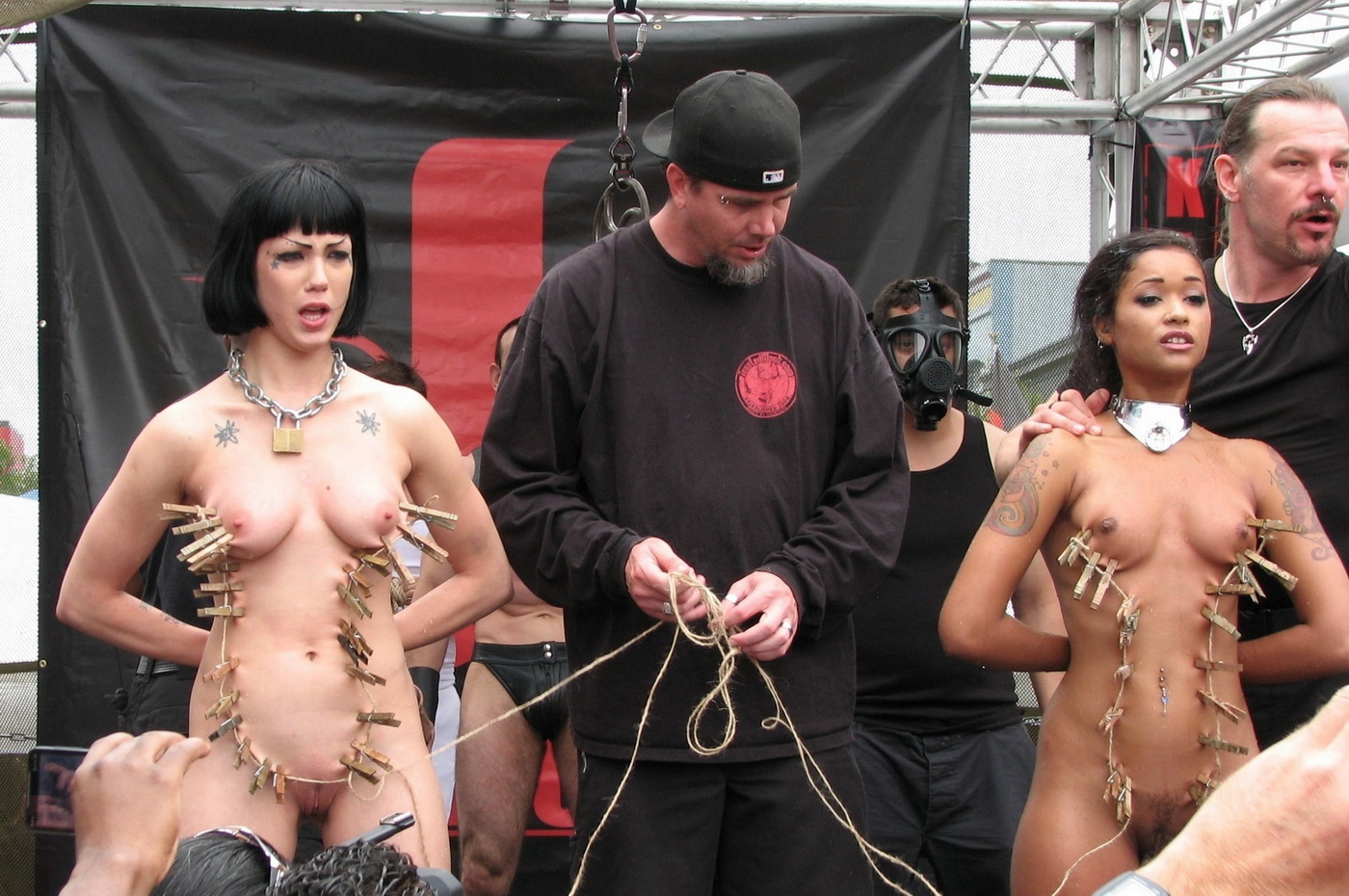
The Folsom Street Fair, Folsom or FSF for short, is a street fair on the last Sunday of September on Folsom Street in San Francisco’s South of Market, SoMa, from 8th Street to 13th. It closes Leather Pride Week. It is California’s third-largest single-day outdoor event and the world’s largest leather gathering. It is also a showcase for BDSM products and culture, and it runs as a nonprofit charity. Gate donations, beverage booths, games, and spanking for donations send money to local and national groups. The day is a party and a piece of political memory.
Modern American gay leather culture grew after 1945, when thousands of gay servicemen settled in port cities. Marlon Brando’s look in the 1953 film The Wild One — black leather jacket, boots, jeans, and a motorcycle — set a visual model for butch gay men. In the 1950s, Bizarre magazine spread fetish imagery. San Francisco’s first proto-leather bar, the Sailor Boy Tavern, opened in 1938 near the Embarcadero YMCA and served Navy men looking for sex with men. Before SoMa became the leather center, the Embarcadero and the Tenderloin held bars including Jack’s On The Waterfront. The Tool Box, at 339 4th St., opened in 1961 and was SoMa’s first leather bar. Paul Welch’s 1964 Life feature “Homosexuality In America” made it known nationally. Photographer access came through Hal Call. The article opened on Chuck Arnett’s life-size mural of leathermen, called San Francisco “The Gay Capital of America,” and drew leathermen west.
Leather business on Folsom Street followed. On 25 July 1966, Febe’s opened at 11th and Folsom. The same year The Stud opened at 1535 Folsom. It went from a bar with Hells Angels history to a hippie dance bar, and it had an Arnett black-light mural. In 1967 Nick O’Demus opened A Taste of Leather inside Febe’s, one of the first in-bar leather stores. It ran until 2009. By the late 1970s the Miracle Mile on Folsom had nearly thirty leather bars, sex clubs, and shops within walking distance. In rough founding order: Off the Levee and The Ramrod in 1968; The In Between / No Name and The Bootcamp in 1971; the hardcore BDSM bathhouse The Barracks in 1972 and the connected Red Star Saloon; Folsom Prison, The Ambush, and Big Town in 1973; the hardcore fisting club The Catacombs in 1975; The Slot and Handball Express in 1976; Sutro Baths at 1015 Folsom in 1978, with a banner about a rainbow of sexual preferences; and The Eagle, opened in 1981, still San Francisco’s oldest and largest leather bar as of 2010. Around 1971 the modern hanky code entered leather use. Embarcadero YMCA culture, including nude swimming and weightlifting, fed the same crowd.
The fair’s institutional ancestor is the CMC Carnival, the California Motorcycle Club Carnival: a dance, vendor fair, and back-room sex party run by gay leather motorcycle clubs, from 1966 to 1986. San Francisco’s Warlocks (1960) and the California Motorcycle Club (1960), and later the Barbary Coasters (1966) and the Constantines (1967), were part of that tradition. Early-1970s crowds were only in the hundreds. The last large carnival, in 1982 at the Yellow Cab Building at Jones and Turk, drew more than 4,000 people. In 1979 the lesbian club Dykes on Bikes first led the San Francisco Gay Freedom Day Parade and has led it since. From the mid-1980s into the early 1990s, lesbian leatherwomen often helped care for gay leathermen with AIDS.
The fair began in 1984, against city redevelopment and the shock of AIDS. Through the 1970s, SoMa leather people fought high-rises on blue-collar warehouse land. From 1984, bathhouses closed in the name of public health and bars were regulated, and leather institutions came apart. Community organizers used a street fair to make the community visible again and to pass on safer-sex information. That success produced Up Your Alley Fair in 1985. COVID-19 canceled the 2020 Folsom. Photographer Michael Rababy has said that while algorithms and trust-fund hipsters replace artists, and while the Millennium Tower sinks, the Folsom Street Fair still holds its ground.
The fair now puts SM in public street space. The crowd includes players, exhibitionists, tourists, and photographers. Organizers say about 250,000 people come each year. Net proceeds often top $300,000 for public-health, human-services, and arts charities, with the Sisters of Perpetual Indulgence organizing at the gate. There are charity spanking booths, BDSM demos, and a Twister stage. Stages have hosted musicians including Austra, Little Boots, and Ladytron. The DJ area has included Tony Moran and Manny Lehman. A women’s area started in 2006 and is now called the Playground. An erotic artists’ area was added in 2007, and a performance-art stage in 2013. Conservatives attack the fair as bawdy. Organizers talk about it as political power.
The 2007 “Last Supper” poster fight was a separate storm. Official art by FredAlert restaged The Last Supper with LGBT and BDSM community figures, the table draped in the leather pride flag. Conservatives called it blasphemous. Press coverage noted that Last Supper parodies are common. Miller Brewing was threatened with a boycott because its logo was on the poster, the logo came off, and the boycott ended. House Speaker Nancy Pelosi said she did not believe Christianity had been harmed by the Folsom Street Fair.
Once the fair became a top-tier outdoor spectator event, cameras and tourists were part of the ecology. Leather communities walk a line between visibility and spectacle, and they treat public SM as community property. In 2017 the San Francisco South of Market Leather History Alley opened on Ringold Alley: Gayle Rubin’s granite narrative, Mike Caffee’s “Leather David,” Arnett’s Tool Box mural, leather pride flag pavement, and metal bootprints for 28 community figures. Sister events export the name with separate boards: Folsom Street East in New York since 1997, organized by GMSMA; Folsom Europe in Berlin since 2003, copying the nonprofit model; and Toronto’s Folsom Fair North, 2003–2008. Pantheon of Leather has given Folsom Street Events more than one award for its nonprofit work.
Alan Selby’s The Mayor of Folsom Street (2017) covers the early fair and the gear-shop world around it. Michael Rababy’s Folsom Street Food Court (2018) uses food-court photographs to show Folsom’s stubborn realness while San Francisco gentrifies. Together the books treat Folsom as a yearly argument about how much kink the city will still allow on a street in daylight, not as a freeze-frame of 1984. The Barracks and the Catacombs are gone. The history alley and a thinner bar ecology, including The Eagle’s long run, still let new players walk into that story. Leather culture is still here after real estate and an epidemic erased the old rooms.