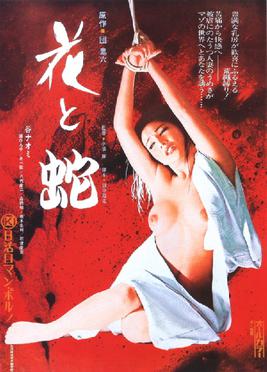
Nikkatsu, Japan’s oldest major film studio, went into soft-core pink film in 1971 to avoid bankruptcy and launched its Roman Porno line. By 1974 the studio was having another dry year at the box office. Flower and Snake (Hana to hebi) was made in that gap. Directed by Masaru Konuma and starring Naomi Tani, it adapts a novel by Oniroku Dan, Japan’s best-known author of sadomasochistic fiction. It is counted as the first Nikkatsu Roman Porno feature to take on a full S&M theme. With Wife to Be Sacrificed, released a little later the same year, it is credited with opening the S&M Roman Porno cycle that helped Nikkatsu through the financial crisis of the 1970s, and with setting a commercial pattern for Japanese SM film. For BDSM and fetish viewers it is remembered as erotic cinema about control, trauma, and desire. The people in the story are adults. The plot is a 1970s commercial pink film, not a set of instructions.
Makoto Katagiri, played by Yasunori Ishizu, is a thirty-year-old man who lives with his mother Miyo, played by Hiroko Fuji. She runs a pornographic photography business and an adult-toy shop. Makoto’s sexuality is stuck in childhood. He saw his mother having sex with a Black American soldier and shot the soldier dead. The incident left him impotent, and his mother still treats him like a child. He is an adult with a strong interest in S&M and nowhere to put it. The elderly owner of the company where he works, Senzô Tôyama, played by Nagatoshi Sakamoto, also wants S&M. His new wife Shizuko, played by Naomi Tani, is proud and cold. She refuses to be tied, and she will not even let her husband watch her bathe. Senzô takes that frustration out on the maid Haru, until he finds bondage pornography in Makoto’s desk. He then orders Makoto to kidnap Shizuko and “train” her, so her pride will break and she will submit to her husband.
Senzô arranges it so Makoto can take Shizuko after she has been given sleeping pills. On the way Makoto tries to rape the half-conscious Shizuko, then stops when arousal brings up the hallucination of the Black soldier from his childhood. At the Katagiri house Shizuko wakes up tied. Miyo does not free her. She urges her son to have sex with her. Makoto cannot get an erection because Shizuko is too beautiful, so his mother suggests an enema to ruin that perfect impression. He does it, then rapes Shizuko, and he reports the “training” to Senzô. As the story goes on he becomes attached to Shizuko and clashes with his mother, who is against the relationship. Miyo secretly has a man who looks like the Black soldier “use” the tied Shizuko, to break Makoto’s potency again. That leaves Makoto impotent once more. He does not stop. He keeps training her, and he even takes her out for walks. After he unties her she is gone for a long time. He panics. When she comes back he is relieved. They watch a pornographic film. The image of a Black man in it makes Makoto remember the truth: Miyo fired the shot, not him. The relief brings his potency back, and he spends the night with Shizuko.
At the end Senzô comes to take his wife back. Shizuko moves to her husband eagerly, because she has realized she is now the “total slut” her husband’s desire wanted, and she is happy about it. She invites Makoto to leave with them. He hesitates, then agrees. Miyo begs him to stay. The three of them get into Senzô’s car anyway. The last image is Shizuko tied again and used by Senzô and Makoto together, while Haru watches in shock. The film’s charge is that shift from coercion to her accepting the identity.
Naomi Tani is the reason the film exists. She was the “Queen of Pink,” the most popular actress in the independent pink market, and she kept turning Nikkatsu down because the studio would not touch S&M. She finally agreed on one condition: her first film there had to be based on Oniroku Dan’s Flower and Snake. To get Dan’s consent, Konuma and screenwriter Yozo Tanaka visited the writer. The power failed during the visit. Tani appeared in a kimono, carrying a lantern. Konuma took that as Dan’s theatrical way of saying yes. Dan and Tani were unhappy with major script changes. On set Tani was thoroughly professional, playing Shizuko as a proud wife who becomes a willing participant. In some readings she is the one controlling the men around her. That reading is the film’s lasting erotic center.
Critics generally treat Flower and Snake as an industrial and historical landmark, not as pure art. Izumi Evers has noted that the film accidentally picks up a comic streak, and that the heroine, while suffering the humiliations, is actually controlling the desire of the men around her. Thomas and Yuko Mihara Weisser call it “well-made garbage” and one of the better Nikkatsu films of the type. After it became a hit, Nikkatsu wanted a sequel. Dan was still bitter and refused to take part in the next film, Wife to Be Sacrificed (1974), which sold even better. He reconciled later and kept a working relationship with Nikkatsu and with Tani. The film opened Nikkatsu’s SM Roman Porno cycle. Later sequels include Flower and Snake: Sketch of Hell (1985). Takashi Ishii’s 2004 Flower and Snake, starring Aya Sugimoto, is a loose remake and started a separate cycle. For readers, Flower and Snake is not a how-to. It is 1970s Japanese commercial pink cinema, in which rope, training, and family trauma were the entertainment credited with helping save a studio.