
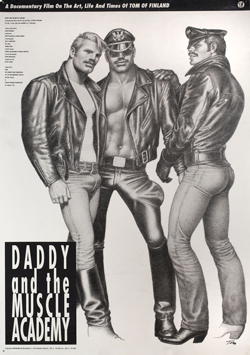
Daddy and the Muscle Academy is a 1991 Finnish documentary written and directed by Ilppo Pohjola about the life and work of Tom of Finland—the pen name of gay erotic artist Touko Laaksonen. Shot in the years just before Laaksonen’s death in 1991, the film pairs interviews with the artist and a retrospective of his hyper-masculine homoerotic illustrations with voices from people shaped by that imagery. For leather, BDSM, and gay fetish audiences, it remains a core screen document of how Tom of Finland’s cops, sailors, and leather men rewired twentieth-century gay desire.
What the documentary covers
The film centers on Laaksonen’s mid-century illustrations of exaggeratedly masculine men—the drawings that helped define leather aesthetics, muscle worship, and a proud erotic masculinity long before mainstream gay media caught up. Viewers get the artist in his own words and a tour through the art that made “Tom of Finland” a global shorthand for leather fantasy. Interview subjects include artists and scene figures influenced by his work, notably Etienne, Nayland Blake, Durk Dehner, and Bob Mizer. That mix matters: Tom’s influence was never only gallery wall—it ran through physique magazines, leather clubs, and the men who built modern gay SM visual culture.
Production, soundtrack, and release path
Pohjola wrote and directed. Kari Paljakka and Alvaro Pardo produced; Kjell Lagerroos shot; Jorma Höri edited. Production companies were Filmitakomo and Yleisradio; Kristallisilmä handled distribution. Composer Elliott Sharp scored the film, saying Pohjola offered only a few vague guidelines and left him wide latitude. The soundtrack leans on electronically processed guitar rather than conventional documentary piano cues—another choice that keeps the film closer to underground heat than polite arts programming.
The documentary premiered in 1991 at the Helsinki International Film Festival. Finnish television has rebroadcast it multiple times; a 2019 airing on Yle Teema & Fem still ran with roughly three minutes of censorship cuts. In 2017 the film was restored and released by Kino Lorber on Blu-ray with unedited interview segments restored—useful for anyone who wants the full artist-talk without broadcast trims.
Reception and why kink viewers still watch
Critic B. L. Panther, writing for The Spool, places Daddy and the Muscle Academy inside New Queer Cinema: provocative secular-sexual imagery, a non-linear structure, and a celebration of queer culture with a real history. Panther stresses the film’s clear sense of how gay men used, sent, lent, and shared magazines to see male erotica—and how that circuit of images made them feel seen. At the 1992 Jussi Awards, the crew received a Special Award.
On a BDSM and leather site, the film is more than film-history homework. Tom of Finland’s men—boots, caps, leather jackets, exaggerated cocks and chests—still set the visual default for leather bars, pride floats, and a huge slice of gay SM porn styling. Watching Laaksonen and peers such as Dehner and Mizer talk through that archive is a direct line from paper fantasy to dungeon aesthetics. Durk Dehner’s appearance links the film to the Tom of Finland Foundation’s later institutional work; Bob Mizer’s presence ties it to the older physique-photo underground. Related reading includes Martti Lahti’s “Politics of the Flesh: Ilppo Pohjola’s Films and Images of the Body,” the film’s IMDb entry, and the 2017 Kino Lorber restoration for uncut interview material rather than a censored TV print. For anyone who wears a cap and harness without knowing the drawing tradition behind it, Pohjola’s documentary is still the shortest honest path from “cool leather look” to why that look exists.