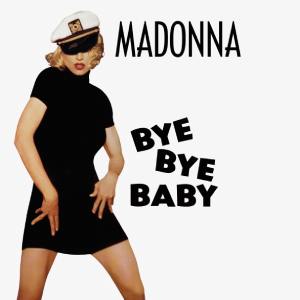
“Bye Bye Baby” is a Madonna cut from her fifth studio album Erotica (1992). It went out on 15 November 1993 as the sixth and last single from that record—and only outside the United States. Madonna wrote it with Shep Pettibone and Anthony Shimkin; she and Pettibone produced. The track sits in the same miserable, horny headspace as the rest of the album: a string of wrecked relationships, no sugar-coating, and the S&M thoughts she was then wearing in public as the dominatrix persona Dita. Musically it is a hip-hop song that lifts a hook from LL Cool J’s 1990 single “Jingling Baby.” Her vocal is filtered so it sounds like an answering machine. Keyboards carry the arrangement. Lyrically she interrogates a lover she is about to dump. Critics split down the middle. The single had a limited worldwide push, peaked at number seven in Italy, and also charted in Australia, New Zealand and Switzerland. She performed it at the 1993 MTV Video Music Awards and on that year’s Girlie Show World Tour, both times dressed as a Victorian gentleman in tailcoat and top hat, dancing with backup singers and three barely dressed women in a brothel tableau. That package—Dita, the filtered taunt, the cane and the chairs—is why the song still belongs on a BDSM-media map. It is not a flogging tutorial. It is a pop record about taking control of a mind-game-playing partner, dressed in 1940s radio voice, a hip-hop sample, and a live show that puts butch/femme chair work on a stadium stage.
After she finished shooting A League of Their Own, Madonna went into Erotica with Pettibone. She was miserable after a run of failed relationships and put the frustration and depression straight into the music. Lucy O’Brien, in Madonna: Like an Icon, notes that the album has no sugar-coated songs. She put on the Dita dominatrix mask, and both the songwriting and the imagery in the coffee-table book Sex tracked her S&M thinking. The Australian release date, 15 November 1993, was timed to her Australian run of the Girlie Show. Ricky Crespo produced the remixes that travelled with that release. Jose F. Promis, reviewing the single for AllMusic, still preferred the album version and flagged “Madonna’s Night On the Club” as the most interesting remix: swirling organs and guitar effects over an early-1990s house beat.
Writing credits: Madonna, Shep Pettibone, Anthony Shimkin. Production: Madonna and Pettibone. The session was at Sound Works Studios in Astoria, New York, and the beat samples that LL Cool J hook from “Jingling Baby” (1990). Pettibone handled sequencing, keyboard arrangement and programming with Shimkin. Dennis Mitchell and Robin Hancock engineered the recording. George Karras mixed. Ted Jensen mastered. Mark Goodman assisted. Niki Haris and Donna De Lory sang backgrounds—the same singers who would later stand beside her in tailcoats on the Girlie Show. Madonna and Pettibone wanted a 1940s antique-radio vocal. They got it with a Pultec HLF filter. Shimkin later said the vocal was a first take, and that the filter was already live in her headphones while she stood at the microphone. The last line, “You fucked it up,” is bleeped so it lands like the machine’s end-of-message tone. The finished track is hip-hop and dance. It opens with the declaration “This is not a love song.” Alfred Publishing’s sheet music puts it in common time at a fast 109 beats per minute, in G minor, with Madonna’s high-register line spanning F3 to A4. The basic chord loop is G–B♭–G–D–G–Dm. The lyric is a set of questions aimed at a lover she is walking away from. “Does it make you feel good to see me cry? I think it does.” The line “I’d like to hurt you” was immediately compared with her previous single “Erotica,” where she sang “I only hurt the ones I love.” Richard Harrington in The Washington Post heard a sonically filtered, detached, slightly taunting voice talking about taking control rather than getting revenge on a dominating, mind-game-playing partner. Chris Willman in the Los Angeles Times simply called it a “brushoff song.”
Most reviews were mixed. Stephen Holden of The New York Times called the song “sly, spunky.” J. D. Considine in The Baltimore Sun praised the “dense, gimmicky groove” and said the album “really heats up” and sounds “body-conscious in the best sense of the term.” David Browne in Entertainment Weekly heard her as “honest.” Louis Virtel, listing “The 100 Greatest Madonna Songs” for The Backlot, tagged it as “a hip-hop kiss-off with cabaret flair.” Michael R. Smith at The Daily Vault found it “defiant” and “in-your-face,” and read the lyric as aimed at her past relationships with Warren Beatty and Sandra Bernhard. In 2018 Billboard ranked it her 60th greatest single. The other half of the press was colder. Arion Berger in Rolling Stone heard her vocals as “infantile” and her delivery as “flat”—not assertive, more “a drag queen toying with a pop hit of the past.” Rikky Rooksby thought the aggressive lyric and the closing profanity sat badly on an erotic album and “strengthen[ed] the air of narcissism and calculation.” O’Brien heard the vocal as cool and minimal but still “flat,” the dance beat as “barely discernible.” When Jude Rogers ranked Madonna singles for The Guardian on the singer’s 60th birthday, “Bye Bye Baby” landed at number 55; Rogers still liked those “babyish 1940s-style vocals, filtered to sound like they’re wavering through a wireless.”
The official single went out in Australasia, Germany and Japan. Italy never got a proper commercial single, and it still peaked at number seven on the Italian Singles Chart—the fifth Erotica track to make that country’s top ten. On 25 November 1993 it debuted at 39 on the Swiss Hitparade, climbed to 28 three weeks later, then fell off. In Australia it entered at 31 on 5 December 1993, peaked at 15 the next week, and left the chart on 6 February 1994 after eight weeks. New Zealand saw it enter at 49 the week of 25 November 1993, drop off the following week, then re-enter the week of 23 January 1994 and peak at 43. Australia’s 15 is the best official-single peak in the territories that actually released it.
On 2 September 1993 Madonna opened the MTV Video Music Awards with “Bye Bye Baby.” She worked the stage with three scantily clad women in a brothel-style set, everyone in tuxedos and top hats, in a tightly choreographed, highly sexual routine. Choreographer Alex Magno had wanted “Justify My Love” or “The Beast Within” for MTV. Madonna decided those were too hot for live television and killed the idea. They used the Girlie Show choreography instead. Louis Virtel later ranked the VMA slot number eight on a list of “Madonna’s 11 Greatest VMA Moments.” On the Girlie Show itself, Madonna and her backup singers Donna De Lory and Niki Haris dressed as Victorian gentlemen: masculine tailoring, top hats, tailcoats. The look is an homage to Marlene Dietrich in the 1930 romance drama Morocco, and Madonna carried a cane. The segment’s main references were 1900s showgirls and Takarazuka Revue, the Japanese all-female cross-dressing dance company. Madonna switched her voice into circus-ringmaster mode to announce three female strip-club dancers. A voice treatment close to the record’s filter sat on the live vocal. The dance is built around three chairs. The strippers seduce Madonna and the singers—rubbing against them, holding sexual poses, dominating them—before the suited women take control again. The 19 November 1993 show at Sydney Cricket Ground was filmed and issued on VHS and Laserdisc on 26 April 1994 as The Girlie Show: Live Down Under. In Queer Studies, Brett Beemyn argues that the performance expands Madonna’s usual butch/femme staging: White and African-American women play the butch roles; Asian-American women play the strippers; the choreography simulates masturbation and sexual penetration while the butch figures control the femmes. Beemyn’s sharpest claim is double-edged—casting Asian-American women as the femmes leans on stereotypes of Asian women as the passive, exotic, feminine “other,” and at the same time mocks the history of Asian women used as “comfort girls” for American servicemen. Gerry Bloustien, in Girl Making, pairs the “Bye Bye Baby” and “Like a Virgin” tour performances as pieces that underline the “blurring of gender and representation.”
You do not need a dungeon lyric sheet to hear the power exchange. Dita, the Sex book, the filtered taunt, “I’d like to hurt you,” the answering-machine kiss-off, and a live show that puts a cane, tailcoats, strippers and butch/femme chair work on a stadium stage are the same 1992–93 project. Harrington’s “taking control rather than exacting revenge” line is the cleanest critic paraphrase of that dynamic. For this site’s readers, the useful object is the whole package: hip-hop sample from “Jingling Baby,” Pultec radio voice, first-take vocal, limited official release in Australasia, Germany and Japan, unofficial Italian top ten, VMA brothel tuxedo, Girlie Show ringmaster, Dietrich cane, Takarazuka cross-dress, and the queer-studies argument about who dominates whom on those three chairs.
![[Kinbaku Romance] Tatsuro Hamada’s Dress-Up Bondage Hall Clothed Bondage 001404](https://bdsmwild.com/wp-content/uploads/2026/09/Hamada-Dress-up-Bondage-Hall-001404.jpg)