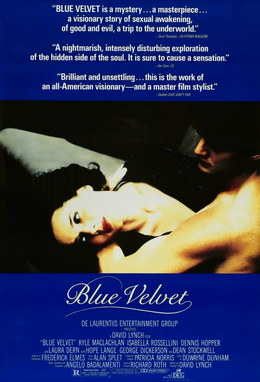
David Lynch’s 1986 Blue Velvet mixes psychological horror with classic noir. The title comes from the 1951 song. For adult viewers into BDSM, fetish, or adult film, it is a cult classic and a blunt set of sadism-and-voyeur prototypes. College student Jeffrey Beaumont comes back to Lumberton, North Carolina, for his sick father, finds a severed ear in a field, and follows that ear into a criminal underground centered on lounge singer Dorothy Vallens and the sadistic gangster Frank Booth.
The film’s core is a voyeur’s education. Jeffrey talks his way into Dorothy’s apartment as an exterminator and watches from the closet. When Frank walks in and beats and rapes her with a strong sadistic charge, Jeffrey sees it from the dark. Frank sucks gas from a canister and cycles between sobs and rage—one of mainstream cinema’s rawest portraits of sexual sadism. Dorothy and Jeffrey also start a sadomasochistic affair in which she asks him to hit her. That is not a side plot. It is Jeffrey learning to use force the way a Freudian reading casts the father owning the mother, and it is his slide from innocent watcher into participant.
Casting against type
The casting refuses thriller stereotypes. Dennis Hopper’s Frank is not a rented heavy; he is a nervous, bloody, controlling villain. The role gave Hopper a second career, and critics still treat the performance as classic. Isabella Rossellini’s Dorothy breaks the scream-queen mold. Known for cosmetics ads and for being Ingrid Bergman and Roberto Rossellini’s daughter, she plays fragile, sexual, and tough at once and got a dramatic part that was not a product contract. Kyle MacLachlan’s Jeffrey is the safe gaze—innocent enough that you trust him into the closet. Laura Dern’s Sandy is Jeffrey’s lover and the bridge between the two worlds.
Low budget, final cut
After Dune (1984) flopped, Lynch wanted something more personal and surreal. He cut a deal with Dino De Laurentiis’s independent De Laurentiis Entertainment Group: a $6 million budget—the smallest film on that slate—in exchange for full artistic freedom and final cut. The cheapness is part of why the movie feels handmade. The screenplay had circulated from the late 1970s into the early 1980s; major studios kept passing on the sex and violence. Principal photography ran August to November 1985 in Wilmington, North Carolina. Lynch shot in public; locals with picnic baskets watched until police barred the production from some public areas.
Rotten lawn and insect motif
Visually the film wears 1950s noir: period clothes, shadow photography, warped people. Under the tidy small-town smile is rot. Insects run through the picture: the opening lawn-mower idyll dives into bugs under the grass; ants work the severed ear; Frank’s gas mask looks like an insect face; Jeffrey’s first disguise is an exterminator; the Yellow Man’s jacket can read as a wasp; a robin eats a bug on a fence at the end. The ear is the portal into that nightmare canal. The film also lines up with Hitchcock’s Psycho: curiosity as the engine, an investigation that dumps the lead into a voyeur’s crime world.
Soundtrack as character
Angelo Badalamenti supervised the score. Vintage pop—Bobby Vinton’s “Blue Velvet,” Roy Orbison’s “In Dreams”—is not wallpaper; it is part of the characters. Lynch played Shostakovich’s 15th Symphony on set to lock the mood. Sound editor Alan Splet, an Oscar winner for The Black Stallion, mattered. At partner Ben’s place, Ben lip-syncs “In Dreams” and Frank cries; later at the sawmill yard Frank replays the song, smears lipstick, kisses Jeffrey, and beats him unconscious. Without Orbison those scenes are just beatings. The music gives the violence a psychological depth that makes Frank’s eruptions land.
Walkouts, critics, and the canon
Reviews split hard. Some viewers walked out over the explicit sexual violence; in Chicago a man fainted, had his pacemaker checked, and came back to finish the film. Janet Maslin in The New York Times praised the “sheer lack of inhibition.” Roger Ebert accused Lynch of misogyny for degrading, slapping, and humiliating Dorothy and said that if you ask that of an actress you owe her an important film. Over time the picture was reassessed. The AFI called it one of the ten greatest American mystery films and in 2008 ranked it eighth among American mysteries. Sight & Sound, Time, and others parked it on all-time lists. For kink readers, Frank’s gas-huffing rape of Dorothy and her asking Jeffrey to hit her remain mainstream cinema’s hard markers of sexual sadism and voyeur education. The 25th-anniversary Blu-ray restored deleted scenes. Blue Velvet locked Lynch’s look and set the tone for Twin Peaks and Mulholland Drive.