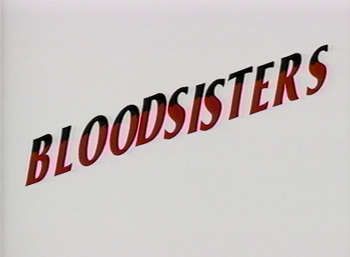
Michelle Handelman’s 1995 documentary BloodSisters: Leather, Dykes and Sadomasochism premiered in San Francisco. It records the mid-1990s lesbian leather and BDSM scene there. Unlike the freak-show inserts common in other documentaries of the time, the subjects are self-identified leatherdykes on camera, showing their own community. The three words in the full title—leather, dykes, sadomasochism—still read as scandal then, especially when lesbian SM was edged out inside and outside queer politics. Handelman had moved to San Francisco in 1986 and entered that world through Pat Califia and J.C. Collins. She already practiced S&M but did not yet know leather as a culture, so she aimed for a film that could work as historical document and teaching tool—something that would make outsiders take the scene seriously.
Vocab, marches, and a title pageant
The camera stays with women active in San Francisco’s mid-1990s BDSM world. It walks through S&M practices and terminology, then follows them to the 1993 March on Washington for Lesbian, Gay and Bi Equal Rights and Liberation, the San Francisco International Ms. Leather pageant, and the New York City Pride March. That cut—vocab lesson, street politics, title contest—is the point: these women are not only scene-internal; they show up in national queer public space in leather. The soundtrack uses Frightwig, Typhoon, Coil, Fred Giannelli, and Chris and Cosey.
NEA money, AFA clip reels, wrong sex scenes
Women Make Movies handled the first wave of distribution and was an NEA grantee. The film premiered June 10, 1995 at the San Francisco International Lesbian & Gay Film Festival and went on to more than 50 festivals in 11 countries. The American Family Association then used it in their push to kill NEA funding. For 1997 congressional hearings on the NEA, the AFA cut a reel of lesbian sex scenes from Women Make Movies titles, tagging footage to BloodSisters plus work by Barbara Hammer and Cheryl Dunye. Two facts undercut the smear. Women Make Movies had NEA money; the making of BloodSisters itself did not. And the sex scenes pinned on Handelman’s film were from Georgia B. Wright’s short Stellium in Capricorn, merely laid under interviews that actually belong to BloodSisters. Women Make Movies dropped the film from distribution. Water Bearer Films picked it up, then Reframe Collection under the Tribeca Film Institute. In 2020, for the 25th anniversary, it screened at Outfest, NewFest, and BFI Flare: London LGBT Film Festival. A restored version was slated for Kino Lorber release on July 29, 2021.
Hidden history, not a how-to
In 1998 the film won the Bravo Award at the Manchester Underground Film Festival. Critics largely stayed with it. Jane Ursula Harris in BOMB called it a “brave, complex, and unflinching look at a much-maligned subculture.” Steve Seid in the Pacific Film Archive Calendar wrote that the often humorous film “broadens the discussion about private expressions of eroticism, political implications and all.” The San Francisco International Film Festival said that by cutting between personal lives and political activity the film offers a smarter, less sensational view of a misunderstood community. Jennie Kermode at Eye for Film said there is not enough here for a newcomer’s BDSM guide, but what it delivers is hidden history—material of interest whether or not you share the subjects’ sexuality. Handelman wanted a historical document and a teaching tool; she got the mid-nineties leatherdyke record—Califia and Collins on camera, International Ms. Leather and the 1993 march in the cut, Coil on the track, and an AFA reel that tried to turn it into NEA porn until the distributor flinched and later restorers brought it back.