
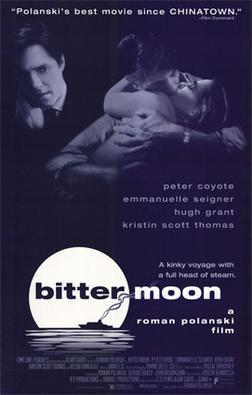
Bitter Moon is a 1992 erotic romantic thriller co-written and directed by Roman Polanski. Peter Coyote, Emmanuelle Seigner, Hugh Grant, and Kristin Scott Thomas star. The French title, Lunes de fiel, puns on "lune de miel"—honeymoon. The script comes from Pascal Bruckner’s novel Lunes de fiel, published in English as Evil Angels. Vangelis wrote the score. For kink viewers this is Polanski’s cruise-ship seminar in erotic power exchange gone septic: bondage, SM, voyeurism, public humiliation, a coerced abortion, a wheelchair reversal, a birthday gun, and a New Year’s party that ends in a double killing. It is not a consent manual. It is a hate-love loop told to a polite British couple who cannot stop listening. Coyote’s Oscar talks; Seigner’s Mimi acts; Grant’s Nigel leans in; Scott Thomas’s Fiona answers in kind. The Bruckner novel is the source, Vangelis is the unofficial score, and the honeymoon pun in the French title is the joke the marriage cannot survive.
Nigel and Fiona meet Oscar and Mimi
British couple Nigel and Fiona Dobson are on a Mediterranean cruise toward Istanbul, bound eventually for India. They notice a beautiful young French woman, Mimi. That night Nigel speaks with her briefly in the ship’s bar after watching her dance alone. Later he meets her much older, disabled American husband, Oscar Benton—a failed writer, acerbic, cynical, used up. Oscar invites Nigel to his cabin and, at length, tells how he and Mimi met on a Paris bus and fell into obsessive love. Nigel reports all of it to Fiona. Both are appalled by Oscar’s exhibitionism; Nigel is also hooked on Mimi, who keeps provoking him.
Oscar continues: they moved into bondage, sadomasochism, and voyeurism. As a tonal counterweight, Nigel and Fiona meet a distinguished Indian passenger, Mr Singh, traveling with his little daughter Amrita. Invited by Mimi, Nigel ducks out of a bridge game and goes to her cabin—only to find that she and Oscar have set him up. He wants to leave. Another session starts anyway. Oscar describes how love curdled into hate. Bored, he tried to end it. Mimi begged to stay on any terms. He let her, then began running sadistic fantasies at her expense and humiliating her in public. When she became pregnant he made her have an abortion, saying he would be a terrible father. Visiting her in hospital, shocked by her condition, he almost stopped trying to drive her out. He promised a Caribbean holiday, then got off the plane just before takeoff. Mimi left alone, crying.
Leaving Oscar’s cabin, Nigel meets Mimi and they kiss. He then finds Fiona in the bar flirting with a younger man. She warns him not to stray too far—anything he can do, she can do better. Nigel returns to Oscar, who keeps talking. After two years of parties and one-night stands, Oscar drunkenly stepped in front of a vehicle. To his surprise Mimi visited the hospital where he was recovering from minor injuries and a fractured femur. She shook his hand, then yanked him out of bed and left him hanging in the traction gear, paraplegic. He had no choice but to let her move back in and care for him. She enjoyed dominating and humiliating him, seducing other men in front of him. When he wanted to die, she gave him a gun for his birthday. After the highs and the wreckage they decided they needed each other and actually married.
Nigel tries clumsily to court Mimi, with Oscar coaching. It breaks at the New Year’s Eve party. Fiona catches them dancing, then tells Nigel that Oscar talked her into coming. She dances seductively with Mimi; they kiss, and the room cheers. A storm interrupts the party. The two women leave together. Nigel goes on deck with a bottle and screams into wind and waves. He finds Fiona in Oscar’s cabin, asleep naked beside Mimi. Oscar says the women have had sex. Nigel grabs his throat; Oscar points the gun; Nigel backs off. Oscar shoots the sleeping Mimi twice, then kills himself. As the bodies are stretchered off the ship, a shaken Nigel and Fiona hold each other. Mr Singh encourages his little girl to comfort them.
The unreleased Vangelis score and a split reception
Vangelis’s music was never officially issued. Bootlegs pulled from the film’s soundtrack have circulated since. The movie failed commercially in Europe in 1992 and in North America in 1994, and reviews were mixed. Derek Elley in Variety wrote that Polanski was approaching rock bottom, calling the film "a phony slice of huis clos drama" with a script all over the map and a tone that veers from outré comedy to erotic game-playing. Janet Maslin in The New York Times said that whatever else Polanski may be—nasty, mocking, darkly subversive—he is not dull, and that Bitter Moon is the kind of world-class, defiantly bad film that has a life of its own. Roger Ebert was warmer: Polanski directs without compromise or apology, and while critics may condescend, you could hear a pin drop in the theater. Time Out read it as a slightly protracted tale of erotic obsession treated partly as deeply ironic black comedy—rich, darkly disturbing, and wickedly entertaining. Revisiting it in 2009, Scott Tobias called it his favorite later-period Polanski: nasty, potent, and psychologically knotty in a way that recalls the devil-may-care, enfant terrible director of the early work. Journalist Matthew Tempest has written that he and filmmaker Christopher Nolan, as students, shared "a soft spot" for the film.
Rotten Tomatoes has 63% positive from 35 reviews, average 6.2/10. Metacritic gives 62 out of 100 from 28 critics—"generally favorable." Year-end lists that made room for it include Jonathan Rosenbaum at the Chicago Reader (5th), David Elliott at The San Diego Union-Tribune (7th), Matt Zoller Seitz at the Dallas Observer (top ten, alphabetical, unranked), and an honorable mention from Howie Movshovitz at The Denver Post. For BDSMWild readers, Bitter Moon is the cruise-ship power-exchange tragedy: Paris bus to bondage and voyeurism, public humiliation, abortion as control, the traction-frame revenge that puts Mimi on top, a birthday pistol, a New Year’s kiss, and two corpses leaving the ship while the English couple cling to each other. It is fiction about SM as mutual destruction, not a how-to—and it still holds a room because Polanski refuses to blink. Europe got the film in 1992; North America waited until 1994; both markets shrugged commercially while critics split between Elley’s "rock bottom" and Ebert’s pin-drop defense. Later champions—Tobias in 2009, Nolan and Tempest as students, Rosenbaum’s year-end fifth—treated it as late Polanski that still had teeth. For this site the usable core is the power-exchange plot, not the auteur gossip: a couple who climb from Paris-bus lust into bondage and SM, then into humiliation, medical control, paralysis, and a shared need so ugly they marry it, then shoot it dead on a boat while two tourists watch.