
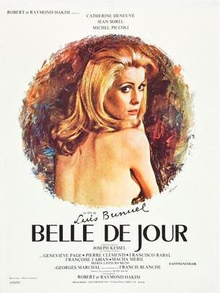
Belle de Jour (1967) is Luis Buñuel’s surrealist erotic psychological drama about a bourgeois housewife who works weekday afternoons in a high-class brothel while her husband is at the office. Catherine Deneuve plays Séverine; the screenplay is Buñuel with Jean-Claude Carrière, from Joseph Kessel’s 1928 novel. Jean Sorel is the husband, Michel Piccoli the predatory friend. For kink viewers the film is not a how-to of negotiated SM—it is a cold, dream-logic study of a woman whose real sex life is domination, sadomasochism, and bondage fantasy, and whose “day job” as a whore is the only place those fantasies get a body. It remains one of Buñuel’s most famous films and Deneuve’s second major triumph after The Umbrellas of Cherbourg.
Title, Cast, and the Daytime Alias
The title puns on belle de nuit—“beauty of the night,” French slang for a prostitute—because Séverine works in daylight under the alias Belle de Jour. The same phrase is the French name for the morning glory (Convolvulaceae), a flower that opens only by day: “beauty of the day.” Supporting players include Geneviève Page, Francisco Rabal, Pierre Clémenti, Francis Blanche, and Georges Marchal. The film won the Golden Lion and the Pasinetti Award for Best Film at the 1967 Venice Film Festival. Deneuve was nominated for the BAFTA Award for Best Actress in a Leading Role.
Plot: Frigidity at Home, a Firm Hand at 11 Cité Jean de Saumur
Séverine Serizy is young, beautiful, and unable to share physical intimacy with her husband, Dr. Pierre Serizy, even though they love each other. Her sexual life is confined to elaborate fantasies of domination, sadomasochism, and bondage. Pierre is frustrated by her frigidity toward him and still respects her wishes. On a ski trip they meet two friends, Henri Husson and Renée. Séverine dislikes Husson’s manner and the way he looks at her. Back in Paris she learns from Renée that a mutual friend, Henriette, now works in a brothel. Roses arrive from Husson and unsettle her. At the tennis courts Husson talks houses of pleasure and names a high-class brothel at 11 Cité Jean de Saumur. He also confesses desire; she rejects him.
Haunted by childhood memories—including one of a man who appears to touch her inappropriately—Séverine goes to the house. Madame Anaïs runs it and names her Belle de Jour. That afternoon she takes her first client. Reluctant at first, she answers Madame Anaïs’s “firm hand” and has sex with the stranger. After a week away she returns and works from two to five, then goes home to an unsuspecting husband. Husson calls at the apartment; she refuses to see him, then fantasizes about sex with him in Pierre’s presence. At the same time her physical life with Pierre improves and she begins to have sex with him.
She becomes involved with a young criminal, Marcel, who offers the charge her fantasies demand. Husson then visits the brothel, discovers her, and agrees not to tell Pierre—while rejecting her services because he is no longer attracted to her. She leaves the house with Madame Anaïs’s blessing; the madam believes Marcel’s jealousy and demands are the reason. An associate follows Séverine home. Marcel appears, threatens to expose her, and leaves calling Pierre “the obstacle.” He waits downstairs, shoots Pierre three times, flees, and is shot dead by police. Pierre survives in a coma. Police find no motive. Later Séverine nurses a paralysed, blind husband in a wheelchair. Husson visits to tell him the truth; she does not stop him. After he leaves she finds Pierre crying. In an ending that may be another fantasy, Pierre rises from the chair, pours a drink, and talks holiday plans with her.
Making the Film: Brothel Research, an Unwilling Star, Saint Laurent Clothes
In 1966 the Hakim brothers, Robert and Raymond—Egyptian-French producers who specialized in sexy films by star directors—offered Buñuel Kessel’s novel, a book about an affluent young woman leading a double life as a prostitute that had scandalized readers on first publication in 1928. Buñuel did not like the book. He called it “a bit of a soap opera,” then took the job because he wanted to turn something he disliked into something he did. He and Carrière interviewed women in Madrid brothels about their sexual fantasies. He was also unhappy with twenty-two-year-old Deneuve in the lead, feeling the Hakims and Deneuve’s then-lover François Truffaut had foisted her on him. Actress and director found the shoot difficult. Deneuve later said they showed more of her than they had promised and that she felt “totally used.” Buñuel mocked her prudery on set. Principal photography ran from 10 October to 12 December 1966.
Much of Deneuve’s wardrobe was designed by Yves Saint Laurent and Roger Vivier. Locations included 1 Place Albin-Cachot (Paris 13), 79 Champs-Élysées, the Chalet de la Grande Cascade in the Bois de Boulogne, the Champs-Élysées itself, and Rue de Messine in the 8th arrondissement as the Serizy home.
Reception, Awards, Sequel, and the Call-Girl Alias
On Rotten Tomatoes the film holds a 95% approval rating from 60 reviews, average 8.6/10; the critics’ consensus calls it radiantly filmed and resistant to easy interpretation. Roger Ebert gave it four stars and put it on his Great Movies list. In 2010 Empire ranked it No. 56 among the 100 Best Films of World Cinema. Martin Scorsese promoted a 1995 limited American re-release and a 2002 DVD. The 2006 Portuguese film Belle Toujours, directed by Manoel de Oliveira, is a sequel set thirty years later: another encounter between Séverine and Henri. Michel Piccoli returned as Henri; Bulle Ogier replaced Deneuve as Séverine.
Former London escort Brooke Magnanti used “Belle de Jour” as the alias and pen name for her 2005 book The Intimate Adventures of a London Call Girl, later adapted as the 2007 series Secret Diary of a Call Girl with Billie Piper. The nickname stuck because Buñuel’s film had already taught a mass audience that a respectable woman might keep a second, paid, daytime erotic life—and that the interesting part might be the fantasy architecture, not the money.
Why the Film Still Belongs on a Kink Shelf
Kessel’s novel was already a scandal in 1928: a well-off young wife with a second life as a prostitute. Buñuel and Carrière kept that double timetable and then did what the novel could not—they put the SM fantasies on screen as if they were as real as the brothel sofa. Séverine’s body is available to Pierre in theory and unavailable in practice. The “firm hand” of Madame Anaïs is the first actual dominance she accepts. Marcel is the first partner whose danger matches the daydreams of bondage and humiliation. Husson is the man who wants her, is refused, then holds the secret that can destroy the marriage. The wheelchair ending—cure, punishment, or another fantasy—refuses the tidy moral that a wife who whores must be ruined or redeemed. Deneuve’s second big success after The Umbrellas of Cherbourg is also one of the most widely seen European films in which a woman’s erotic life is organized around being named, scheduled, and used.
Production details sharpen the kink reading rather than decorating it. The Hakims hired a surrealist to sex up a book he thought was soap opera; he and Carrière went into Madrid brothels and asked working women what they fantasized. The twenty-two-year-old star felt overexposed; the director mocked her prudery; Yves Saint Laurent and Roger Vivier dressed the housewife so the clothes would argue with the afternoons at Cité Jean de Saumur. Principal photography was only two months, 10 October to 12 December 1966. Venice answered with a Golden Lion. Ebert later put the film on his Great Movies list; Empire slotted it at 56 in a world-cinema hundred. Scorsese walked it back into American theaters in 1995 and onto DVD in 2002. Oliveira’s 2006 sequel, with Piccoli returning and Bulle Ogier in Deneuve’s role, treats the Henri–Séverine knot as unfinished business thirty years on.
The plot’s kink architecture is worth restating in order, because the film’s famous “ambiguity” is built on a very clear sequence of power. Séverine cannot share a bed with Pierre; she can be sent into a fantasy of domination, SM, and bondage. Husson names the house and is refused. Childhood memory—an inappropriate adult touch—pushes her through the door. Madame Anaïs names her and applies a firm hand. Hours are two to five. Marcel supplies criminal voltage. Husson finds her, loses interest, keeps the secret until the wheelchair. Marcel shoots the husband three times and dies in the street. Pierre lives, blind and paralysed, until the last shot lets him stand. Cast around Deneuve: Sorel as Pierre, Piccoli as Husson, Page as the madam, plus Rabal, Clémenti, Blanche, and Marchal. Title pun: belle de nuit versus morning glory, a flower that only opens by day. That is the whole machine.
For BDSM viewers the usable core is Séverine’s inner cinema: she cannot fuck the husband she loves, but she can be named, scheduled, and handled by a madam, then pulled toward a criminal who matches the violence of the daydreams. The brothel is a workplace with hours; the fantasies are the actual kink content. Buñuel never resolves whether the ending is cure, denial, or another scene in her head. That refusal is why the film still plays as erotic rather than as a morality play about a fallen wife. Watch it for the afternoon alias, the madam’s hand, the roses that feel like a threat, and the last shot that will not tell you whether Pierre can walk.