
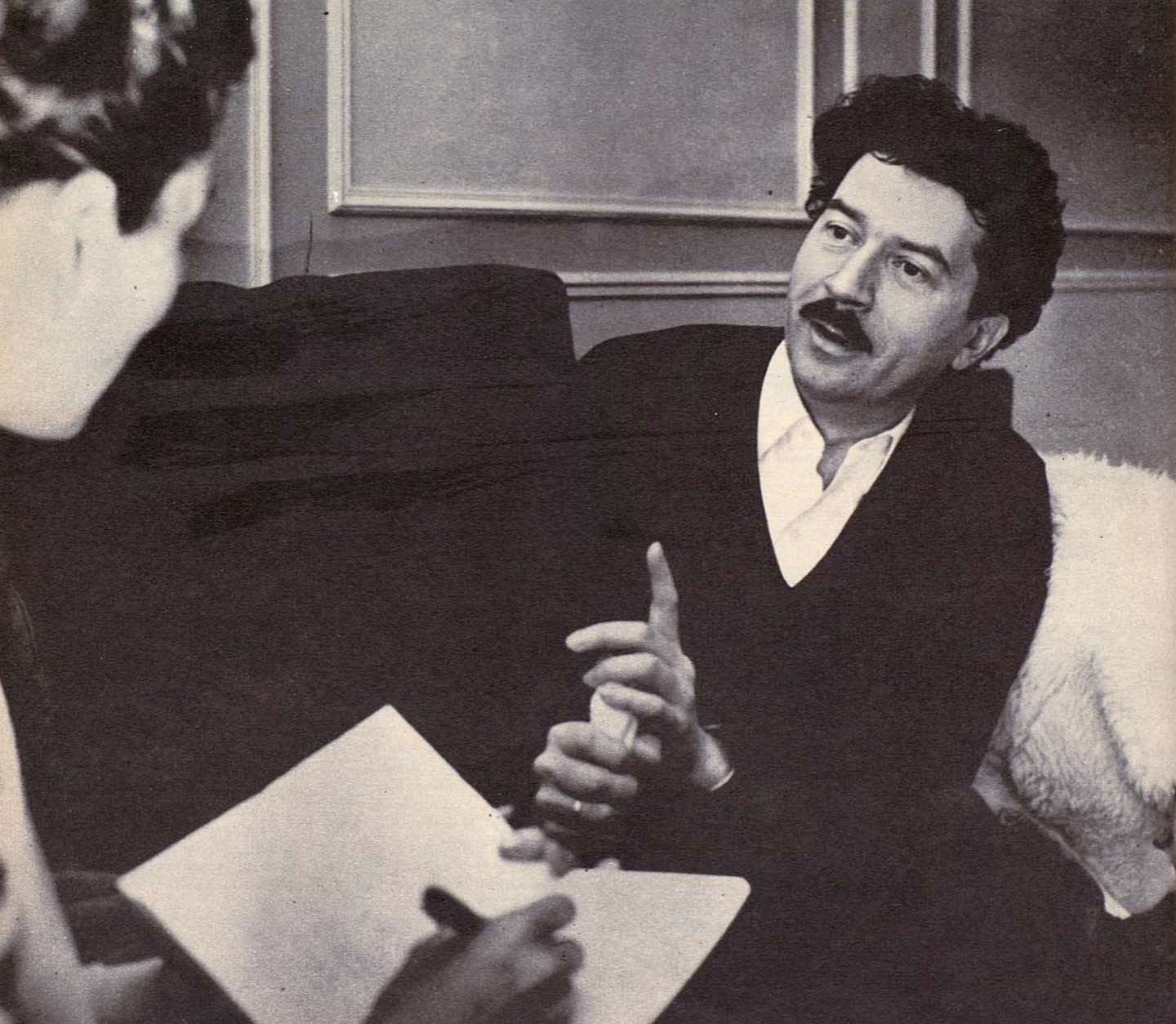
Alain Robbe-Grillet (1922–2008) helped invent the Nouveau Roman and then spent the rest of his career putting voyeurism, the body as text, and — by the last film — explicit sadism and bondage on screen. For kink readers he is not a footnote who once used the word “whip.” He is the high-art novelist-director whose erotic work kept returning to looking, tying, and hurting, and who made that preoccupation unmistakable in Gradiva (2006).
From agricultural engineer to cold observer
Robbe-Grillet was born in Brest, in Finistère, into a family of engineers and scientists. He trained as an agricultural engineer and took his diploma at the National Institute of Agronomy in 1945. That training left him with a measuring eye: methodical, geometric descriptions of objects instead of the psychology older novels would have stated outright. During 1943 and 1944 he did compulsory labor in Nuremberg as a machinist; he later described the first months as something like a holiday, with time for theatre and opera between rudimentary machine training. Agronomist work then sent him to Martinique, French Guiana, Guadeloupe, and Morocco — the colonial itinerary that sits under the banana-plantation geometry of La Jalousie.
The public life was institutional as much as literary. He was a literary advisor at Les Éditions de Minuit for thirty years and taught his own novels at New York University from 1971 to 1995. On 25 March 2004 the Académie française elected him to seat No. 32, succeeding Maurice Rheims. He was never formally received: he refused to submit a welcome speech in advance, preferring to improvise, and he refused the green tails and sabre as outdated. The quarrel over procedure left him elected and unreceived.
Absent crime and jealousy as architecture
His novels are known for a “theory of pure surface.” In The Erasers (Les Gommes, 1953) a detective hunts an assassin for a murder that has not yet happened; timelines crack and the plot fractures like a cubist painting different readers assemble differently. In The Voyeur (Le Voyeur, 1955) traveling watch salesman Mathias returns to the island of his youth. A newspaper clipping about a young girl’s body among the seaside rocks keeps returning. Whether Mathias killed her or only fantasizes the killing is never settled. The opening line sets the temperature: “It was as if no one had heard.” The uncertainty is about looking as much as about crime — the reader is placed as voyeur and never allowed to know whether the looker is the killer.
La Jalousie (1957) pushes that gaze further. Set on a banana plantation, it is built around an absent third-person narrator: a jealous husband who never names himself, implied by the number of place settings or deck chairs, watching his wife (only “A…”) and a neighbor, Franck. He replays observations and invented scenes until the reader cannot tell which moments were seen and which were suspected. The French title also means Venetian or Persian blinds — the horizontal shutters the husband looks through, the world mutating slightly each time. Jealousy as architecture: that is the novel. Pushing interior feeling out onto furniture and objects is the Robbe-Grillet signature.
Film: the body staged as text
In 1961 he wrote the script for Alain Resnais’s Last Year at Marienbad, which won the Golden Lion and was nominated for the Academy Award for Writing Original Screenplay — the Nouveau Roman moved onto film. He then became writer-director of cerebral, often sexually provocative features that carried the same themes as the books: voyeurism, the double, the body as text.
L’Immortelle (The Immortal One, 1962) won the Louis Delluc Prize. The most commercially successful film after Marienbad was Trans-Europ-Express (1966), starring Jean-Louis Trintignant, who then worked with him on the next four pictures: The Man Who Lies (1968), Eden and After (1970), Progressive Slidings towards Pleasure (1974), and Playing with Fire (1975). Those titles already tell a kink reader where the camera is going — from lost Eden to pleasure sliding across the body’s surface to a dangerous game with fire.
In the mid-1970s erotic ritual and accusation slide into each other in Progressive Slidings towards Pleasure, with Anicée Alvina, Olga Georges-Picot, and others; Bob Wade edited, Roger Boublil produced. La belle captive (The Beautiful Captive, 1983), shot with cinematographer Henri Alekan and a cast including Daniel Mesguich and Gabrielle Lazure, pushed captivity and the gaze further. Un bruit qui rend fou (The Blue Villa, 1995) set a mystery thriller on a small Greek island with Fred Ward and Arielle Dombasle.
Late work: sadism and bondage on the last reel
Before his death he directed Gradiva (C’est Gradiva qui vous appelle, 2006), with James Wilby, Arielle Dombasle, and Dany Verissimo. That last picture brought sadism and bondage back to the foreground. For a BDSM readership this title should not be buried under the Académie anecdote. The high-modernist who described blinds and banana trees had, by the end, put sadism and bondage where a general audience could not pretend they were only formal devices. The thesis is plain: this body of work was always, among other things, about domination, looking, and the bound body.
He published several of the films as ciné-novels at Minuit: Last Year at Marienbad (1960), L’Immortelle (1963), Progressive Slidings towards Pleasure (1974), and Gradiva (2002). Page and reel were the same project in different formats. In 1975 he and René Magritte published La Belle Captive, prose interspersed with seventy-seven Magritte paintings. In 1977 he collaborated with Irina Ionesco on Temple aux miroirs. In 1981, with Yvone Lenard, he issued Le Rendez-vous in the United States as an intermediate French textbook; the same text, stripped of the exercises, appeared in France a month later as Djinn — even the language-class novel is a double.
The standard literary summary stops at Nouveau Roman, Marienbad, and the refusal of the green coat. That is incomplete. Robbe-Grillet built a career on surfaces that hide a crime, a jealous watch, a girl’s body among rocks, a wife seen through blinds, a captive, a sliding toward pleasure, a game with fire, and finally a film that will not let you miss the sadism and the bondage. Read The Voyeur and La Jalousie for the method that later becomes a camera. Watch Marienbad and Trans-Europ-Express for the public titles. Watch Progressive Slidings towards Pleasure, Playing with Fire, La belle captive, and Gradiva for the erotic line this site is here to name. The interviews in The Erotic Dream Machine and the film chapter in Immoral Tales treat that line as central, not as a late embarrassment. In his hands the Nouveau Roman was also a theory of the gaze that binds.


![[Art Video] 1507 Amateur Girl Shy Training Raped Classmate Ayumi Watase, Keiko Harada](https://bdsmwild.com/wp-content/uploads/2026/08/Art-Video-1507.jpg)